Visualizzazione post con etichetta Sita. Mostra tutti i post

sabato 19 ottobre 2013

Do not cross Lakshmana Rekha

In India there is a saying that is related to the Lakshmana rekha, the line of Lakshmana. It says "careful not to exceed the Lakshmana rekha ", "this marks the Lakshmana rekha ", etc .
In practice this is an insurmountable limit or, however, a limit which, if crossed , it will accrue serious consequences.
This saying comes from an episode from the Ramayana, the great Indian epic. It is a crucial moment of the poem or the kidnapping of Sita, wife of Rama, by the demon Ravana, King of Lanka, who wanted revenge against Rama who had defeated and disfigured his sister Surpanakha.
Rama and Lakshmana
Things went more or less like this .

Ravana decided to kidnap Sita, Rama's beloved wife, and to do this asked for help of the demon-hermit Marica. Despite Marica put on guard Ravana, the King of Lanka was inflexible and concocted a diabolical plan.
At that time, Rama and Sita were in exile in the forest along with Lakshmana, Rama's faithful brother.
Marica - thanks to his demonic powers - turned into a beautiful deer, with a golden cloak. The animal began to wander in the forest.
When Sita saw that beautiful animal said to her husband:
"Look how beautiful it is that deer, I'd like to capture it to keep it, if you can not take it alive , kill it, I would love to have his golden cloak."
Lakshmana was not convinced, that deer was too beautiful and too different from the other deer and tried to dissuade Rama .
But every desire of Sita to Rama was an order and he went in pursuit of the deer, leaving Lakshmana to protect Sita.
The deer-Marica took Rama as far as possible. When Rama was able to reach the animal, he shot an arrow that struck at the heart of the deer. The animal immediately changed its appearance and showed itself for what he was, Marica. The demon fell to the ground and, before dying, imitating the voice of Rama, he cried:
" Lakshmana , Sita help me!"
Rama realized that it was a deception and rushed to the hut, but it was too far away.
Sita, hearing the lament from the forest, prayed Lakshmana to rush to the rescue of his brother, but Lakshmana he refused .
"It was not Rama to to cry - he said - Rama is so powerful that he can not be in need of someone, it is a deception."
"If you do not go to the aid of Rama I'll kill myself ." Lakshmana could not do anything but go in search of his brother. Before leaving, did recommended for Sita not to exceed  the line that had done around the hut, the Lakshmana Rekha, the line of Lakshmana. If she had stayed inside that circle would not in any danger, because anyone who had crossed that line to approach Sita would have been charred by the flames.
Cleared the field of Rama and Lakshmana, Ravana, transformed into wandering ascetic, went to the hut of Sita and asked her for food and water.
To honor the sacred duties of hospitality, Sita came to the hermit, crossing the Lakshmana rekha, Ravana captured her and took her to his kingdom in Lanka.

Then: " careful to overcome the Lakshmana rekha !

Non superare la Lakshmana rekha

Rama e Lakshmana
In India c'è un modo di dire che è legato alla Lakshmana rekha, la linea di Lakshmana. Si dice "attento a non superare la Lakshmana rekha", "questo punto segna la Lakshmana rekha", etc.
In pratica si tratta di un limite invalicabile o, comunque, di un limite che, se valicato,  ne deriveranno gravi conseguenze.
Il tutto nasce da un episodio del Ramayana, il grande poema epico indiana. Si tratta di un momento cruciale del poema ossia il rapimento di Sita, moglie di Rama, da parte del demone Ravana, Re di Lanka, che voleva vendicarsi contro Rama che aveva sconfitto e sfigurato la sorella Surpanakha, anch'essa una demonessa.
Le cose andarono più o meno così.

Ravana decise di rapire Sita, la persona più amata da Rama e per far questo chiese l'aiuto del demone-eremita Marica. Nonostante Marica mettesse in guardia Ravana, il Re di Lanka fu irremovibile ed architettò un piano diabolico.
In quel periodo Rama e Sita erano nella foresta in esilio insieme a Lakshmana, fedele fratello di Rama.
Marica - grazie ai suoi poteri demoniaci - si trasformò in un cervo dalle sembianze bellissime, il suo mantello sembrava d'oro. L'animale cominciò ad aggirarsi nella foresta.
Quando Sita vidi quel bellissimo animale disse al marito e al cognato:
"Guardate come è bello quel cervo, catturatelo mi piacerebbe tenerlo, se non riuscite a catturarlo vivo, uccidetelo, mi piacerebbe tanto avere il suo mantello dorato."
Lakshmana non era convinto, quel cervo era troppo bello e troppo diverso dagli altri cervi e cercò di dissuadere Rama.
Ma ogni desiderio di Sita per Rama era un ordine e si lanciò all'inseguimento del cervo, lasciando Lakshmana a proteggere Sita. 
Il cervo-Marica portò Rama il più lontano possibile. Quando Rama riuscì a raggiungere l'animale, scoccò una freccia che colpì al cuore il cervo. Immediatamente l'animale cambiò sembianze e si mostrò per quello che era, Marica. Il demone cadde al suolo e, prima di morire, imitando la voce di Rama, gridò:
"Lakshmana, Sita aiuto!"
Rama capì che si trattava di un inganno e si precipitò verso la capanna, ma ormai era troppo distante.
Sita, sentendo il lamento proveniente dalla foresta, pregò Lakshmana di correre in soccorso del fratello, ma Lakshmana si rifiutò. 
"Non può essere stato Rama a gridare - disse - Rama è così potente che non può avere bisogno di qualcuno, è un inganno."
"Se non vai in aiuto di Rama mi ucciderò." Sita era irremovibile e Lakshmana non potè fare altro che andare alla ricerca del fratello. prima di partire si raccomandò con Sita affinchè non superasse la linea che aveva fatto intorno alla capanna, la Lakshmana Rekha, la linea di Lakshmana. Se fosse rimasta dentro quel cerchio non avrebbe corso alcun pericolo, perchè chiunque avesse oltrepassato quella linea per avvicinarsi a Sita sarebbe stato carbonizzato dalle fiamme.
Sgombrato il campo da Rama e Lakshmana, Ravana, trasformatosi in asceta itinerante, si recò alla capanna di Sita e chiese del cibo e dell'acqua.
Per onorare i sacri doveri di ospitalità, Sita si avvicinò all'eremita, oltrepassando la Lakshamana rekha, Ravana la catturò e la portò nel suo regno a Lanka.

Quindi: "attenti a superare la Lakshmana rekha!


sabato 7 gennaio 2012

Hanuman lifts Mount Dronagiri

Shri Hanuman
The dead and wounded warriors of the Rama’s army were million. Indrajit - powerful rakshasa - had used the deadly weapon provided to him by Brahma. The outcome of the war seemed to be compromised for the army of the Prince of Ayodhya and seventh avatar of Vishnu.
Yet the day before fortune seemed to be propitious to Rama. With the help of the monkeys Sugriva and Hanuman, he had found the prison where the demon Ravana kept locked up his wife Sita.
Yes, absolutely, the powerful rakshasa Ravana – in love for the breathtaking beauty of Sita - had kidnapped the wife of Lord Rama and had taken into his kingdom of Lanka and Ramayana tells that just in Lanka there was one of the bloodiest wars the history of mankind.
In short, Rama was in serious trouble, his army was decimated and the war almost lost. What to do?
Jambavan, a wise man, spoke and said: "On the highest and most inaccessible peaks of the Himalayas, on Dronagiri, there are magical plants that restores life to the dead, healing the wounds, which invigorate the body and that strengthen the bones. Bring those plants and I will restore our military force. "
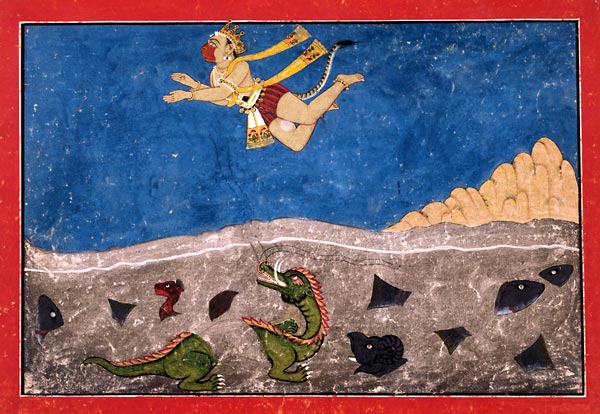
Who could go very quickly from Lanka to Himalayas, who was traveling throughout India and return with the miraculous medicinal herbs? Only Hanuman, the son of Vayu, the God of the wind. And so he did. With three steps (and after many adventures), the monkey god reached the heights of Dronagiri and here, not being able to find those herbs, picked up the entire mountain and with three steps, returned to the battlefield with his precious cargo. 
Some wounded soldiers were re-established only by scent of miraculous herbs, for others injured Jambavan prepared ointments, infusions and other medications. The wounded soldiers healed, the killed soldiers were raised, the battle could go on and Rama could free Sita.
The Ramayana tells us that Hanuman then put the mountain in its place, in fact, still looking at this impressive mountains of the Himalayas it seems that a part is missing. According to the inhabitants of the place it is just the piece that Hanuman took to Lanka to heal his companions.

Hanuman sposta il monte Dronagiri

Hanuman vola veloce come il vento

I morti ed i feriti dell’esercito di Rama erano milioni. Indrajit – potentissimo rakshasa – aveva iniziato ad utilizzare la micidiale arma fornitagli da Brahma. Le sorti della battaglia sembravano compromesse per l’esercito del Principe di Ayodhya e settimo avatar di Vishnu
Eppure il giorno prima la fortuna sembrava arridere a Rama. Con l’aiuto delle scimmie Sugriva e Hanuman, aveva rintracciato la prigione dove il demone Ravana teneva rinchiusa la sua sposa Sita
Sì, proprio così, il potente rakshasa Ravana – invaghitosi della stupefacente bellezza di Sita – aveva rapito la moglie del dio Rama e l’aveva portata nel suo regno di Lanka e proprio a Lanka il Ramayana ci racconta come si svolse una delle più sanguinose guerre della storia dell’umanità. 
Le cose insomma si erano messe male per Rama, il suo esercito era decimato e la guerra praticamente persa. Che fare? 
Il saggio Jambavan prese la parola e disse: “Sulle più alte ed inaccessibili vette dell’Himalaya, sul monte Dronagiri, esistono piante magiche che ridanno la vita ai morti, che guariscono le ferite, che rinvigoriscono i corpi e che rinsaldano le ossa. Portatemi quelle piante ed io ridarò vigore al nostro esercito.” 
Chi poteva andare velocemente da Lanka fin sull’Himalaya, chi poteva percorre tutta l’India e tornare con le piante miracolose? Solo Hanuman, il figlio di Vayu, dio del vento. E così fu. Con tre passi (e dopo molte peripezie) il dio scimmia raggiunse le vette del Dronagiri e qui, non essendo in grado di individuare con precisione le piante, staccò l’intera montagna e, con altri tre passi, tornò sul campo di battaglia col suo prezioso carico. 
Alcuni feriti si ristabilirono al solo profumo delle piante miracolose, per gli altri Jambavan preparò pomate, decotti e altri medicamenti. I feriti guarirono, i morti risuscitarono, la battaglia potè continuare e Rama riuscì a liberare Sita. 
Il Ramayana ci racconta che Hanuman poi rimise la montagna al suo posto, in realtà ancor oggi guardando questa imponente montagna dell’Himalaya sembra che ne manchi un pezzo. Secondo gli abitanti dei luoghi è proprio il pezzo che Hanuman portò a Lanka per guarire i suoi compagni.

giovedì 30 giugno 2011

Sita, Rama's wife

She was faithful to her husband, but she, prisoner, had lived with another man. It was not good. And Rama, Lord of Ayodhya, tell to his beloved wife that the war against Ravana, the millions of deaths, the mythical bridge linking India to Sri Lanka, none of all this had been done for her, but to restore the order, the dharma. "I cannot live with you who lived so long with another man."
Rama and Sita, the couple shown as exemple of the perfect wedding even today in India, of what must be the relationship between husband and wife and that speaks volumes about the status of women in the Indian continent.
Sita was stunned, outraged that they doubted her loyalty, "light a fire - she ordered - if I have been faithful to Rama, though I have always respected, if any other man has touched me, Agni, the god of fire, protect me. Otherwise, I burn! " And she threw herself into the flames.
Agni protected her, held her and brought her to Rama, saying, "This woman is pure and have always been faithful."
She was the goddess Lakshmi, who, like Sita, she became the wife of Rama, seventh avatar of Vishnu and hero of the Ramayana epic. Her father found her in a furrow of earth and so called Sita. He married the Prince of Ayodhya, but she was kidnapped by the demon Ravana who took her to Lanka. Rama, with the help of monkeys Sugriva and Hanuman, rescued his wife.
The couple and Rama's army returned to Ayodhya, they lived happily, but the people whispered again. "She lived for more than a year with another man, she cannot live with our King." It was not good that she lived with the example of dharma, righteousness, of what is good, of the rules that make turn the universe.
This time Rama, although his wife was pregnant, forsed Sita to leave the kingdom. She will go in the forest near the hermitage of Valmiki, where the two sons of Rama born: Lava and Kusa.
Rama knew Kusa and Lava when they had children. Once he had kwown them, Rama wanted to return Sita to Ayodhya too.
The queen again declared her loyalty to Rama and her own purity and, before the assembly convened to receive her, said: "If in my mind I had no other man that Rama, if I was always faithful to my husband, you mother, earth, where I was born, give me the grace to get my body."
Having said that the earth opened and revealed a royal throne, where Sita sat before disappearing into the earth closed over her.
In a furrow she was born, in a furrow she returned.

Sita, la moglie di Rama

La prova del fuoco di Sita
Era rimasta fedele a suo marito, ma era vissuta prigioniera presso un altro uomo. Non era bene. E Rama, signore di Ayodhya, dichiara all’amata moglie che la battaglia contro Ravana, i milioni di morti, il mitico ponte che unisce la punta d’India a Sri Lanka,  tutto ciò non era stato compiuto per lei, ma per ristabilire l’ordine, il dharma. “Non posso più vivere con te che hai vissuto così a lungo con un altro uomo.”
Rama e Sita, la coppia modello portata ancora oggi ad esempio in India di matrimonio perfetto, di quello che deve essere il rapporto tra marito e moglie e che la dice lunga sulla condizione femminile nel continente indiano.
Sita rimase attonita, sdegnata che si dubitasse della sua fedeltà, “accendete un rogo – ordinò – se sono stata fedele a Rama, se sempre l’ho rispettato, se mai altro uomo mi ha toccato, Agni, il dio del fuoco, mi proteggerà, altrimenti, che io bruci!” E si gettò nelle fiamme.
Agni la protesse, la sorresse e la condusse da Rama dicendo “Questa donna è pura e ti è sempre stata fedele.”
Era la dea Lakshmi che, come Sita, divenne moglie di Rama, settimo avatar di Vishnu ed eroe dell’epica del Ramayana. Suo padre la trovò in un solco di terra e per questo la chiamò Sita. Si sposò col principe di Ayodhya, ma venne rapita dal demone Ravana che la condusse a Lanka. Rama, con l’aiuto delle scimmie Sugriva e Hanuman, liberò sua moglie.
La coppia e l’esercito di Rama tornarono ad Ayodhya e vissero felicemente, ma la gente mormorava ancora. “Ha vissuto per più di un anno con un altro uomo, non è bene che stia col nostro re.” Non era bene che vivesse con il campione del dharma, della rettitudine, di ciò che è bene, delle regole che fanno girare l’universo.
Questa volta Rama, nonostante la moglie sia incinta, la obbliga ad andarsene dal regno. Andrà nella foresta presso l’eremo di Valmiki dove partorirà i due figli di Rama, Kusa e Lava.
Rama seppe di Kusa e di Lava quando erano già fanciulli e, conosciutili, volle che tornasse ad Ayodhya anche Sita.
La regina dichiarò nuovamente la propria fedeltà a Rama e la propria purezza e, di fronte all’assemblea convocata per riceverla, disse: “Se nella mia mente non ho avuto altro uomo che Rama, se sono stata sempre fedele al mio sposo,  tu madre terra da cui sono nata fammi la grazia di riprendere il mio corpo.”
Detto questo la terra si aprì e ne emerse un trono regale dove Sita si assise prima di scomparire nella terra che si richiuse sopra di lei.
Dal solco della terra era nata, nel solco della terra ritornò.