|
| Suttee |
What did Roop Kanwar, 18 years, think when she took the dead husband's head in her arms and laid on his funeral pyre? What did she feel when, after three ritual laps around the corpse, her brother in law set fire to the pyre on which she, alive, and her husband, dead, were lying? How did she suffer when the smoke of the pyre surrounded her and the flames have seized up to burn her alive?
It is anugamana (which in Sanskrit means ‘to follow’) or sahamarana (in Sanskrit saha = together, marana = death), universally known as 'sati' o suttee (in Sanskrit 'fidelity') and it’s the name of the first wife of Shiva self-immolated by burning because she was offended for insulting his father Daksha did to the divine spouse.
It’s a practice banned in India since 1839 and now quite rare, but we have news of this ritual from more or less remote villages of the subcontinent (especially in Rajasthan and Bengal) even today. And who knows how many we have no news.
Unbelievably in India – where there are many movements against sati and in favor of women - among the general population and among intellectuals and religious men there is still hesitation in condemning without appeal this ritual (see here and here).
The last case of 'sati' was recognized officially on 2008, when a woman 75 years old has been thrown on the pyre of her dead husband (80 years) in the state of Chattisgarh. Previously ‘sati’ were on 1973, 1978, 1987, 1988, 2002 and, two cases, on 2006.
The practice is/was generally voluntary, but in many cases there was a physical or psychological coercion against the woman to force or 'persuade' her to self-immolation (see here).
The case of Roop Kanvar, for example, created a sensation because according to many it was unthinkable that on 1987 a girl of 18 years with a high level of education voluntarily followed her dead husband in the flames facing a painful death.
In the past, statements were not only cases where the wife was even tied to the funeral pyre, but also cases where she had been drugged with bhang or opium to wear out the strength and will.
The rite of sati is not found in the Vedas - the main sacred texts of Hinduism – where it provides for the widow marriage with her husband's brother or other close relatives. We find, however, a nod, you do not know what period dating, which is reminiscent of that custom in Atharva Veda where we read that "every good woman is burned with the corpse of her husband."
The sati in Ramayana and Mahabharata appear to be added later too.
The scholars mostly believe that the origin of the shameful practice - founded in the seventh century BC and widespread, especially but not only, between the upper caste of Brahmins - is a direct consequence of the division of castes, endogamy and obligations. The sati is in fact closely related to other phenomena as child marriage with older men as prohibition on remarriage and other social restrictions for widows.
The husband for the Indian woman is like a God, the wife must serve and worship him, she must follow him in life and precede him in the death. Consequently, a wife without a husband, without her God, has no reason to exist and she could become a problem for the rigid caste concept. A widow in fact could hardly find another husband in India among people of the same caste and therefore she could be brought to marry men of different caste, violating the primary rule that prohibits caste mobility between castes.
In fact the condition of the widow in indian traditional villages and sometimes even today, is particularly difficult, at best the woman remained to serve in her husband's family, she had to sleep on the floor and could eat only foods that are not seasoned.
Often widows are still sent to convents or shelters where, shaved and dressed in white (the color of mourning in India), to spend their time praying in temples or, if young people into prostitution as we can read in the good book 'Water' of Bapsi Sidhwa and in the eponymous film directed by Deepa Mehta.
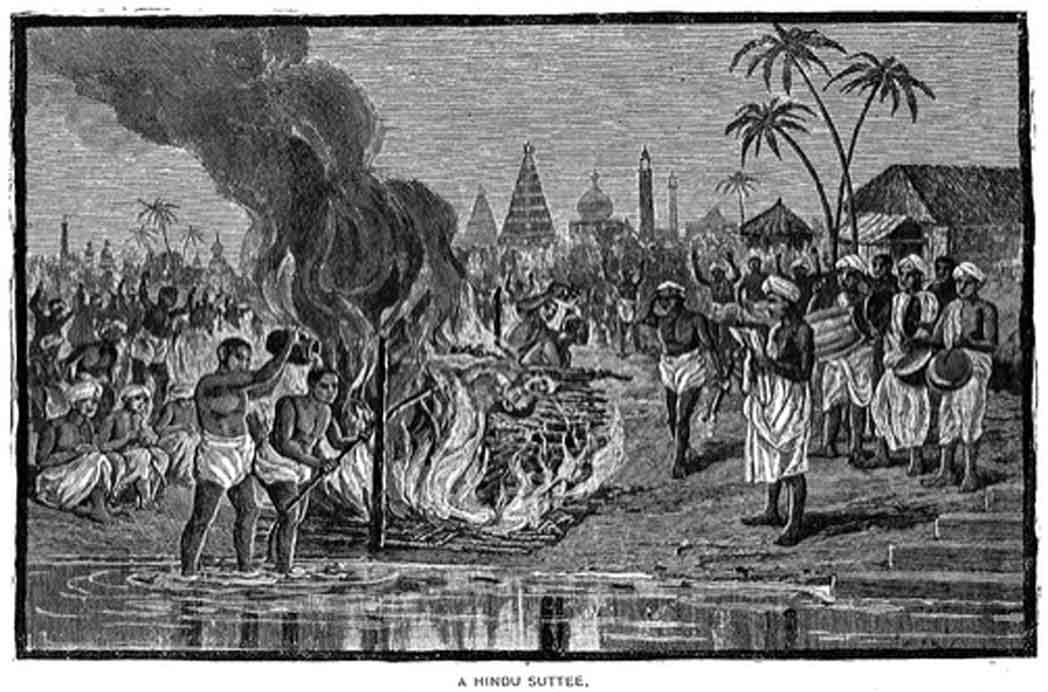
As far as reporting the news, the terrible rite is/was celebrated in a solemn manner, the woman wears the clothes of marriage, goes in procession to the cremation ground and, after turning three times around the pyre of husband by chanting sacred mantras, lies on the pile of wood to be burned alive with her deceased hausband. The widow who is self-immolation is then worshiped as a Goddess and temples are built for her.
At present Indian laws provide severe punishment against who organizes, promotes, encourages or takes part in a sati, it is also forbidden to build altars and temples to worship ‘sati-women’.
It is anugamana (which in Sanskrit means ‘to follow’) or sahamarana (in Sanskrit saha = together, marana = death), universally known as 'sati' o suttee (in Sanskrit 'fidelity') and it’s the name of the first wife of Shiva self-immolated by burning because she was offended for insulting his father Daksha did to the divine spouse.
It’s a practice banned in India since 1839 and now quite rare, but we have news of this ritual from more or less remote villages of the subcontinent (especially in Rajasthan and Bengal) even today. And who knows how many we have no news.
Unbelievably in India – where there are many movements against sati and in favor of women - among the general population and among intellectuals and religious men there is still hesitation in condemning without appeal this ritual (see here and here).
The last case of 'sati' was recognized officially on 2008, when a woman 75 years old has been thrown on the pyre of her dead husband (80 years) in the state of Chattisgarh. Previously ‘sati’ were on 1973, 1978, 1987, 1988, 2002 and, two cases, on 2006.
The practice is/was generally voluntary, but in many cases there was a physical or psychological coercion against the woman to force or 'persuade' her to self-immolation (see here).
The case of Roop Kanvar, for example, created a sensation because according to many it was unthinkable that on 1987 a girl of 18 years with a high level of education voluntarily followed her dead husband in the flames facing a painful death.
In the past, statements were not only cases where the wife was even tied to the funeral pyre, but also cases where she had been drugged with bhang or opium to wear out the strength and will.
The rite of sati is not found in the Vedas - the main sacred texts of Hinduism – where it provides for the widow marriage with her husband's brother or other close relatives. We find, however, a nod, you do not know what period dating, which is reminiscent of that custom in Atharva Veda where we read that "every good woman is burned with the corpse of her husband."
The sati in Ramayana and Mahabharata appear to be added later too.
The scholars mostly believe that the origin of the shameful practice - founded in the seventh century BC and widespread, especially but not only, between the upper caste of Brahmins - is a direct consequence of the division of castes, endogamy and obligations. The sati is in fact closely related to other phenomena as child marriage with older men as prohibition on remarriage and other social restrictions for widows.
The husband for the Indian woman is like a God, the wife must serve and worship him, she must follow him in life and precede him in the death. Consequently, a wife without a husband, without her God, has no reason to exist and she could become a problem for the rigid caste concept. A widow in fact could hardly find another husband in India among people of the same caste and therefore she could be brought to marry men of different caste, violating the primary rule that prohibits caste mobility between castes.
In fact the condition of the widow in indian traditional villages and sometimes even today, is particularly difficult, at best the woman remained to serve in her husband's family, she had to sleep on the floor and could eat only foods that are not seasoned.
Often widows are still sent to convents or shelters where, shaved and dressed in white (the color of mourning in India), to spend their time praying in temples or, if young people into prostitution as we can read in the good book 'Water' of Bapsi Sidhwa and in the eponymous film directed by Deepa Mehta.
As far as reporting the news, the terrible rite is/was celebrated in a solemn manner, the woman wears the clothes of marriage, goes in procession to the cremation ground and, after turning three times around the pyre of husband by chanting sacred mantras, lies on the pile of wood to be burned alive with her deceased hausband. The widow who is self-immolation is then worshiped as a Goddess and temples are built for her.
At present Indian laws provide severe punishment against who organizes, promotes, encourages or takes part in a sati, it is also forbidden to build altars and temples to worship ‘sati-women’.