Visualizzazione post con etichetta Godse. Mostra tutti i post

lunedì 29 gennaio 2018

70th anniversary of Gandhi's death

Gandhi Smriti: the exact place where Gandhi was killed in Delhi
On January 30, 1948, Mohandas Karamchand Gandhi, the Mahatma, was killed by Nathuram Godse, a Hindu fundamentalist.
For details on his death you can click here, for a brief biography of his killer here.
Gandhi was in Delhi and was staying at the Birla House. in the afternoon, at 17.17, when he went to the garden where he prayed every day, he was hit by three gunshots.
This year is the 70th anniversary of his death and I want to remind him with some thoughts of the Mahatma on death.

"What a comforting thought it is to think of death, whenever it comes, as a wise plan in the economy of nature ? If we could realise this law of our being and be prepared for death as a welcome friend and deliverer we should cease to engage in the frantic struggle for life. We shall cease to want to live at the cost of other lives and in contempt of all considerations of humanity.  Such realization is impossible without a due conception of the definite and grave limitations of the body and an abiding faith in God and His unchangeable Law of Karma. [...]
As Hindus we ought to be the least affected by the thought of death, since from the very cradle we are brought up on the doctrines of the spirit and the transitoriness of the body. [...] Our scriptures tell us, that childhood, old age and death are incidents only to this perishable body of ours and that man's spirit is eternal and immortal. That being so, why should we fear death ? And where there is no fear of death there can be no sorrow over it either."


Mohandas Karamchand Gandhi - Young India 1927-1928


70° anniversario della morte di Gandhi

Gandhi Smriti: il luogo esatto dove venne ucciso Gandhi a Delhi
Il 30 gennaio del 1948 Mohandas Karamchand Gandhi, il Mahatma, venne ucciso da Nathuram Godse, un integralista hindu.
Per i particolari sulla sua morte potete cliccare qui, per una breve biografia del suo assassino qui.
Gandhi si trovava a Delhi e alloggiava presso la Birla House. nel pomeriggio, alle 17.17, mentre si recava nel giardino dove quotidianamente pregava, venne colpito da tre colpi di pistola.
Quest'anno ricorre quindi il 70° anniversario della sua morte e voglio ricordarlo con alcuni pensieri del Mahatma proprio sulla morte.

"Che pensiero confortante è pensare alla morte come un piano saggio nell'economia di natura? Se potessimo realizzare questa legge del nostro essere ed essere pronti per la morte come amica benvenuta e liberatrice, smetteremmo di impegnarci nella frenetica lotta per la vita. Smetteremo di voler vivere a spese degli altri e nel disprezzo di ogni considerazione verso l'umanità.
Tale realizzazione è impossibile senza una dovuta consapevolezza dei limiti definiti ed enormi del corpo e senza una fede duratura in Dio e nella Sua Legge immutabile del Karma. [...]
Come indù dobbiamo essere i meno colpiti dal pensiero della morte, perchè sin dalla culla siamo cresciuti con le dottrine sullo spirito e sulla transitorietà del corpo. [...]
Le nostre scritture ci dicono che l'infanzia, la vecchiaia e la morte sono episodi che riguardano solo questo nostro corpo deperibile e che lo spirito dell'uomo è eterno e immortale. Stando così le cose, perché dovremmo temere la morte? E dove non c'è paura della morte non ci può essere alcun dolore per essa". 


Mohandas Karamchand Gandhi - Young India 1927-1928


sabato 21 gennaio 2017

January 30, Anniversary of Gandhi's death


The January 30, 1948 Nathuram Godse killed Mahatma Gandhi in Delhi, while he was on his way to prayer.

* * * * * 

Non-possession is allied to non-stealing. A thing not originally stolen must nevertheless be classified as stolen property if we possess it without needing it. Possession implies provision for the future. A seeker after truth, a follewer of of the law of love, cannot hold anything against tomorrow. God never stores for the morrow; He never creates more than what is strictly needed for the moment. If, therefore, we repose faith in His providence, we should be assured that He will give us every day our daily bread, meaning everything we require.[...]
Our ignorance or negligence of the Dine Law, which gives to man from day to day his daily bread and no more, has given rise to inequalities with all the miseries attendant upon them.
The rich have a superfluous store of things which they do not need, and which are therefore neglectet and wasted; while millions starve to death for want of sustenance. 
If each retained possession only of what he needed, no one would be in want and all would live in contentment. As it is, the rich are discontented no less than the poor. The poor man would fain become a millionaire, and the millionaire a multi-milionaire. [...]
If only the rich keep their own property within moderate limits, the starving will be easily fed and willlearn the lesson of contentment along with the rich.
perfect fulfilment of the ideal of non-possession requires that man should, like the birds, have no roof over his head, no clothing and no stock of food for the morrow. He will indeed need his daily bread, but it will be God's business, and not his, to provide it. Only very very few, it any at all, can reach this ideal. We ordinary seekers may not be repelled by the seeming impossibility. But we must keep the ideal costantly before us, and in the light thereof critically examine our possessions and try to reduce them.
Civilization, in the real sense of the term, consists not in the multiplication, but in the deliberate and voluntary reduction of wants.


Mohandas Karamchand Gandhi


30 Gennaio: Anniversario della morte di Gandhi


Il 30 gennaio 1948 Nathuram Godse uccise il Mahatma Gandhi a Delhi, mentre si stava recando alla preghiera.


* * * * *


"Il non possedere è alleato del non rubare. Una cosa inizialmente non rubata va ugualmente considerata rubata se la possediamo senza averne bisogno.
Il possesso implica l'accumulo per il futuro. Un cercatore della verità, un seguace della legge dell'amore, non può avere nulla in vista del domani. Dio non fa mai scorte per il domani. Non crea mai più cose di quelle che sono strettamente necessarie per il momento presente. Quindi, se abbiamo fede nella sua provvidenza, dobbiamo essere certi che ogni giorno ci darà il nostro pane quotidiano, cioè tutte le cose che ci occorrono.[...]
La nostra ignoranza o negligenza della legge di Dio, che dà all'uomo giorno per giorno il suo pane quotidiano e niente di più,  è all'origine di tutte le diseguaglianze con tutte le miserie che ad esse si collegano. I ricchi hanno scorte superflue di cose di cui non hanno bisogno e che restano, perciò, dimenticate e sprecate, mentre ci sono milioni di morti per mancanza di sostentamento.
Se ognuno si limitasse a possedere soltanto ciò di cui necessita, nessuno si troverebbe in stato di bisogno e tutti vivrebbero appagati. 
Così come stanno le cose, i ricchi sono scontenti non meno dei poveri. Il povero diventerebbe volentieri milionario e il milionario multimilionario.[...]
Se i ricchi trattenessero le loro proprietà in quantità ragionevoli, si potrebbe facilmente nutrire gli affamati ed insegnare loro la lezione di sapersi accontentare, insieme ai ricchi.
Il perfetto conseguimento dell'ideale del non-possesso comporta che un uomo dovrebbe, come gli uccelli, non avere nè tetto sopra la testa, nè vestito, nè alcuna riserva di cibo per il domani. Egli dovrebbe considerare necessario solo il pane quotidiano, ma sarà compito di Dio non suo di fornirglielo. Soltanto pochissimi, se mai alcuno, riescono a raggiungere tale ideale. Noi, comuni cercatori, non dobbiamo lasciarci scoraggiare dall'apparente impossibilità. Dobbiamo bensì tenere costantemente di fronte a noi questo ideale e, alla sua luce,  esaminare criticamente il nostro possesso e cercare di ridurlo.
La civiltà, nel vero senso del termine, non consiste nella moltiplicazione, ma nella deliberata e volontaria riduzione dei bisogni."

Mohandas Karamchand Gandhi


sabato 19 maggio 2012

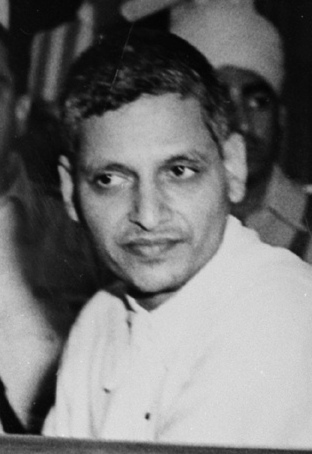
Nathuram Godse, the man who killed Gandhi

Nathuram Godse
Today is the anniversary of the birth of Nathuram Godse, the criminal who killed Mahatama Gandhi in cold blood. I don't think it's great date to remember, but in India this anniversary is celebrated by many people, too, as if it were a national holiday to celebrate a hero, then I say something too.
Personally I have a different opinion of the heroes and even if we find them among those who use violence, we could hardly considered hero who in cold blood with a gun kill a defenseless old man.
So, Nathuram Vinayak Godse was born May 19, 1910 at Ambala in a family of Brahmins. Since his youth he joined the Indian independence movement and also participated in several initiatives of civil disobedience organized by Gandhi against the British Raj, he was arrested for this and tortured by the police.
His proximity to Vinayak Damodar Savarkar, Hindu fundamentalist leader, however, led him to positions antithetical to those of the Mahatma and as regards the rejection of violence and most of all for hatred against Muslims.
Precisely the attitude that Gandhi had towards the Indians of Islamic faith is the main fault that Godse and most of the Indians integralistici imputed (and impute) to the Mahatma.
Gandhi is accused of being too accommodating with Indian Muslims, of being responsible for the partition and the creation of Pakistan, of having fasted against massacres of Muslims in India and not of Hindus in Pakistan and, finally, of demanding that the Indian Republic gave to the newborn Pakistan state funding they were entitled under the agreements of the partition.
Godse decided to kill Gandhi when he began a fast for the massacres of Muslims by Hindu fundamentalists, "the accumulating provocation (of Gandhi) of thirty-two years, culminating in his last pro-Muslim fast, - Godse said during the trial - at last goaded me to the conclusion that the existence of Gandhi should be brought to an end immediately.... I do say - continued Godse - that my shots were fired at the person whose policy and action had brought rack and ruin and destruction to millions of Hindus."
For the murder of Gandhi, Godse was arrested and sentenced to death along with his accomplice Narayan Apte. Despite the opposition of the followers of the Mahatma, Godse and Apte were hanged on November 15, 1949.

Nathuram Godse, l'uomo che uccise Gandhi

Nathuram Godse
Oggi è l'anniversario della nascita di Nathuram Godse, il criminale che uccise il Mahatama Gandhi a sangue freddo. Non mi pare sia una gran data da ricordare, ma visto che in India questo anniversario è celebrato da molti, troppi, come se fosse una festa nazionale in cui si celebra un eroe, dico qualcosa anche io.
Personalmente ho un'altra opinione degli eroi ed anche se andiamo a cercarli tra coloro che utilizzano la violenza, difficilmente potremmo considerare eroi coloro che a sangue freddo, con un arma da fuoco uccidono un vecchio disarmato.
Ebbene, Nathuram Vinayak Godse nacque il 19 maggio 1910 ad Ambala in una famiglia di brahmani. Sin da giovane si unì al movimento indipendentista indiano e partecipò anche ad alcune iniziative di disobbedienza civile organizzate da Gandhi contro il Raj Britannico, per questo venne anche arrestato e torturato dalla polizia.
La sua vicinanza a Vinayak Damodar Savarkar, leader fondamentalista hindu, lo spinse però su posizioni antitetiche a quelle del Mahatma sia per quanto riguarda il rifiuto della violenza sia e soprattutto per l'odio contro i musulmani.
E proprio l'atteggiamento che Gandhi aveva verso gli indiani di fede islamica è la principale colpa che Godse e gran parte degli indiani integralisti imputarono (ed imputano) al Mahatma.
Gandhi è accusato di essere troppo accondiscendente con i musulmani indiani, di essere responsabile della partizione e della creazione del Pakistan, di aver digiunato contro i massacri di musulmani in India e non anche degli hindu in Pakistan e, infine, di aver preteso che la Repubblica Indiana corrispondesse al neonato stato pakistano i finanziamenti che gli spettavano in base agli accordi di partizione. 
Godse quindi pensò bene di uccidere Gandhi quando questi iniziò un digiuno per i massacri dei musulmani ad opera degli integralisti hindu, "il digiuno pro-musulmani - disse poi Godse durante il processo - mi ha definitivamente convinto che doveva essere messa fine alla vita di Gandhi al più presto... Io dico - continuò Godse - che i miei colpi sono stati sparati contro la persona la cui politica e azione avevano portato in rovina e alla distruzione di milioni di hindu."
Per l'omicidio di Gandhi, Godse venne arrestato e condannato a morte insieme al suo complice Narayan Apte. Nonostante l'opposizione dei seguaci del Mahatma, Godse e Apte furono impiccati il 15 novembre del 1949.