Visualizzazione post con etichetta Vishnu. Mostra tutti i post

sabato 3 febbraio 2018

Ayyappan: the son of Shiva and Mohini

The Hindu God Ayyappan, also known as Hariharaputra, Hariharasuta, Dharmasashta, Manikanta, Ayyanar and Bhoothnath, is the son of Shiva, less well known than Ganesh and Kartikeya, but still very revered in southern India. 
Like all the sons of Shiva, his conception and birth are also 'particular'. Ayyappan in fact was born from the union of Shiva with Mohini (literally "the enchantress") and that is with Vishnu in his representation of women.
We have already met Mohini when we talked about Samutramanthan, the "ocean shake". On that occasion Vishnu was transformed into this seductive beauty to recover the amrita, the nectar of immortality, which had been stolen by demons.
Well, even Shiva was not immune to the charm of Mohini and the excitement in seeing that beautiful goddess, Ayyappan was born.
One of the names of the god, as mentioned, is also Hariharaputra, which literally means son of Vishnu (Hari) and Shiva (Hara).
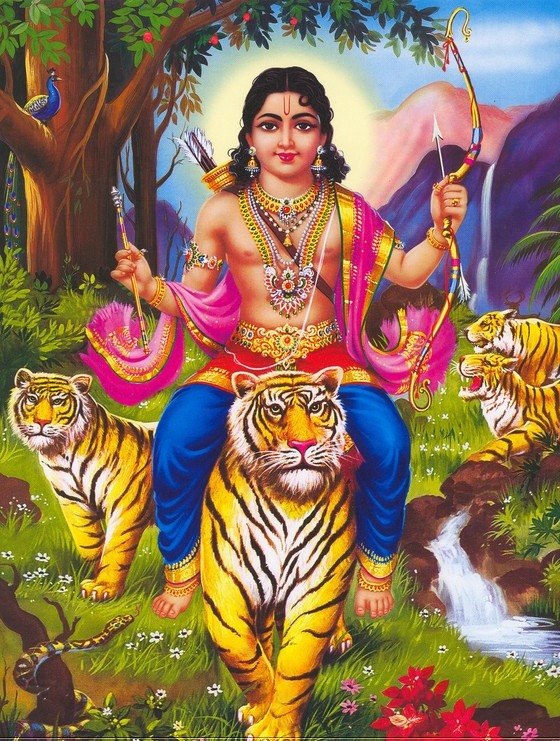
Ayyappan is a warrior deity and he is represented with a bow and arrow riding a  tiger.
One of the many legends tells that the newborn son of Shiva was found by King Pantalam who raised him as a son and gave him the name of Manikantha.
Once he grew up, the king wanted to pass the kingdom to Manikantha, but the king's wife, instigated by an evil minister, was displeased with it because she wanted her biological son to become king.
To try and eliminate Manikhanta, the queen pretended to be ill and was told that only tiger milk could recover her.  Then Manikantha went to the forest in the hope that he was eaten by the tiger. Instead the boy returned riding a big tiger!
Pantalam understood then that the boy had divine nature and decided to build a temple in his honor. To choose the place where to build the temple, Manikhanta flung with his bow an arrow that fell to the ground after traveling thirty kilometers, there was built the first temple in honor of Ayyappan.
In Sabarimalai, Kerala, every year in the month of Margali (December-January) a great pilgrimage takes place in honor of the God.
After 41 days of absolute abstinence from alcohol, meat, eggs and sex, the faithful go to the temple to climb the 18 golden steps that lead to the God, the Pathinettu thripadikal, on which the devotees split a coconut.
According to a tradition, the coconut should be broken every year starting from the first step, to climb, year after year, the entire staircase. After eighteen years, and eighteen broken coconuts, the pilgrim is washed of all sin.
It is absolutely forbidden to make the pilgrimage without first having spent the 41 days of preparation.


Ayyappan, figlio di Shiva e Mohini


Il dio hindu Ayyappan, conosciuto anche come Hariharaputra, Hariharasuta, Dharmasashta, Manikanta, Ayyanar e Bhoothnath, è figlio di Shiva, meno noto di Ganesh e di Kartikeya, ma comunque molto venerato nell'India del sud. Come tutti i figli di Shiva, anche il suo concepimento e la sua nascita sono 'particolari'. Ayyappan infatti nacque dall'unione di Shiva con Mohini (letteralmente "l'incantatrice") e cioè con Vishnu nella sua rappresentazione femminile. 
Abbiamo già incontrato Mohini quando abbiamo parlato del Samutramanthan, il "frullamento dell'oceano". In quell'occasione Vishnu si trasformò in questa seducente bellezza per recuperare l'amrita, il nettare dell'immortalità, che era stato rubato dai demoni.
Ebbene, anche Shiva non rimase immune dal fascino di Mohini e dall'eccitazione nel vedere di fronte a sè quella bellissima dea, nacque Ayyappan
Uno dei nomi del dio, come detto, è anche Hariharaputra, che significa letteralmente figlio di Vishnu (Hari) e di Shiva (Hara).
Ayyappan è una divinità guerriera ed è rappresentato con un arco e una freccia a cavallo di una tigre. 
Una delle tante leggende, narra che il neonato figlio di Shiva venne trovato dal re Pantalam che lo crebbe come un figlio e gli diede il nome di Manikantha.
Una volta cresciuto, il re voleva passare il regno a Manikantha, ma la moglie del re, istigata da un malvagio ministro ne fu contrariata in quanto voleva che diventasse re il suo figlio biologico.
Per cercare di eliminare Manikhanta, la regina si finse malata e venne detto che solo del latte di tigre l'avrebbe potuta guarire. Venne allora inviato nella foresta Manikantha nella speranza che venisse mangiato dalle tigri. Invece il ragazzo tornò a corte sano e salvo, a cavallo di una tigre.
Pantalam capì quindi che il ragazzo aveva natura divina e decise di costruire un tempio in suo onore. Per scegliere il luogo dove costruire l'opera, Manikhanta scagliò col propio arco una freccia che cadde a terra dopo aver percorso trenta chilometri, lì venne costruito il primo tempio in onore di Ayyappan.
A Sabarimalai, nel Kerala, ogni anno nel  mese di margali (dicembre-gennaio) si svolge un grande pellegrinaggio in onore del dio.
Dopo 41 giorni di astinenza assoluta da alcol, carne,uova e sesso, i fedeli si recano al tempio per salire i 18 gradini d'oro che portano al dio, i Pathinettu thripadikal, sui quali i devoti spaccano una noce di cocco.
Secondo una tradizione, la noce di cocco va spaccata ogni anno a cominciare dal primo gradino, per salire, anno dopo anno, l'intera scala. Dopo diciotto anni, e diciotto cocchi spaccati, il pellegrino è lavato da ogni peccato.
Non è assolutamente permesso fare il pellegrinaggio senza prima aver trascorso i 41 giorni di preparazione.


sabato 17 novembre 2012

Diwali


On the left you can see the view of India from satellite in a regular night, in the right hand is India during Diwali, the Festival of lights, the most important event on the Hindu calendar, the festival marks the victory of good over evil and the start of the New Year. 
How you can read in this interesting article by Asia News, celebrations last five days but the third, which this year fell on November 13, is the most important because it is dedicated to Lakshmi, the goddess of prosperity and good fortune. On this day, families clean their homes and keep clay lamps or 'diyas' lit overnight to welcome the divinity. 
According to tradition, Diwali marks the return of Lord Ram to Ayodhya (Uttar Pradesh) after vanquishing the demon king Ravana and rescuing his wife Sita. Together, husband and wife enter the city welcomed by thousands of glowing lamps.
For Hindus, Rama represents the seventh manifestation (avatar) of the god Vishnu, and Sita is the incarnation of his wife Lakshmi. The prince's adventures are told in the Ramayana, one of Hinduism's most important poetic epics.

Diwali


Nella foto a sinistra potete vedere l'India vista dal satellite in una notte qualsiasi, in quella a destra invece è l'India durante Diwali, la festa delle luci, una delle più importanti feste del calendario hindu. 
Essa simboleggia la vittoria del bene sul male e segna l'inizio del nuovo anno. Come si puo' leggere in questo interessante articolo di Asia News, le celebrazioni durano cinque giorni, ma il terzo - che quest'anno è caduto il 13 novembre - è il più importante, perché dedicato al culto di Lakshmi, dea della fortuna e della prosperità. In questo giorno, ogni famiglia pulisce con cura la propria casa, e poi lascia accese per tutta la notte le diyas, le lampade tradizionali, per accogliere la divinità. 
Secondo la tradizione, il Diwali festeggia il ritorno nella città di Ayodhya (Uttar Pradesh) del principe Rama, settimo avatar di Vishnu, dopo aver sconfitto il demone Ravana e salvato sua moglie Sita, incarnazione della dea Lakshmi. Insieme, i due entrano nella città accolti da migliaia di lampade accese. 


domenica 2 settembre 2012

Padma, lotus flower

"Be like the lotus - say the sages of India - which has its roots in the mud, but whose flower emerges above the pond water and it is not contaminated." 
Vishnu on lotus flower
The lotus, padma in Sanskrit, is a very important flower in India. 
From Vishnu's navel grew a lotus on which was seated Brahma who created the universe. That is one of the names of Vishnu Padmanabha, i.e. with the navel lotus. 
Also according to another tradition, the universe was born from a golden lotus, it tells the Padmapurana, the Purana lotus. 
On padmapitha, i.e. on the lotus pedestal, the gods are always resting in their representations. 
In the sacred buildings, the capitals of the columns are in the shape of lotus and lotus petals are the ones which surround the mandala and yantra. 
The god Krishna is Padmapada, the god of the lotus feet, but above all Padma is one of the names of Lakshmi, the goddess of prosperity and luck, wife of Vishnu. 
It's called padma asana, which is the lotus position, one of the main positions of yoga, one sitting with legs crossed and back straight. It’s the position best suited for meditation and one of the most popular positions of the Kamasutra. 
Padma is called the wide delta of the sacred river Ganges, in fact the river flows into the sea, extending its branches like the petals of a lotus flower. 
And finally, the Padma Shri is the fourth highest honor of the Indian Republic.

Padma, il fiore di loto

Vishnu su un fiore di loto
“Siate come il loto – dicono i saggi indiani – le cui radici sono nel fango, ma il cui fiore emerge sopra l’acqua dello stagno non venendone contaminato.” 
Il loto, padma in sanscrito, è un fiore molto importante in India. 
Dall’ombelico di Vishnu nacque un loto sul quale era seduto Brahma che creò l’universo. Per questo uno degli appellativi di Vishnu è padmanabha, cioè con l’ombelico di loto. 
Anche secondo un’altra tradizione da un loto d’oro nasce l’universo, lo narra il Padmapurana, il purana del loto appunto. 
Sul padmapitha, il piedistallo di loto, sono sempre poggiati gli dei nei dipinti e nelle sculture. 
Negli edifici sacri i capitelli delle colonne sono a forma di loto e sono petali di loto quelli che circondano i mandala e gli yantra. 
Il dio Krishna è padmapada, il dio dai piedi di loto, ma soprattutto Padua è uno dei nomi di Lakshmi la dea della prosperità e della fortuna, sposa di Vishnu. 
Si chiama padma asana, cioè la posizione del loto, una delle principali posizioni dello yoga, quella seduti con le gambe incrociate e il dorso eretto. E’ la posizione maggiormente indicata per la meditazione e una delle più popolari posizioni del Kamasutra. 
Si chiama Padma l’ampio delta del sacro fiume Gange, infatti il fiume si getta nel mare ampliando i suoi rami come petali di un fiore di loto. 
E infine, il Padma Shri è la quarta più alta onorificenza della Repubblica Indiana.

domenica 18 marzo 2012

Harihara

Harihara, Vishnu on the left
and Shiva on the right
The sage Shankaracharya, pilosopher of Vedanta, had come on pilgrimage to a large city in India and asked to go to the main temple to give thanks to God, but the city was inhabited mainly by people of faith Vaishnava and the temple the city was dedicated to Vishnu. This was a problem as it was known that Shankara was a Shaivite and at that time the contrasts between the two confessions were very hard. 
The Brahmans of the temple therefore refused to grant permission to Shankara to enter the temple. The wise man then spoke to the Brahmans, and citizens, he explained his theory of the one God, the basis of Vedanta. To prove the correctness of his beliefs, he invited the Brahmans to go in garbhagrha, the most sacred sanctuary of the temple, one that preserves the main deity. The Brahmans went where it was kept a statue of Vishnu and found that the statue was changed. For half it was still represented Vishnu, but in the other half was represented Shiva. Harihara was born, God, half Vishnu and half Shiva, also called Shambuvishnu or Shankaranarayana. 
Convinced by the words and 'miracle' of Sankara, it was allowed to enter the temple to the sage. This legend explains Harihara worship of the god half Vishnu and half Shiva, trying to end to the sectarian warfare that characterized 'medieval' Hinduism and representation of the basic concept of Hinduism throughout the oneness of God, to beyond the many forms in which it is venerated.
In Harihara, the left half represents Vishnu with his usual attributes, including the royal crown and the disk. In the half left is Shiva with matted hair, the crescent moon, the stream that represents the Ganges and the Trishula.
Hari in Sanskrit means yellow, but also fascinating, beautiful all the epithets of Vishnu and Hara means take away, remove, and is one of the 1008 names of Shiva, the destroyer, which, in fact, take away.
In Harihara then we have the preservation and destruction in one image, the space (Vishnu) and time (Shiva) present in a syncretism of the theological meaning very pregnant. 
There is another tradition that harks back to the Puranas, I'll talk about in another post.

Harihara

Harihara, a sinistra Vishnu, a destra Shiva
Il saggio Shankaracharya, teorico del Vedanta, era giunto in pellegrinaggio in un’importante città dell’India e chiese di essere condotto al tempio principale per rendere grazie a Dio. 
La città però era abitata prevalentemente da persone di fede vaishnava, cioè vishnuita, e il tempio della città era dedicato a Vishnu. Questo era un problema in quanto era noto che Shankara era uno shivaita e in quel periodo i contrasti tra le due confessioni erano molto accesi. I brahmani del tempio pertanto si rifiutarono di concedere a Shankara il permesso di entrare nel tempio. 
Il saggio allora parlò ai brahmani e ai cittadini e spiegò la sua teoria dell’unico Dio, base del Vedanta. A riprova della correttezza delle proprie convinzioni, invitò i brahmani ad andare nel garbhagrha, il santuario più sacro del tempio, quello che conserva la divinità principale.
I brahmani si recarono là dove era conservata la statua di Vishnu e, con loro meraviglia, trovarono che la statua era cambiata. Per metà era ancora rappresentato Vishnu, ma nell’altra metà era rappresentato Shiva. Era nato Harihara, il Dio per metà Vishnu e per metà Shiva, detto anche Shambuvishnu o Shankaranarayana. 
Convinti dalle parole e dal ‘miracolo’ di Shankara, venne consentito al saggio di entrare nel tempio. 
Questa leggenda spiega il culto di Harihara, il dio per metà Vishnu e per metà Shiva, forse tentativo di porre fine alle guerre settarie che caratterizzarono l’induismo ‘medievale’ e rappresentazione del concetto base di tutto l’induismo quello cioè dell'unicità di Dio, al di là delle molteplici forme nelle quali viene venerato.
In Harihara, la metà sinistra rappresenta Vishnu con i suoi usuali attributi, tra cui la corona regale e il disco. Nella metà sinistra c’è invece Shiva con i capelli arruffati, la mezzaluna, lo zampillo che rappresenta il Gange e il trishula
Hari in sanscrito significa giallo, ma anche affascinante, bello tutti epiteti di Vishnu; mentre hara significa portar via, rimuovere ed è uno dei 1008 nomi di Shiva, il distruttore che, appunto, porta via.
In Harihara abbiamo quindi la preservazione e la distruzione in una sola immagine, lo spazio (Vishnu) e il tempo (Shiva) compresenti in un sincretismo dal significato teologico molto pregnante. 
Esiste anche un’altra tradizione sulla nascita del culto di Harihara, che si rifà ai Purana, ne parlerò in un prossimo post.

sabato 11 febbraio 2012

Shining lingam

We saw in the previous post, that the Vaishnava traditions narrate myths and legends to prove the supremacy of Vishnu over the other Gods of the Trimurti, and to explain why the god Brahma isn't worshiped in India. But of course there are myths and traditions of Shaivism that support exactly the opposite tesis: Shiva is the greatest among the Gods, who is the Absolute, the principle of all things. In short, the Skanda Purana, the Vayu Purana or Linga Purana tell us a different story. This one.
Lingamyoni
At the beginning of time, when nothing had been created, or, more precisely, in the period that elapsed between the destruction/absorption of the Universe and the creation of a new Universe, Vishnu was lying on the serpent Ananta sure to be the most powerful among all the Gods. Unexpected, however, appeared Brahma, who claimed to be the creator of the universe, who by whom all things are born. Between the two Gods arose a dispute, each supported with many issues to be the Absolute, and each told the facts, actions and heroic deeds that were supposed to prove their supremacy over the other.
But while this dispute was going on, in the vastness of space there was a deafening roar, a roar accompanied by a light beam, a column appeared suddenly glowing from the hell that came up to the infinite spaces spearing the oceans and the earth. It was a  infinite  and resplendent lingam, flamboyant and powerful, who left amazed and terrified the two Gods.
"But what is that?"  astonished Vishnu and Brahma asked. To understand they  decided that Vishnu would be plunged into the depths of the ocean and Brahma would fly in the infinite spaces to reach the two ends of that shining column which naked eye they could not measure, nor height nor depth.
Vishnu became a boar and plunged into the ocean, Brahma became a wild goose and flew in the celestial spaces. Their journey lasted over a thousand years, but for what they tried, they failed to reach the end of the column of fire that continued to grow.
Returning to the surface the two looked at each other, Vishnu admitted that he was not able to find the beginning of the lingam, Brahma instead, to win the challenge with Vishnu, lied saying he reached the summit at the fiery lingam.
At that moment, in the pillar of fire a fissure opened from which Shiva emerged, the Lord of lingam self-manifested and proclaimed his own supremacy as the Absolute, as creator, preserver and destroyer of the Universe, everything that exists including the two Gods. Vishnu and Brahma prostrated in front of the great God, and worshiped him recognizing his supremacy.
But it did not end there. According to the Skanda Purana, Shiva also launched a curse against Brahma becsause he had lied by claiming to have reached the top of the lingam of fire. No longer would worship existed in his honor. And so it was.

Il lingam di fuoco

Abbiamo visto nel precedente post, che le tradizioni vaishnava narrano miti e leggende per comprovare la supremazia di Vishnu sugli altri dèi della trimurti e per spiegare il motivo per cui il dio Brahma non è oggetto di culto in India. Ma esistono ovviamente miti e tradizioni shivaite che sostengono esattamente il contrario e cioè che Shiva è il più grande tra gli dèi, che è l’Assoluto, il principio di tutte le cose. Insomma lo Skanda Purana, Il Lingam Purana o il Vayu Purana narrano una storia diversa. Questa. 

Rama, Sita, Saraswati e altri dei
venerano lo Shivalingam
All’origine dei tempi, quando niente era stato creato o, più precisamente, nel periodo che intercorreva tra la distruzione/assorbimento dell’Universo e la creazione di un nuovo universo, Vishnu stava sdraiato sul serpente ananta convinto di essere il più potente dio. Imprevisto apparve però Brahma, che dichiarò di essere il creatore dell’universo, colui dal quale tutte le cose sono nate. Tra i due dèi nacque una disputa, ciascuno sosteneva con molteplici argomenti di essere l’Assoluto e ciascuno narrava fatti, azioni e imprese che avrebbero dovuto comprovare la propria supremazia sull’altro. 
Ma mentre questa disputa stava andando avanti, nell’immensità degli spazi si sentì un rombo assordante, un fragore accompagnato da un fascio di luce, comparve improvvisamente una colonna rifulgente che dagli inferi arrivò fino agli spazi infiniti trafiggendo gli oceani e la terra. Era un lingam infinito e splendente, fiammeggiante e possente che lasciò stupefatti e terrificati i due dèi. 
“Ma cos’è?” si domandarono attoniti Vishnu e Brahma. Per capirlo decisero che Vishnu si sarebbe immerso nelle profondità dell’oceano e Brahma sarebbe volato negli spazi infiniti per raggiungere le due estremità di questa colonna splendente di cui ad occhio nudo non riuscivano a misurarne né l’altezza né la profondità. 
Vishnu si trasformò in cinghiale e si gettò nell’oceano, Brahma si trasformò in oca selvatica e volò negli spazi celesti. Il loro viaggio durò più di mille anni, ma per quanto si sforzassero, non riuscirono a raggiungere le estremità della colonna di fuoco che continuava a crescere. 
Ritornati in superficie i due si guardarono, Vishnu ammise di non essere riuscito a trovare l’inizio del lingam, Brahma invece, che voleva vincere la sfida con Vishnu, mentì dicendo di essere arrivato in vetta al lingam fiammeggiante. 
In quel momento però nella colonna di fuoco si aprì una fenditura dalla quale uscì Shiva, il signore del lingam si auto manifestò e proclamò la propria supremazia come Assoluto, come creatore, preservatore e distruttore dell’universo, di tutto ciò che esiste inclusi i due dèi che, prostrati al cospetto del grande dio, lo adorarono riconoscendone la supremazia assoluta. 
Ma non finì qui. Shiva infatti lanciò anche una malediazione contro Brahma che aveva mentito sostenendo di aver raggiunto la vetta del lingam di fuoco. Nessun culto sarebbe più esistito in suo onore. E così fu.

domenica 5 febbraio 2012

Bhrigu, Shiva, Brahma and Vishnu

Maharishi Bhrigu
Why Shiva is worshiped in the form of lingam? Why Brahma hasn’t special worship and are very few the temples dedicated to him although he’s considered 'creator god'?
The variety of religious experiences existed for millennia in the Indian peninsula have often resulted in conflicts and disagreements that have also echoed in the myths, such as already I told in the sacrifice of Daksha and the death of Sati. Obviously each religious tradition narrates myths and legends in which its own God has prevailed over the others and this makes the mythological tradition, literary and cultural life of the Indian subcontinent very rich. Today I want to mention one of the many Vaishnava traditions narrated by many texts - including the Padma Purana - which recalls the curse of the sage Bhrgu hurled against Shiva and Brahma.
Well, during a great sacrifice held on Mount Mandara, the wise Brahmins wondered who was the greatest among the Gods Shiva, Brahma or Vishnu. The sage Manu - son of Prajapati - said: "He who is made of pure sattva, who has only the cohesive tendency (guna) and preserver without even a fraction of tamas, the tendency of dissolution, or raja, the centripetal tendency, he is the Absolute, the greatest of the Gods. "
To test who among the three gods were characterized by benevolent guna sattva, one of the Maharishi, the great sages, was chosen, he was Bhrgu, son of the God Varuna (or Prajapati). 
Bhrgu first went to Shiva. But the wise man could not even see the God, as he was stopped by Nandin - the bull vahana of Shiva - which did not allow him entry. "Shiva is enjoying the love of his consort Parvati, you cannot enter." The Brahmin - who like all the Brahmins was very touchy - got angry and cursed Shiva. "You, who are totally taken by tamas, obscured by passion, you don’t honor worthily a wise Brahmin will be transformed into a lingam and your wife in a yoni and you will be worshiped in that form, but not by the Brahmins."
Bhrgu then went to Brahma and could come before him, but the God, seated on a lotus, was immersed in rajas and he didn’t get up nor saluted the Brahmin.
"Because you're surrounded by rajas and have not honored me - cried Bhrgu to Brahma - you may not be worshiped by any devoted!”
The wise brahmin arrived finally in front of Vishnu, the God was sleeping lying on Ananta, the serpent residue (seshanaga) while his wife Lakshmi massaging the feet. Bhrgu came to God and placed his foot on his chest. Vishnu got up and said, "Thank you wise man, the touch of your foot is a blessing for me, the dust that falls from the feet of every Brahmins leads to salvation." So said Vishnu and donated to Bhrgu food and wealth and reserved a special attention.
Bhrgu then prostrated himself at the feet of Vishnu and worshiped him, "Thou, God of a thousand names, you Vasudeva, you Hari, you Narayana, thou Blessed One, thou Janardana, thou preserver of the Universe, you pervade everything, you are formed only by sattva, you’re the supreme deity and you alone will be worshiped by the brahmanas and by the twice-born. "

Bhrgu, Shiva, Brahma e Vishnu

Vishnu su Ananta,
il 'serpente residuo' 
Perché Shiva è venerato sotto la forma di lingam? Perchè Brahma non è oggetto di particolari culti e a lui sono dedicati pochissimi templi pur essendo considerato ‘il dio creatore’? 

Le molteplici esperienze religiose che nei millenni sono convissute nella penisola indiana hanno spesso dato luogo a conflitti e dissidi che hanno un’eco anche nei miti, come quello già narrato del sacrificio di Daksha e dell’autoimmolazione di Sati. Ovviamente ogni tradizione religiosa narra miti e leggende nelle quali il proprio dio ha la meglio sugli altri e anche questo rende particolarmente ricca la tradizione mitologica, letteraria e culturale del subcontinente indiano. Oggi voglio ricordare una delle tante tradizioni vaishnava, di fede cioè visnuita, narrata da molti testi – tra i quali il Padma purana – in cui si ricorda la maledizione che il saggio Bhrgu lanciò contro Shiva e contro Brahma. 
Ebbene, durante un grande sacrificio organizzato sul Monte Mandara, i saggi brahmani si domandavano quale fosse il più grande degli dèi tra Shiva, Brahma o Vishnu. Il saggio Manu – figlio di Prajapati – dichiarò: “Colui che è fatto di puro sattva, colui che possiede solo la tendenza (guna) coesiva e preservatrice senza avere nemmeno una minima parte di tamas, la tendenza della dissoluzione, o di rajas, la tendenza centripeta, costui è l’Assoluto, la più grande delle divinità.” 
Per verificare chi dei tre dèi fosse caratterizzato dalla benevola tendenza sattva, venne mandato uno dei Maharishi, i grandi saggi, si trattava di Bhrgu, figlio del dio Varuna (o, secondo altre tradizioni, di Prajapati). 
Bhrgu andò innanzitutto da Shiva. Ma il saggio non potè neppure vedere il dio, in quanto venne fermato da Nandin – il toro vahana di Shiva – che non gli consentì l’ingresso. “Shiva sta godendo dell’amore della sua consorte Parvati, non puoi entrare.” Il brahmano – che come tutti i brahmani era molto suscettibile – si arrabbiò e maledì Shiva. “Tu, che sei totalmente preso da tamas, obnubilato dalla passione, tu che non onori degnamente un saggio brahmano sarai trasformato in un lingam e la tua consorte in una yoni e così, in tale forma verrete adorati, ma non certo dai brahmani.” 
Bhrgu si recò poi da Brahma, potè arrivare al suo cospetto, ma il dio, seduto su un loto, era immerso in rajas, la tendenza centripeta, non si alzò né salutò il brahmano. 
“Poiché tu sei immerso rajas e non mi hai onorato – gridò Bhrgu a Brahma – non sarai venerato da alcun fedele!” 
Il saggio brahmana arrivò infine al cospetto di Vishnu che se ne dormiva sdraiato su Ananta, il serpente residuo (seshanaga) mentre la sua sposa Lakshmi gli massaggiava i piedi. Bhrgu si avvicinò al dio e gli pose un piede sul petto. Vishnu si svegliò e disse, “Ti ringrazio o saggio, il tocco del tuo piede per me è una benedizione, la polvere che cade dai piedi di ogni brahmano porta alla salvezza.” Così detto Vishnu donò a Bhrgu cibo e ricchezze e gli riservò un’attenzione speciale. 
Bhrgu allora si prostrò ai piedi di Vishnu e lo venerò, “Tu, dio dai mille nomi, tu Vasudeva, tu Hari, tu Narayana, tu Bhagavan, tu Janardana, tu preservatore dell’Universo, tu che tutto pervadi, tu, formato di solo sattva, sei la divinità suprema e tu solo sarai venerato dai brahmana e dai nati due volte.”

domenica 16 ottobre 2011

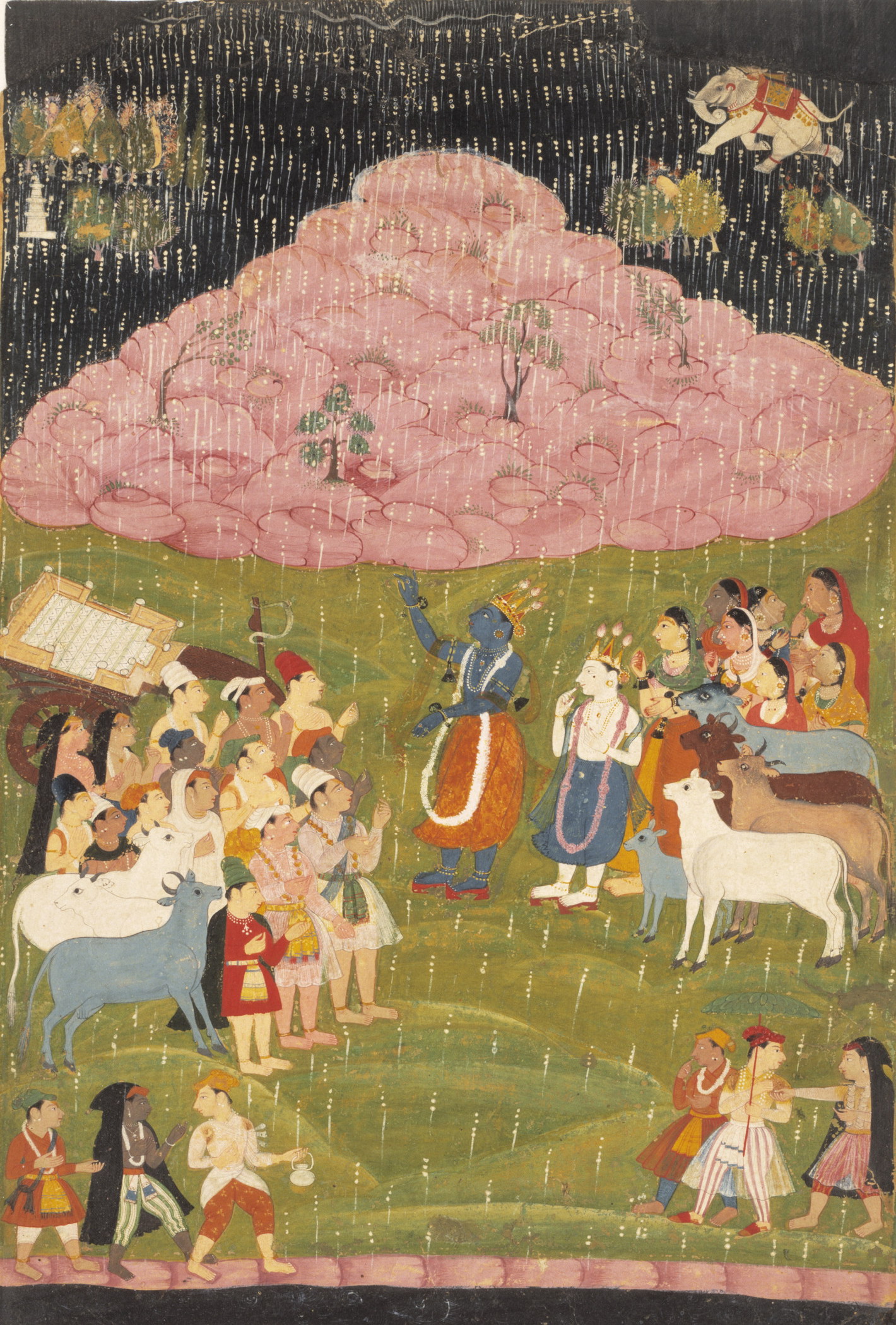
Krishna and Govardhan hill

Krishna raising Govardhan
The villagers of Vrindavana were preparing Indrapuja, the yearly sacrifice dedicated to the King of the Gods, Lord of the rain who, with his benevolence, made possible their lives and the lives of animals bred by them.
But Krishna, the seventh iavatar of Vishnu, who lived with the shepherds of the village, persuaded them there was no need to make that sacrifice.
"There is no need to make a sacrifice to Indra, the rain will fall and the water will not fail for you or for your animals and for your fields. It's better than the sacrifice you are doing in honor of the hill Govardhan, it's makes your life possible, not Indra. "
The shepherds and peasants of Vrindavana were astounded by those words, but after some hesitation, they began to celebrate a grand sacrifice in honor of the hill at the foot of which stood their village.
Krishna wanted to teach a lesson to Indra became too proud and wanted to restore the hierarchy, he was the Supreme Personality of Godhead which bakta, devotees, had veneration and worship.
Indra, however, was furious and called together his most powerful clouds starting samvartaka, the awful cloud that appears every dissolution of the universe.
The village of Vrindavan was struck by most furious storm of all time, for days and days it did rain and hail. The land was no longer able to absorb water, the village was devastated by severe floods, people and animals did not know where to stand and turned to Krishna, pleading for help.
Krishna then lifted by his hand the whole hill of Govardhan and invited all the shepherds and their animals under that huge umbrella.
Indra continued to bring down rain, but friends of Krishna were safe under his protection, and the wrath of the King of the gods nothing could against Krishna.
Indra understood, he did stop raining and bowed humbly at the feet of Krishna.
Govardhan Hill was put back in its place and is still celebrated every year a sacrifice in his honor, Govardhanpuja.

Krishna e la collina Govardhan

Krishna sostiene la collina Govardhan
Gli abitanti del villaggio di Vrindavana stavano preparando l'Indrapuja, il sacrificio annuale dedicato al re degli dei, signore delle piogge che con la sua benevolenza rendeva possibile la loro vita e quella degli animali da loro allevati.
Ma Krishna, settimo avatara di Vishnu che abitava con i pastori del villaggio, riuscì a cionvincerli che non era necessario fare quel sacrificio. "Non c'è bisogno di fare un sacrificio ad Indra, la pioggia cade lo stesso e l'acqua non mancherà nè per voi nè per i vostri animali nè per i vostri campi. E' meglio che il sacrificio lo facciate in onore della collina Govardhan, è lei che rende possibile la vostra vita, non Indra."
I pastori e i contadini di Vrindavana rimasero stupiti da quelle parole, ma dopo qualche esitazione iniziarono a celebrare un sontuoso sacrificio in onore della collina ai cui piedi sorgeva il loro villaggio.
Krishna voleva dare una lezione ad Indra divenuto troppo orgoglioso e voleva ristabilire le gerarchie, lui era la Persona Suprema cui i bakta, devoti, dovevano venerazione e culto.
Indra però non ci stette e chiamò a raccolta le sue più potenti nuvole a cominciare da Samvartaka, la terribile nuvola che appare ad ogni dissoluzione dell'universo. Sul villaggio di Vrindavana si scatenò il più furioso di tutti i temporali, per giorni e giorni piovve e grandinò. Il terreno non riusciva più ad assorbire l'acqua, il villaggio venne devastato da violente inondazioni, gli uomini e gli animali non sapevano più dove stare e si rivolsero a Krishna, supplicandolo di aiutarli.
Krishna allora sollevò con la mano l'intera collina di Govardhan ed invitò tutti i pastori ed i loro animali sotto quell'enorme ombrello.
Indra continuò a far cadere pioggia, ma gli aminci di Krishna erano al sicuro sotto la sua protezione e l'ira del re degli dei niente poteva contro Krishna.
Indra capì, fece smettere di piovere e si prostrò umilmente ai piedi di Krishna.
La collina Govardhan venne rimessa al suo posto e ogni anno ancora oggi viene celebrato un sacrificio in suo onore, il Govardhanpuja.

domenica 3 luglio 2011

A treasure was born from Vishnu's navel

Lying Vishnu, lotus and Brahma
Bags full of jewels and precious stones, gold coins of the Napoleonic period, rings, necklaces, bracelets with diamonds, rubies and emeralds, gold necklaces meters long, crown, inlaid with precious stones sticks, plates and cups of gold.
For a first estimate of the treasure found in India is worth about 500 billion rupees ($ 11.2 billion) and it should be the greatest treasure ever found in the country and one of the richest ever found in the world.
We are in Thiruvananthapuram (Trivandrum), capital of Kerala, wonderful state in  south India and under the floor of the temple dedicated to Sree Padmanabhaswamy has been found what is presumably a maharaja's treasure, hidden there before independence from the British crown .
But there’s more, the exploration of the underground excavations of the temple is still in its beginning and it is possible that further discoveries are made. There are two of the six vaults were opened in the subsoil for the moment.
Only after a legal battle and court ruling of the local authorities had been able to start the research as the descendants of the Maharaja of Trevancore still ran the temple through a foundation, and they strenuously opposed the initiative and announced that they have appealed against the sentence .
The temple, also known as Ananda Sree Padmanabhaswamy Temple (from here the name of city) is dedicated to the god Vishnu on the serpent Ananda in its infinite quiet, Anananthasayanam position, after the end of time he has absorbed all that exists.From dreaming Vishnu's navel borns a lotus on which Brahma is located who, according to one of the many Hindu cosmogonies, realizes the world that Vishnu dreams.
From here the name of the temple, in fact in Sanskrit padma means lotus and nabha navel.


The news:


Dall'ombelico di Vishnu nasce un tesoro

Sacchetti pieni di gioielli e pietre preziose, monete d'oro del periodo napoleonico, anelli, collane, bracciali con diamanti, rubini e smeraldi, collane d'oro lunghe metri, corone, bastoni incastonati da pietre preziose, piatti e coppe d’oro. 
Ad una prima stima il tesoro trovato in India vale circa 500 miliardi di rupie (11,2 miliardi dollari) e dovrebbe essere il più grande tesoro mai trovato nel paese e uno dei più ricchi mai trovato al mondo.
Siamo a Thiruvananthapuram (Trivandrum), capitale del Kerala, meraviglioso stato del sud dell’India e sotto il pavimento del tempio dedicato a Sree Padmanabhaswamy è stato trovato quello che presumibilmente è il tesoro di un maharaja, lì nascosto prima dell’indipendenza dalla corono britannica.
Dall'ombelico di Vishnu nasce un loto su cui è posto Brahma
Ma non è finita, gli scavi e l’esplorazione del sottosuolo del tempio sono ancora agli inizi e non è escluso che vengano effettuati ulteriori ritrovamenti. Al momento sono state aperte due delle sei cripte presenti nel sottosuolo.
Solo dopo una battaglia legale e una sentenza dl tribunale le autorità locali avevano potuto iniziare le ricerche in quanto i discendenti del maharaja di Trevancore gestivano ancora il tempio attraverso una fondazione e si sono opposti strenuamente all’iniziativa ed hanno annunciato che presenteranno appello contro la sentenza.
Il tempio, conosciuto anche come Sree Ananda Padmanabhaswamy Temple, è dedicato al dio Vishnu nella sua forma riposante sul serpente infinito Ananda o Anantha (che in sanscrito significa senza fine) e dal quale deriva anche il nome della città), nella posizione Anananthasayanam. Dall’ombelico di Vishnu sognante nasce un loto su cui è posto Brahma che, secondo una delle molte cosmogonie hindu, realizza il mondo che Vishnu sogna.
Da qui il nome del tempio, infatti in sanscrito padma significa loto e nabha ombelico.


La notizia:


giovedì 30 giugno 2011

Sita, Rama's wife

She was faithful to her husband, but she, prisoner, had lived with another man. It was not good. And Rama, Lord of Ayodhya, tell to his beloved wife that the war against Ravana, the millions of deaths, the mythical bridge linking India to Sri Lanka, none of all this had been done for her, but to restore the order, the dharma. "I cannot live with you who lived so long with another man."
Rama and Sita, the couple shown as exemple of the perfect wedding even today in India, of what must be the relationship between husband and wife and that speaks volumes about the status of women in the Indian continent.
Sita was stunned, outraged that they doubted her loyalty, "light a fire - she ordered - if I have been faithful to Rama, though I have always respected, if any other man has touched me, Agni, the god of fire, protect me. Otherwise, I burn! " And she threw herself into the flames.
Agni protected her, held her and brought her to Rama, saying, "This woman is pure and have always been faithful."
She was the goddess Lakshmi, who, like Sita, she became the wife of Rama, seventh avatar of Vishnu and hero of the Ramayana epic. Her father found her in a furrow of earth and so called Sita. He married the Prince of Ayodhya, but she was kidnapped by the demon Ravana who took her to Lanka. Rama, with the help of monkeys Sugriva and Hanuman, rescued his wife.
The couple and Rama's army returned to Ayodhya, they lived happily, but the people whispered again. "She lived for more than a year with another man, she cannot live with our King." It was not good that she lived with the example of dharma, righteousness, of what is good, of the rules that make turn the universe.
This time Rama, although his wife was pregnant, forsed Sita to leave the kingdom. She will go in the forest near the hermitage of Valmiki, where the two sons of Rama born: Lava and Kusa.
Rama knew Kusa and Lava when they had children. Once he had kwown them, Rama wanted to return Sita to Ayodhya too.
The queen again declared her loyalty to Rama and her own purity and, before the assembly convened to receive her, said: "If in my mind I had no other man that Rama, if I was always faithful to my husband, you mother, earth, where I was born, give me the grace to get my body."
Having said that the earth opened and revealed a royal throne, where Sita sat before disappearing into the earth closed over her.
In a furrow she was born, in a furrow she returned.

Sita, la moglie di Rama

La prova del fuoco di Sita
Era rimasta fedele a suo marito, ma era vissuta prigioniera presso un altro uomo. Non era bene. E Rama, signore di Ayodhya, dichiara all’amata moglie che la battaglia contro Ravana, i milioni di morti, il mitico ponte che unisce la punta d’India a Sri Lanka,  tutto ciò non era stato compiuto per lei, ma per ristabilire l’ordine, il dharma. “Non posso più vivere con te che hai vissuto così a lungo con un altro uomo.”
Rama e Sita, la coppia modello portata ancora oggi ad esempio in India di matrimonio perfetto, di quello che deve essere il rapporto tra marito e moglie e che la dice lunga sulla condizione femminile nel continente indiano.
Sita rimase attonita, sdegnata che si dubitasse della sua fedeltà, “accendete un rogo – ordinò – se sono stata fedele a Rama, se sempre l’ho rispettato, se mai altro uomo mi ha toccato, Agni, il dio del fuoco, mi proteggerà, altrimenti, che io bruci!” E si gettò nelle fiamme.
Agni la protesse, la sorresse e la condusse da Rama dicendo “Questa donna è pura e ti è sempre stata fedele.”
Era la dea Lakshmi che, come Sita, divenne moglie di Rama, settimo avatar di Vishnu ed eroe dell’epica del Ramayana. Suo padre la trovò in un solco di terra e per questo la chiamò Sita. Si sposò col principe di Ayodhya, ma venne rapita dal demone Ravana che la condusse a Lanka. Rama, con l’aiuto delle scimmie Sugriva e Hanuman, liberò sua moglie.
La coppia e l’esercito di Rama tornarono ad Ayodhya e vissero felicemente, ma la gente mormorava ancora. “Ha vissuto per più di un anno con un altro uomo, non è bene che stia col nostro re.” Non era bene che vivesse con il campione del dharma, della rettitudine, di ciò che è bene, delle regole che fanno girare l’universo.
Questa volta Rama, nonostante la moglie sia incinta, la obbliga ad andarsene dal regno. Andrà nella foresta presso l’eremo di Valmiki dove partorirà i due figli di Rama, Kusa e Lava.
Rama seppe di Kusa e di Lava quando erano già fanciulli e, conosciutili, volle che tornasse ad Ayodhya anche Sita.
La regina dichiarò nuovamente la propria fedeltà a Rama e la propria purezza e, di fronte all’assemblea convocata per riceverla, disse: “Se nella mia mente non ho avuto altro uomo che Rama, se sono stata sempre fedele al mio sposo,  tu madre terra da cui sono nata fammi la grazia di riprendere il mio corpo.”
Detto questo la terra si aprì e ne emerse un trono regale dove Sita si assise prima di scomparire nella terra che si richiuse sopra di lei.
Dal solco della terra era nata, nel solco della terra ritornò.

lunedì 10 gennaio 2011

Avatars of Vishnu

Kurma avatar and churning of the ocean
Vishnu, one of the main gods of the hinduism, has assumed several times the forms of being living in the saeveral ages of the world. I'm talking about the avatars of Vishnu. Descents of God from heaven to earth (avatar in Sanskrit is "to cross over" joined with the prefix ava, off, away, down in english). Every descent has a purpose, there is always a reason, a emercency for which Vishnu must be manifested on the earth: the protection of the good and the destruction of evil.
The avatars of Vishnu are multiple and the traditions attribute very much of those, but the main ones are the Dashavatars, those are the ten avatars of Vishnu told in Puranas and just:
Matsya Avatar, the Fish, saved Manu (Satyavrata) from the Deluge and get him the Vedas.
Kurma Avatar, the Tortoise, shell of tortoise was fulcrum of Mandara when the Devas and Asuras were churning the ocean in order to get amrita, devine nectar.
Varaha Avatar, the Boar defeated Hiranyaksha, a demon, and get back the Earth from ocean.
Narasimha Avatar, the Man-Lion killed wicked and powerful king of demons Hiranyakashipu.
Vamana Avatar, the Dwarf by three steps was able to reconquest earth and sky and drove king Bali back.
Parashurama Avatar, Rama with axe restored social order killing every kshatryia (worriors class) in favour of brahmins (priestly class).
Rama, the Prince of Ayodhya, the god of virtues, the hero of Ramayana, defeated demon king of Lanka, Ravana, for capturing his life Sita.
Krishna, avatar of love destroyed evil. He is a complete avatar of Vishnu. In Mahabharata he is the Arjuna's charioteer and protagonist of Bhagavad Gita.
Buddha, avatar of Kali Yuga, was advanced to create misunderstanding amongst people.
Kalki, the last avatar. This avatar will appear at the end of world, to restart the new creation and to restore purity of conduct in people's lives.

Gli avatara di Vishnu

Matsya Avatara salva la nave di Manu dal Diluvio
Vishnu, una delle principali divinità dell’induismo, è l’Immanente, l’Onnipervasivo. Innumerevoli sono le sue incarnazioni nelle varie ere del mondo. Gli avatara di Vishnu, le sue discese sulla terra hanno uno scopo, esiste sempre un motivo, un’emergenza per cui Vishnu deve manifestarsi sulla terra. Gli avatara di Vishnu sono molteplici e i vari testi gliene attribuiscono innumerevoli, ma i principali sono i Dashavatara, cioè i dieci avatara raccontati da vari Purana e precisamente:
Matsya Avatara, il Pesce che salvò Manu (detto anche Satyavrata) dal diluvio universale facendogli costruire una nave su cui ripararsi insieme a uomini, donne, piante e animali. Fu Matsya a donare i Veda all’umanità.
Kurma Avatara, la Tartaruga il cui guscio servì da base d’appoggio del Monte Mandara usato per  ‘frullare’ l’oceano dal quale emerse - tra l’altro - l’amrita, il nettare degli dei.
Varaha Avatara, il Cinghiale che sconfisse il demone Hiranyaksha e recuperò la terra ormai interamente inghiottita dall’oceano.
Narasimha Avatara, l’Uomo-leone che uccise il malvagio e potente re Hiranyakashipu.
Vamana Avatara, il Nano che con i tre passi riuscì a riconquistare il cielo e la terra e a ricacciare negli inferi Bali, re dei demoni.
Paramashurama, Rama con la scure, che ristabilì l’ordine sociale sovvertito dagli kshatrya, la casta dei guerrieri, a danno dei brahmani, la casta sacerdotale.
Rama, l’ “incantevole”, il principe di Ayodhya, il dio della virtù, l’eroe del Ramayana che sconfisse il demone Ravana, re di Lanka, che aveva rapito sua moglie Sita.
Krishna, incarnazione dell’amore che distrugge il male. E’ considerata una delle incarnazioni complete di Vishnu. Nel Mahabharata guiderà il carro di Arjuna e sarà protagonista della Baghavad Gita.
Buddha, incarnazione dell’ultima era, il Kali Yuga, destinata a diffondere l’errore, la dottrina sbagliata per ingannare gli uomini di bassa casta che erano avanzati troppo nello studio delle scienze sacre.
Kalki, l’avatara che deve ancora venire, con lui il mondo verrà riassorbito e potrà così cominciare un nuovo ciclo.