Visualizzazione post con etichetta Brahma. Mostra tutti i post

lunedì 4 maggio 2015

Jaya, Vijaya and four Kumaras

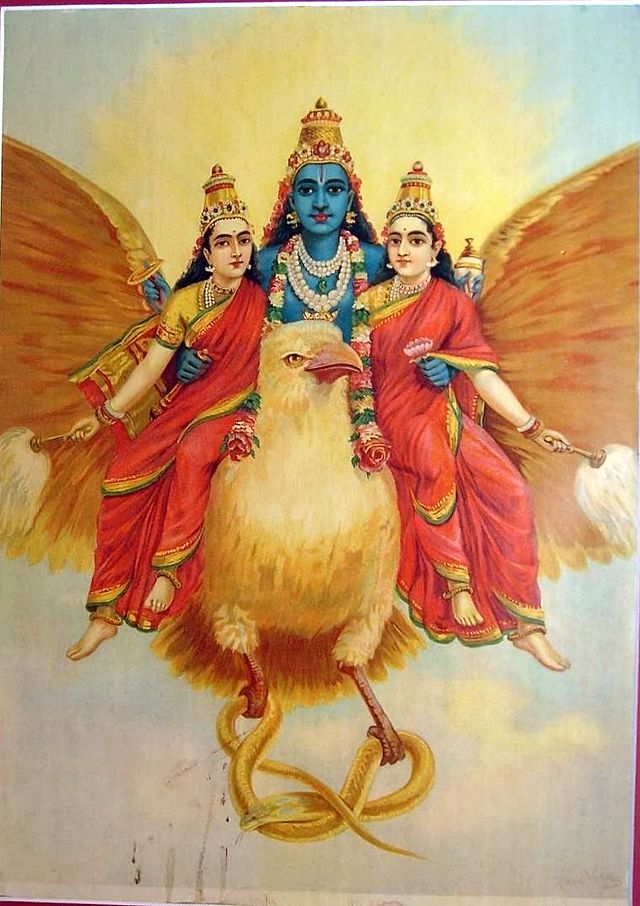
"Garuda Vahan Vishnu," from the Ravi Varma studio, c.1910's Source- ebay, Oct. 2009.jpg
Vishnu with Garuda
Sanaka, Sanandana, Sanatana, and Sanatkumara were the Kumaras, the four beings born from the mind of Brahma at the origin of the creation.

One day the Kumara decided to go to pay homage to Vishnu and presented themselves to the gate of Vaikuntha, the kingdom of God.
The Kumaras, thanks to their meditation and a gift given to them by Brahma, they always look like children, kumara in Sanskrit means in fact child.
When Jaya and Vijaya, who were guarding the gates of Vaikuntha, saw these four children, they blocked their passage, saying that Vishnu was resting and could not be bothered.
The Kumaras replied that Vishnu always had time for his own devotees and that no one could stop them. But Jaya and Vijay were adamant.
The Kumaras then decided to teach a lesson to those two guards and threw them a curse would be reborn on earth as mortal beings.
The two realized their mistake too late, then they went to Vishnu to be loose from the curse.
"You know that no one can be dissolved by a curse when it was launched - said Vishnu - so you have to be born as mortals. I give you, however, two alternatives: you can be born seven times as my devotees or you can be born as my enemies, but only three times."
Jaya and Vijaya much thought to the two alternatives. Finally, they decided to be born just three times as enemies of Vishnu, because they could not think of being separated from God for seven long earthly lives.
The first time Jaya and Vijaya were born as Hiraneyaksha and Hiraneyakashyipu in Satya Yuga. Hiranyaksha was a asura, a demon who was killed by Vishnu came to earth as Varaha, the boar lifted the earth from the cosmic ocean floor. While Hiranyakasipuvenne killed by Narasimha, also avatar of Vishnu.
Jaya and Vijaya were born then as Ravana and Kumbhakarna in Treta yuga and were killed by Vishnu in his avatar of Rama and Lakshmana.
Jaya and Vijaya finally finally born in Dwapara Yuga as Sisupala and Dantavakra and were killed by Balarama and Krishna, avatar of the god Vishnu.
Jaya and Vijaya then had three times as enemies of Vishnu and three times they were killed by avatars of the great God. 

At the end of their third life, they obtained the liberation and came back to the doors of Vaikhunta.

Jaya, Vijaya e i quattro Kumara

"Garuda Vahan Vishnu," from the Ravi Varma studio, c.1910's Source- ebay, Oct. 2009.jpg
Vishnu su Garuda
Sanaka, Sanandana, Sanatana e Sanatkumara erano i Kumara, i quattro esseri nati dalla mente di Brahma all’origine della creazione.
Un giorno i Kumara decisero di andare a rendere omaggio a Vishnu e si presentarono alle porta del Vaikuntha, il regno del Dio.
I Kumara, grazie alla loro meditazione ed ad un dono concesso loro da Brahma, avevano sempre l’aspetto di bambini, kumara in sanscrito significa infatti bambino.
Quando Jaya e Vijaya, che facevano la guardia alle porte del Vaikuntha, videro questi quattro bambini, bloccarono loro il passaggio, dicendo che Vishnu stava riposando e non poteva essere disturbato.
I Kumara replicarono che Vishnu aveva sempre tempo per i suoi devoti e che nessuno poteva fermarli. Ma Jaya e Vijay furono irremovibili.
I Kumara allora decisero di dare una lezione a quei due guardiani e lanciarono loro una maledizione: sarebbero rinati sulla terra come esseri mortali.
I due si resero conto del loro errore troppo tardi, si recarono quindi da Vishnu per essere sciolti dalla maledizione.
“Sapete che nessuno può essere sciolto da una maledizione quando questa è stata lanciata – rispose Vishnu – quindi dovrete nascere come mortali. Vi dó però due alternative:  potete nascere per sette volte come miei devoti oppure potete nascere come miei nemici, ma solo per tre volte.”
Jaya e Vijaya pensarono molto alle due alternative. Alla fine decisero di nascere tre volte come nemici di Vishnu, perché non potevano pensare di essere separati dal dio per sette lunghe vite terrene.
La prima volta Jaya e Vijaya nacquero come Hiraneyaksha e Hiraneyakashyipu nel Satya Yuga. Hiranyaksha era un demone, un asura che fu ucciso da  Vishnu dopo sceso in terra sotto forma di Varaha, il cinghiale che sollevò la terra dal fondo dell’oceano cosmico. Mentre Hiranyakasipuvenne ucciso da Narasimha, anch’esso avatar di Vishnu.
Jaya e Vijaya nacquero poi come Ravana e Kumbhakarna ne Treta-yuga e vennero uccisi da Vishnu nei suoi avatar di Rama e Lakshmana.
Jaya e Vija infine alla fine nacquero nel Dwapara Yuga come Shishupala e Dantavakra e vennero uccisi da Krishna e Balarama, avatar del dio Vishnu.
Jaya e Vijaya quindi nacquero tre volte come nemici di Vishnu e per tre volte vennero uccisi da avatar del grande dio. Al termine della loro terza vita, ottennero la liberazione e tornarono alle porte del  Vaikhunta.


sabato 2 novembre 2013

Hamsa mantra

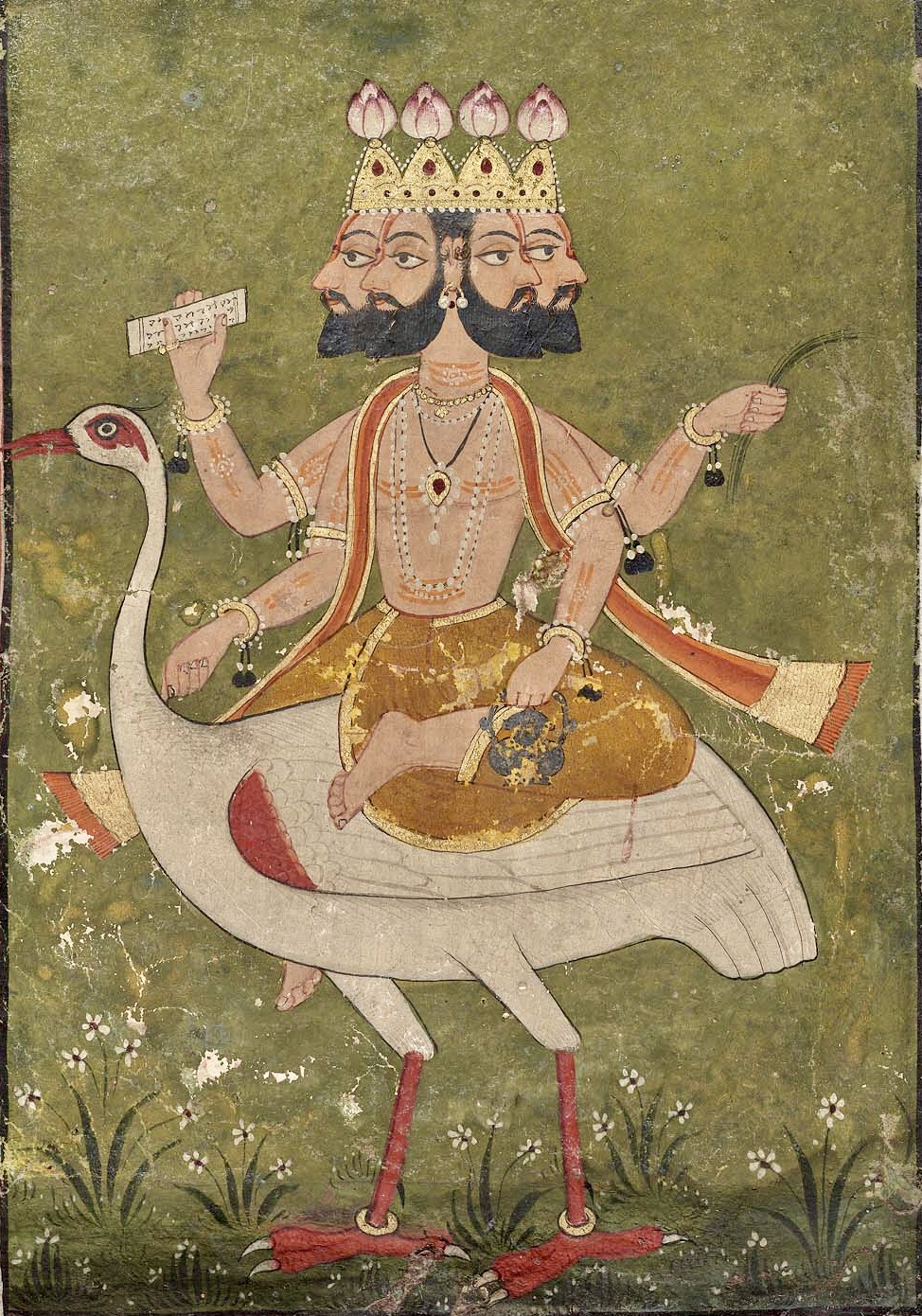
Brahma on his vahana, Hamsa
One of the most powerful and most famous mantra is the Hamsa Mantra, Mantra of the with swan.
The sacred texts, one for all the Shivasutravirmasini, require that the mantra should be repeated 21,600 times.
The syllable ham is pronounced with inspiration and the syllable sa with exhalation. And since the two phases of respiration occupy about four seconds, the repetition of the mantra for 21,600 times covers a period of 24 hours, one day (86,400 seconds that is, in fact, 24 hours).
The word hamsa refers to wild goose or withe swan, among other things it is the vahana of Brahma and his wife Saraswati. 
That animal is the symbol of transcendent knowledge as it can with its flight to break away from the lake as well as the man has to succeed, with the continued repetition of the mantra to break away from the illusory world of maya.
The mantra is very important for the Vedanta philosophy because hamsa refers to the words so ham (I am that) that refers to the identification of individual atman with the supreme Brahman.
The repetition (japa) of this mantra ensures the achievement of the purushatra, the four aims of life dharma, artha, kama and moksha.


Il Mantra Hamsa

Brahma sul suo vahana, l'Hamsa
Uno dei mantra più potenti e più famosi è l’Hamsa Mantra, il Mantra dell’oca o del cigno
I testi sacri, uno per tutti lo Shivasutravirmasini, prescrivono che il mantra vada ripetuto 21.600 volte. 
La sillaba ham va pronunciata con l’ispirazione e la sillaba sa con l’espirazione. E poiché le due fasi della respirazione occupano circa quattro secondi, la ripetizione del mantra per 21.600 volte copre l’arco delle 24 ore (86.400 secondi cioè, appunto, 24 ore).
La parola hamsa fa riferimento all’oca selvatica, tra l’altro vahana di Brahma e di sua moglie Saraswati, simbolo della conoscenza trascendente in quanto riesce col suo volo a staccarsi dal lago così come l’uomo deve riuscire, con la protratta ripetizione del mantra a staccarsi dal mondo illusorio di maya.
Il mantra è molto importante per la filosofia vedanta perchè hamsa fa riferimento a ham so che significa io sono e che si riferisce all’identificazione dell’atman individuale con il supremo brahman.
La ripetizione (japa) di questo mantra assicura il raggiungimento dei purushartha dei quattro scopi della vita dharma, artha, kama e moksha.


sabato 2 marzo 2013

Krishna multiplied himself

Krishna
One day the god Brahma wanted to test the divinity and power of Krishna, the eighth avatar of Vishnu.
The young god had gone with his friends to bring grazing calves.

Arrived on the banks of river Yamuna, boys started playing when they realized that the animals  had disappeared into the forest. Krishna assured his companions and went in search of animals.
The research, however, did not lead to anything, Krishna could not find the animals which had been kidnapped by Brahma.
Returned on the banks of the Yamuna, Krishna was even more amazed, because his friends were gone, they too had been the god Brahma.
Thanks to his own divinity and powers, Krishna realized what had happened, Brahma was putting him to the test.
The young god  knew that Brahma would surely have given back children and calves to their homes, but there was a 'but', that is, that one moment of Brahma corresponds to a year for men, and therefore, even if the joke the god would certainly have been short, for men would last too.
Worried about the anxiety and pain that would affect the inhabitants of Vrndavana, thanks to his own divine powers, Krishna multiplied himself and took the forms, features, appearances, personalities of all the disappeared boys and all the calves too.
Being now evening, Krishna brought his friends and calves in their homes and no one noticed that those kids and those calves were nothing but Krishna, as in nothing they were different from boys and calves who were kidnapped by Brahma.
So when after a moment (divine) Brahma brought back the boys and calves in Vrndavana, a year had passed (human), but no one had noticed anything.

Krishna si moltiplica

Krishna
Un giorno il dio Brahma volle mettere alla prova la divinità e la potenza di Krishna, ottavo avatara di Vishnu
Il giovane dio era andato con i suoi amici a portare al pascolo i vitelli. 

Arrivati sulle rive del fiume Yamuna i ragazzi si misero a giocare quando si accorsero che gli animali che avrebbero dovuto custodire erano scomparsi nella foresta. Krishna rassicurò i compagni e andò alla ricerca degli animali. 
Le ricerche non portarono però a nulla, Krishna non riuscì a trovare gli animali, che erano stati rapiti da Brahma
Tornato sulle rive dello Yamuna, Krishna rimase ancora più stupito, perché anche i suoi amici erano spariti, anch’essi erano stati rapiti dal dio Brahma
Grazie alla sua divinità e ai suoi poteri, Krishna capì cosa era accaduto, Brahma lo stava mettendo alla prova. 
Il giovane dio sapeva che Brahma avrebbe senz’altro riportato bambini e vitelli alle loro case, ma c’era un ‘ma’, e cioè che un solo attimo di Brahma corrisponde a una anno per gli uomini, e quindi, anche se lo scherzo del dio sarebbe stato certamente breve, per gli uomini sarebbe durato troppo. 
Preoccupato quindi per l’ansia e il dolore che avrebbero colpito gli abitanti di Vrindavana, grazie ai propri poteri divini, Krishna si moltiplicò ed assunse sembianze, caratteristiche, aspetto, personalità di tutti i ragazzi e di tutti i vitelli scomparsi. 
Essendo ormai sera, Krishna riportò i suoi amici e i vitelli nelle rispettive case e nessuno si accorse che quei ragazzi e quei vitelli non erano nient’altro che Krishna, in quanto in niente erano diversi dai ragazzi e dai vitelli che erano stati rapiti da Brahma
Così quando dopo un attimo (divino) Brahma riportò i ragazzi e i vitelli a Vrindavana, era passato un anno (umano), ma nessuno si era accorto di niente.

sabato 11 febbraio 2012

Shining lingam

We saw in the previous post, that the Vaishnava traditions narrate myths and legends to prove the supremacy of Vishnu over the other Gods of the Trimurti, and to explain why the god Brahma isn't worshiped in India. But of course there are myths and traditions of Shaivism that support exactly the opposite tesis: Shiva is the greatest among the Gods, who is the Absolute, the principle of all things. In short, the Skanda Purana, the Vayu Purana or Linga Purana tell us a different story. This one.
Lingamyoni
At the beginning of time, when nothing had been created, or, more precisely, in the period that elapsed between the destruction/absorption of the Universe and the creation of a new Universe, Vishnu was lying on the serpent Ananta sure to be the most powerful among all the Gods. Unexpected, however, appeared Brahma, who claimed to be the creator of the universe, who by whom all things are born. Between the two Gods arose a dispute, each supported with many issues to be the Absolute, and each told the facts, actions and heroic deeds that were supposed to prove their supremacy over the other.
But while this dispute was going on, in the vastness of space there was a deafening roar, a roar accompanied by a light beam, a column appeared suddenly glowing from the hell that came up to the infinite spaces spearing the oceans and the earth. It was a  infinite  and resplendent lingam, flamboyant and powerful, who left amazed and terrified the two Gods.
"But what is that?"  astonished Vishnu and Brahma asked. To understand they  decided that Vishnu would be plunged into the depths of the ocean and Brahma would fly in the infinite spaces to reach the two ends of that shining column which naked eye they could not measure, nor height nor depth.
Vishnu became a boar and plunged into the ocean, Brahma became a wild goose and flew in the celestial spaces. Their journey lasted over a thousand years, but for what they tried, they failed to reach the end of the column of fire that continued to grow.
Returning to the surface the two looked at each other, Vishnu admitted that he was not able to find the beginning of the lingam, Brahma instead, to win the challenge with Vishnu, lied saying he reached the summit at the fiery lingam.
At that moment, in the pillar of fire a fissure opened from which Shiva emerged, the Lord of lingam self-manifested and proclaimed his own supremacy as the Absolute, as creator, preserver and destroyer of the Universe, everything that exists including the two Gods. Vishnu and Brahma prostrated in front of the great God, and worshiped him recognizing his supremacy.
But it did not end there. According to the Skanda Purana, Shiva also launched a curse against Brahma becsause he had lied by claiming to have reached the top of the lingam of fire. No longer would worship existed in his honor. And so it was.

Il lingam di fuoco

Abbiamo visto nel precedente post, che le tradizioni vaishnava narrano miti e leggende per comprovare la supremazia di Vishnu sugli altri dèi della trimurti e per spiegare il motivo per cui il dio Brahma non è oggetto di culto in India. Ma esistono ovviamente miti e tradizioni shivaite che sostengono esattamente il contrario e cioè che Shiva è il più grande tra gli dèi, che è l’Assoluto, il principio di tutte le cose. Insomma lo Skanda Purana, Il Lingam Purana o il Vayu Purana narrano una storia diversa. Questa. 

Rama, Sita, Saraswati e altri dei
venerano lo Shivalingam
All’origine dei tempi, quando niente era stato creato o, più precisamente, nel periodo che intercorreva tra la distruzione/assorbimento dell’Universo e la creazione di un nuovo universo, Vishnu stava sdraiato sul serpente ananta convinto di essere il più potente dio. Imprevisto apparve però Brahma, che dichiarò di essere il creatore dell’universo, colui dal quale tutte le cose sono nate. Tra i due dèi nacque una disputa, ciascuno sosteneva con molteplici argomenti di essere l’Assoluto e ciascuno narrava fatti, azioni e imprese che avrebbero dovuto comprovare la propria supremazia sull’altro. 
Ma mentre questa disputa stava andando avanti, nell’immensità degli spazi si sentì un rombo assordante, un fragore accompagnato da un fascio di luce, comparve improvvisamente una colonna rifulgente che dagli inferi arrivò fino agli spazi infiniti trafiggendo gli oceani e la terra. Era un lingam infinito e splendente, fiammeggiante e possente che lasciò stupefatti e terrificati i due dèi. 
“Ma cos’è?” si domandarono attoniti Vishnu e Brahma. Per capirlo decisero che Vishnu si sarebbe immerso nelle profondità dell’oceano e Brahma sarebbe volato negli spazi infiniti per raggiungere le due estremità di questa colonna splendente di cui ad occhio nudo non riuscivano a misurarne né l’altezza né la profondità. 
Vishnu si trasformò in cinghiale e si gettò nell’oceano, Brahma si trasformò in oca selvatica e volò negli spazi celesti. Il loro viaggio durò più di mille anni, ma per quanto si sforzassero, non riuscirono a raggiungere le estremità della colonna di fuoco che continuava a crescere. 
Ritornati in superficie i due si guardarono, Vishnu ammise di non essere riuscito a trovare l’inizio del lingam, Brahma invece, che voleva vincere la sfida con Vishnu, mentì dicendo di essere arrivato in vetta al lingam fiammeggiante. 
In quel momento però nella colonna di fuoco si aprì una fenditura dalla quale uscì Shiva, il signore del lingam si auto manifestò e proclamò la propria supremazia come Assoluto, come creatore, preservatore e distruttore dell’universo, di tutto ciò che esiste inclusi i due dèi che, prostrati al cospetto del grande dio, lo adorarono riconoscendone la supremazia assoluta. 
Ma non finì qui. Shiva infatti lanciò anche una malediazione contro Brahma che aveva mentito sostenendo di aver raggiunto la vetta del lingam di fuoco. Nessun culto sarebbe più esistito in suo onore. E così fu.

domenica 5 febbraio 2012

Bhrigu, Shiva, Brahma and Vishnu

Maharishi Bhrigu
Why Shiva is worshiped in the form of lingam? Why Brahma hasn’t special worship and are very few the temples dedicated to him although he’s considered 'creator god'?
The variety of religious experiences existed for millennia in the Indian peninsula have often resulted in conflicts and disagreements that have also echoed in the myths, such as already I told in the sacrifice of Daksha and the death of Sati. Obviously each religious tradition narrates myths and legends in which its own God has prevailed over the others and this makes the mythological tradition, literary and cultural life of the Indian subcontinent very rich. Today I want to mention one of the many Vaishnava traditions narrated by many texts - including the Padma Purana - which recalls the curse of the sage Bhrgu hurled against Shiva and Brahma.
Well, during a great sacrifice held on Mount Mandara, the wise Brahmins wondered who was the greatest among the Gods Shiva, Brahma or Vishnu. The sage Manu - son of Prajapati - said: "He who is made of pure sattva, who has only the cohesive tendency (guna) and preserver without even a fraction of tamas, the tendency of dissolution, or raja, the centripetal tendency, he is the Absolute, the greatest of the Gods. "
To test who among the three gods were characterized by benevolent guna sattva, one of the Maharishi, the great sages, was chosen, he was Bhrgu, son of the God Varuna (or Prajapati). 
Bhrgu first went to Shiva. But the wise man could not even see the God, as he was stopped by Nandin - the bull vahana of Shiva - which did not allow him entry. "Shiva is enjoying the love of his consort Parvati, you cannot enter." The Brahmin - who like all the Brahmins was very touchy - got angry and cursed Shiva. "You, who are totally taken by tamas, obscured by passion, you don’t honor worthily a wise Brahmin will be transformed into a lingam and your wife in a yoni and you will be worshiped in that form, but not by the Brahmins."
Bhrgu then went to Brahma and could come before him, but the God, seated on a lotus, was immersed in rajas and he didn’t get up nor saluted the Brahmin.
"Because you're surrounded by rajas and have not honored me - cried Bhrgu to Brahma - you may not be worshiped by any devoted!”
The wise brahmin arrived finally in front of Vishnu, the God was sleeping lying on Ananta, the serpent residue (seshanaga) while his wife Lakshmi massaging the feet. Bhrgu came to God and placed his foot on his chest. Vishnu got up and said, "Thank you wise man, the touch of your foot is a blessing for me, the dust that falls from the feet of every Brahmins leads to salvation." So said Vishnu and donated to Bhrgu food and wealth and reserved a special attention.
Bhrgu then prostrated himself at the feet of Vishnu and worshiped him, "Thou, God of a thousand names, you Vasudeva, you Hari, you Narayana, thou Blessed One, thou Janardana, thou preserver of the Universe, you pervade everything, you are formed only by sattva, you’re the supreme deity and you alone will be worshiped by the brahmanas and by the twice-born. "

Bhrgu, Shiva, Brahma e Vishnu

Vishnu su Ananta,
il 'serpente residuo' 
Perché Shiva è venerato sotto la forma di lingam? Perchè Brahma non è oggetto di particolari culti e a lui sono dedicati pochissimi templi pur essendo considerato ‘il dio creatore’? 

Le molteplici esperienze religiose che nei millenni sono convissute nella penisola indiana hanno spesso dato luogo a conflitti e dissidi che hanno un’eco anche nei miti, come quello già narrato del sacrificio di Daksha e dell’autoimmolazione di Sati. Ovviamente ogni tradizione religiosa narra miti e leggende nelle quali il proprio dio ha la meglio sugli altri e anche questo rende particolarmente ricca la tradizione mitologica, letteraria e culturale del subcontinente indiano. Oggi voglio ricordare una delle tante tradizioni vaishnava, di fede cioè visnuita, narrata da molti testi – tra i quali il Padma purana – in cui si ricorda la maledizione che il saggio Bhrgu lanciò contro Shiva e contro Brahma. 
Ebbene, durante un grande sacrificio organizzato sul Monte Mandara, i saggi brahmani si domandavano quale fosse il più grande degli dèi tra Shiva, Brahma o Vishnu. Il saggio Manu – figlio di Prajapati – dichiarò: “Colui che è fatto di puro sattva, colui che possiede solo la tendenza (guna) coesiva e preservatrice senza avere nemmeno una minima parte di tamas, la tendenza della dissoluzione, o di rajas, la tendenza centripeta, costui è l’Assoluto, la più grande delle divinità.” 
Per verificare chi dei tre dèi fosse caratterizzato dalla benevola tendenza sattva, venne mandato uno dei Maharishi, i grandi saggi, si trattava di Bhrgu, figlio del dio Varuna (o, secondo altre tradizioni, di Prajapati). 
Bhrgu andò innanzitutto da Shiva. Ma il saggio non potè neppure vedere il dio, in quanto venne fermato da Nandin – il toro vahana di Shiva – che non gli consentì l’ingresso. “Shiva sta godendo dell’amore della sua consorte Parvati, non puoi entrare.” Il brahmano – che come tutti i brahmani era molto suscettibile – si arrabbiò e maledì Shiva. “Tu, che sei totalmente preso da tamas, obnubilato dalla passione, tu che non onori degnamente un saggio brahmano sarai trasformato in un lingam e la tua consorte in una yoni e così, in tale forma verrete adorati, ma non certo dai brahmani.” 
Bhrgu si recò poi da Brahma, potè arrivare al suo cospetto, ma il dio, seduto su un loto, era immerso in rajas, la tendenza centripeta, non si alzò né salutò il brahmano. 
“Poiché tu sei immerso rajas e non mi hai onorato – gridò Bhrgu a Brahma – non sarai venerato da alcun fedele!” 
Il saggio brahmana arrivò infine al cospetto di Vishnu che se ne dormiva sdraiato su Ananta, il serpente residuo (seshanaga) mentre la sua sposa Lakshmi gli massaggiava i piedi. Bhrgu si avvicinò al dio e gli pose un piede sul petto. Vishnu si svegliò e disse, “Ti ringrazio o saggio, il tocco del tuo piede per me è una benedizione, la polvere che cade dai piedi di ogni brahmano porta alla salvezza.” Così detto Vishnu donò a Bhrgu cibo e ricchezze e gli riservò un’attenzione speciale. 
Bhrgu allora si prostrò ai piedi di Vishnu e lo venerò, “Tu, dio dai mille nomi, tu Vasudeva, tu Hari, tu Narayana, tu Bhagavan, tu Janardana, tu preservatore dell’Universo, tu che tutto pervadi, tu, formato di solo sattva, sei la divinità suprema e tu solo sarai venerato dai brahmana e dai nati due volte.”

domenica 28 agosto 2011

Kama, il dio dell'amore


Kama insidia Shiva

Il demone Taraka era diventato troppo potente e minacciava gli dei ed il loro potere, doveva essere eliminato, ma grazie ad una concessione di Brahma, Taraka poteva essere ucciso soltanto dal un figlio di Shiva.
Il grande dio però, dopo la morte della moglie Sati, era in perenne meditazione, doveva essere svegliato dal suo stato affinché si innamorasse di Parvati e con lei avesse quel figlio che avrebbe salvato gli dei.
Kama, il dio dell’amore, viene allora inviato a distogliere Shiva dalla meditazione. Appena Kama giunge sul suo pappagallo i fiori sbocciano, il clima si fa mite, l’aria è intrisa di profumo. Kama è infatti sempre accompagnato da Vasant e dalla sua sposa Rati (Desiderio o Lussuria), il Signore della primavera. Shiva resta in meditazione, Kama prende il suo arco fatto di canna di zucchero e con la corda, fatta di api, scocca una delle sue cinque frecce ciascuna delle quali al posto della punta ha un fiore.
Shiva si risveglia dalla sua meditazione ed apre il suo terzo occhio che incenerisce in un sol colpo Kama.
Rati, la sposa di Kama, disperata si cosparge il corpo con le ceneri del marito ed implora Shiva di farlo tornare in vita.
Il grande dio, commosso, promette a Rati che Kama rinascerà come Pradyumna, figlio di Krishna e Rukmini.
Kama è il dio dell’amore. Molti saggi sono stati distratti nelle loro meditazioni ed austerità da questo dio, spesso inviato da Indra proprio a distogliere gli umani che si avvicinavano troppo alla divinità.
Nasce da se stesso o è figlio di Dharma e di Shradda, in altre tradizioni è figlio della dea Lakshmi. Sul suo vessillo rosso è dipinto il pesce Kamara ed il sua vahana è un pappagallo.
E’ chiamato anche Smara (Ricordo), Dipaka (L’infiammatore), Manmatha (Colui che turba lo spirito), Ishma (il possessore di frecce),  Mada (Ebbrezza), Shamantaka (Distruttore della pace).
Kama (काम), in sanscrito, significa amore, amare si dice kamayati (कामयति) e "io ti amo" si dice "tvam kamayami" (त्वां कामयामि).
Prima di essere il dio mitologico dell’amore, Kama è un importante concetto metafisico che compare già nei Veda. E’ il desiderio, il motivo per cui l’Uno indistinto si fece molteplice (cfr. post).
Il bellissimo inno del Rig Veda (X, 129) che narra dell’inizio dei tempi  ci ricorda come Kama, cioè il desiderio, fu il germe originale della creazione e in tal senso è Aja, cioè Non nato, e Ananyaja cioè Nato da nessun altro o anche Atmabhu, l’esistente di per se stesso. L’Atharva Veda invece lo chiama ‘motore della creazione’ e ‘primo nato’.
Kama è anche uno dei quattro purusartha, gli scopi che ogni uomo deve perseguire durante la sua vita terrena che sono dharma, cioè la rettitudine morale, artha, cioè il benessere materiale, kama appunto, cioè la soddisfazione dei desideri ed infine moksha, cioè la liberazione dal samsara, il ciclo delle rinascite.

Kama, the God of love

Kama on his parrot
The demon Taraka had become too powerful and threatening the gods and their power. He had to be eliminated, but thanks to a grant of Brahma Taraka could be killed only by a son of Shiva.
The great god, however, after the death of his wife Sati, was in perpetual meditation, had to be woken from his state to fall in love with Parvati and to generate with her a son who would save the gods.
Kama, the god of love, is then sent to distract Shiva from meditation. Kama just come on his parrot flowers bloom, the weather is mild, the air is full of perfume. Kama is in fact always accompanied by his wife Rati (Lust or Desire) and Vasant, the Lord of the spring. Shiva is in meditation, Kama takes his bow made of sugar cane and by the rope, made of bees, he strikes one of his five arrows each of them instead of the tip has a flower.Shiva from his meditation awakens and opens his third eye that incinerates Kama in one fell swoop.Rati, Kama's wife, desperate sprinkle the body with the ashes of her husband, and implored Shiva to bring him back to life.
The great god, moved, promises that Kama reborn as Pradyumna, son of Krishna and Rukmini.
Kama is the god of love. Many shadu have been distracted in their meditations and austerities by this god, often sent by Indra to distract the humans who just got too close to the deity.
He was born from himself or he is the son of Dharma and Shradda, in other traditions he is the son of the goddess Lakshmi. On his red banner is painted the fish Kamara and his Vahana is a parrot.
He i salso called Smara (Memory), Dipak (Inflammation), Manmatha (the one who disturbs the spirit), Ishma (the owner of arrows), Mada (Drunkenness), Shamantaka (Destroyer of peace).
Before being the mythological god of love, Kama is an important metaphysical concept that already appears in the Vedas. He is the desire, why the One became indistinct multiple (see post).
The beautiful hymn of the Rig Veda (X, 129) which tells the beginning of time reminds us as Kama, the desire was the seed of the original creation and in this sense he is Aja, that is not born, Ananyaja, Born from nobody, Atmabhu, the existing by itself. The Atharva Veda instead calls him 'Engine of creation' and 'First Born'.

Kama  (काम) in sanskrit means love, to love is kamayati (कामयति) and "I love you" is "tvam kamayami" (त्वां कामयामि).
Kama is also one of the four purusarthas, the goals that every man should pursue during his earthly life: dharma, or moral rectitude, artha, or material wealth, kama, that the satisfaction of desires and finally moksha, or liberation from samsara, the cycle of rebirth.

domenica 3 luglio 2011

A treasure was born from Vishnu's navel

Lying Vishnu, lotus and Brahma
Bags full of jewels and precious stones, gold coins of the Napoleonic period, rings, necklaces, bracelets with diamonds, rubies and emeralds, gold necklaces meters long, crown, inlaid with precious stones sticks, plates and cups of gold.
For a first estimate of the treasure found in India is worth about 500 billion rupees ($ 11.2 billion) and it should be the greatest treasure ever found in the country and one of the richest ever found in the world.
We are in Thiruvananthapuram (Trivandrum), capital of Kerala, wonderful state in  south India and under the floor of the temple dedicated to Sree Padmanabhaswamy has been found what is presumably a maharaja's treasure, hidden there before independence from the British crown .
But there’s more, the exploration of the underground excavations of the temple is still in its beginning and it is possible that further discoveries are made. There are two of the six vaults were opened in the subsoil for the moment.
Only after a legal battle and court ruling of the local authorities had been able to start the research as the descendants of the Maharaja of Trevancore still ran the temple through a foundation, and they strenuously opposed the initiative and announced that they have appealed against the sentence .
The temple, also known as Ananda Sree Padmanabhaswamy Temple (from here the name of city) is dedicated to the god Vishnu on the serpent Ananda in its infinite quiet, Anananthasayanam position, after the end of time he has absorbed all that exists.From dreaming Vishnu's navel borns a lotus on which Brahma is located who, according to one of the many Hindu cosmogonies, realizes the world that Vishnu dreams.
From here the name of the temple, in fact in Sanskrit padma means lotus and nabha navel.


The news:


Dall'ombelico di Vishnu nasce un tesoro

Sacchetti pieni di gioielli e pietre preziose, monete d'oro del periodo napoleonico, anelli, collane, bracciali con diamanti, rubini e smeraldi, collane d'oro lunghe metri, corone, bastoni incastonati da pietre preziose, piatti e coppe d’oro. 
Ad una prima stima il tesoro trovato in India vale circa 500 miliardi di rupie (11,2 miliardi dollari) e dovrebbe essere il più grande tesoro mai trovato nel paese e uno dei più ricchi mai trovato al mondo.
Siamo a Thiruvananthapuram (Trivandrum), capitale del Kerala, meraviglioso stato del sud dell’India e sotto il pavimento del tempio dedicato a Sree Padmanabhaswamy è stato trovato quello che presumibilmente è il tesoro di un maharaja, lì nascosto prima dell’indipendenza dalla corono britannica.
Dall'ombelico di Vishnu nasce un loto su cui è posto Brahma
Ma non è finita, gli scavi e l’esplorazione del sottosuolo del tempio sono ancora agli inizi e non è escluso che vengano effettuati ulteriori ritrovamenti. Al momento sono state aperte due delle sei cripte presenti nel sottosuolo.
Solo dopo una battaglia legale e una sentenza dl tribunale le autorità locali avevano potuto iniziare le ricerche in quanto i discendenti del maharaja di Trevancore gestivano ancora il tempio attraverso una fondazione e si sono opposti strenuamente all’iniziativa ed hanno annunciato che presenteranno appello contro la sentenza.
Il tempio, conosciuto anche come Sree Ananda Padmanabhaswamy Temple, è dedicato al dio Vishnu nella sua forma riposante sul serpente infinito Ananda o Anantha (che in sanscrito significa senza fine) e dal quale deriva anche il nome della città), nella posizione Anananthasayanam. Dall’ombelico di Vishnu sognante nasce un loto su cui è posto Brahma che, secondo una delle molte cosmogonie hindu, realizza il mondo che Vishnu sogna.
Da qui il nome del tempio, infatti in sanscrito padma significa loto e nabha ombelico.


La notizia:


sabato 7 maggio 2011

Hanuman, the Monkey God

Hanuman - Templum in Cochin - Kerala
The stories of Hanuman, god-monkey strong, brave, loyal devotee of Ram, seventh avatar of Vishnu, are a lot. The Ramayana - great Indian epic poem that tells of the struggle between Rama and Ravana, demon who abducted Sita, the wife of God – reserve him an entire chapter, Sundara Chanda.
As usual the Indian traditions, several versions of the same story. But that is something like this.
The beautiful Apsara (celestial nymph) Punjikasthala because of a curse of  Brihaspati, a sage man to whom she had disobeyed, was embodied in a monkey, Anjana, the daughter of vanara (monkey) Kunjara.
Anjana married Veerakesari, heroic monkey, but they not managed to have a child.
After many prayers, Shiva and Parvati heard the couple and promised them that, with the help of Vayu the God of wind, they would have a strong and faithful son.
According to one tradition, one day picked up the clothes of Anjana, Vayu was fascinated by the beauty of the girl's body. She rebelled him, but Vayu said he would not have touched her and that - like wind – he had already entered into her and the child was conceived so desired. In another tradition, Shiva had indicated to the couple a mango tree whose fruit, once it had been offered them by Vayu, it would conceive a child in the womb of Anjana.
The two went at the mango tree, and after much prayer, the wind had bent a tree branch so as to enable Anjana to catch and eat the fruit that enabled her to conceive Hanuman.In Ramayana of Valmiky it is tell that the King of Ayodhya, Dasaratha, was performing severe austerities and relentless rites for the blessing of a child. Shiva, pleased with his devotion, gave to the king three parties of sacrifical food for his three wives, Kausalya, Sumitra and Kaikeyi.
But the food of Kaikeyi fell and Vayu, God of wind, flew up to Anjana intent in prayer, she ate the food and conceived Hanuman.
Once the baby was born he was immediately lively and voracious, one day, seeing the sun and thinking it was a fruit he tried to catch it to eat. Indra was very angry for that gesture and struck the child with a thunderbolt fell down. In the fall the God monkey broke his jaw, hence the name Hanuman as hanu in Sanskrit means just jaw. Hanuman is strong, fast and flies like the wind (his father), but due to a curse of Brahma, who chastised him as he disturbed the meditation of some saints,  he is not aware of his own powers until someone else reminds him as did Ram in the Ramayana.
This also teaches us the unlimited power that lies unused within each one of us, just to be aware of them.
Hanuman - considered by some an incarnation of Shiva - is called also Anjaneya, i.e. Anjana’s son and he is celebrated during the Hanuman Jayanti is celebrated on full moon day of the month of Chaitra (March-April) and prayer on him is the Hanuman Chalisa.

Hanuman, il Dio scimmia

Hanuman in un tempio di Cochin - Kerala
Le storie di Hanuman, dio scimmia fortissimo, coraggioso, fedele devoto di Rama, settimo avatar di Vishnu, sono moltissime. Il Ramayana – immenso poema epico indiano che narra della lotta tra Rama e Ravana, demone che aveva rapito Sita, la moglie del Dio – gli dedica un intero capitolo, il Sundara Chanda.
Come sempre le tradizioni indiane ci presentano mille e più versioni di uno stesso fatto. Ma le cose stanno pressappoco così.
La bellissima apsara (ninfa celeste) Punjikasthala per una maledizione del saggio Brihaspati, al quale aveva disobbedito, si era incarnata in una scimmia, Anjana, la figlia del vanara (scimmia) Kunjara. Anjana si sposò con Veerakesari, un’eroica scimmia, ma i due non riuscivano ad avere un figlio.
Dopo tante preghiere, Shiva e Parvati ascoltarono i due sposi e promisero loro che, con l’aiuto di Vayu, Dio del vento, avrebbero avuto un figlio forte e fedele.
Secondo una prima tradizione, un giorno Vayu sollevò le vesti di Anjana e rimase affascinato dalla bellezza del corpo della ragazza. Lei si ribellò, ma Vayu le disse che non l’avrebbe toccata e che – come vento – era già entrato in lei ed era stato concepito il figlio tanto desiderato.
In un'altra tradizione invece Shiva aveva indicato ai due sposi un albero di mango il cui frutto, una volta che fosse stato offerto da Vayu, avrebbe concepito nel ventre di Anjana un figlio. I due sposi si recarono presso l’albero di mango e, dopo molte preghiere, il vento piegò un ramo dell’albero in modo da consentire ad Anjana di cogliere e mangiare il frutto che le consentì di concepire Hanuman.
Un’altra storia ancora lega la nascita di Hanuman a quella di Rama. Nel Ramayana di Valmiky si narra infatti che il re di Ayodhya, Dasharatha, stava svolgendo severe austerità e incessanti riti per ottenere la benedizione di un figlio. Shiva, compiaciuto di quella devozione, fornì al re tre porzioni di cibo sacrificale affinchè le facesse mangiare alle sue tre mogli: Kausalya, Sumitra e Kaikeyi. Ma a Kaikeyi cadde la propria parte di cibo che Vayu, Dio del vento, fece volare fino ad Anjana intenta in preghiera. La giovane mangiò il cibo portato dal vento così concependo Hanuman.
Una volta nato, il bambino si dimostrò subito vivace e vorace, un giorno, vedendo il sole e credendolo un frutto cercò di coglierlo per mangiarlo. Indra si arrabbiò molto per quel gesto e colpì il piccolo con un fulmine gettandolo a terra. Nella caduta il dio scimmia si ruppe la mandibola, da qui il nome Hanuman in quanto hanu in sanscrito significa appunto mascella.
Hanuman è chiamato anche Anjaneya, cioè figlio di Anjana.
Hanuman è forte, veloce e vola come il vento (suo padre), ma a causa di una maledizione di Brahma, che lo punì in quanto disturbava la meditazione di alcuni santi, non è consapevole dei propri poteri fino a che qualcun altro non glieli ricorda come fece Rama nel Ramayana.
Questo ci insegna anche del potere immenso che giace spesso inutilizzato dentro ognuno di noi, basta esserne consapevoli.
Hanuman – considerato da certuni un avatara di Shiva - è una divinità molto popolare in tutta l'India ed è festeggiato durante l’Hanuman Jayanti che si celebra il giorno della luna piena del mese di Chaitra (marzo-aprile) e la preghiera a lui rivolta è l’Hanuman Chalisa.