Visualizzazione post con etichetta Sati. Mostra tutti i post

domenica 26 gennaio 2014

Sati doubts Shiva

Sati asked for an explanation to her father, Daksha
Do you remember when Daksha organized his great sacrifice and not invited Shiva and his wife Sati, who was also the daughter of Daksha? Autoimmolò Sati and Shiva destroyed the sacrifice and beheaded Daksha (click here to learn more).
But how was it possible that the wife of the greatest and most powerful of the gods died, she was the embodiment of the supreme goddess? How is it possible that Shiva was deprived of his beloved wife?
The Shiva Purana gives an explanation.
When Brahma was able to convince Shiva to take a wife, the great god put three conditions.
His wife had to be a woman able to sustain his seed of gold, she had to be a woman devoted to meditation when Shiva was meditating, but also passionate lover in the erotic relationship with her husband, and finally she had to be a woman who would never doubted him. "If she will doubt for a moment of me I'll abandon her," said Shiva to Brahma.
There were the suitable woman, she was Sati, the supreme goddess incarnated in one of the daughters of Daksha and all went well for thousands of years. Sati showed great amateur, but also able to spend thousands of years in meditation together with her ​​husband.
But one day, the certainty of Shiva on his wife nicked.
Shiva and Sati in fact met Rama, the seventh avatar of Vishnu, and the two greeted each other by bowing.
Sati asked Shiva why he, the supreme god, he had bowed to a mortal and Shiva explained to her that Rama was not a mortal but the god Vishnu.
Sati was puzzled and Shiva told her, " If you do not believe me, test him."
And so did Sati, she became Sita, Rama's wife who had been kidnapped by Ravana,  to see if Rama would recognize the deception. Rama, being a god, discovered the deception and Sati immediately convinced . But she had doubted Shiva.
Then came the crime of the sacrifice of Daksha which Shiva and Sati had not been invited .
Sati asked the reason for such treatment and Shiva replied, " Daksha consider me as an enemy, so we were not invited."
But Sati replied, "He can not do the sacrifice without us, he didn't invite us because I am his daughter, and he thought that there was no need to call anyone, I'm going to see."
For the second time Sati doubted her husband.
As they went to finish things we know. Sati - humiliated by the behavior of the father - is burned on the pyre. The marriage with Shiva had this end.


Sati dubita di Shiva

Sati chiede spiegazioni a suo padre Daksha durante il grande sacrificio
Vi ricordate quando Daksha organizzò il suo grande sacrificio e non invitò nè Shiva nè sua moglie Sati che era anche figlia di Daksha? Sati si autoimmolò e Shiva distrusse il sacrificio e decapitò Daksha (clicca qui per saperne di più).
Ma come fu mai possibile che la moglie del più grande e potente degli dei, essa stessa incarnazione della dea suprema morisse? Come è mai possibile che Shiva fosse privato della sua amata consorte?
Lo Shiva Purana fornisce una spiegazione.
Quando Brahma riuscì a convincere Shiva a prendere moglie, il grande dio pose tre condizioni.
La sua sposa doveva essere una donna in grado di sostenere il suo seme d'oro, doveva essere una donna dedita alla meditazione quando Shiva meditava, ma anche appassionata amante nel rapporto erotico col marito ed infine doveva essere una donna che non avrebbe mai dubitato di lui. "Se lei dubiterà anche per un momento di me, io l'abbandonerò," disse Shiva a Brahma.
La donna adatta c'era, era Sati, la suprema dea incarnatasi in una delle figlie di Daksha e tutto andò bene per migliaia di anni. Sati si dimostrò grande amatrice, ma anche capace di passare migliaia di anni in meditazione insieme al suo sposo. 
Ma un giorno, la certezza di Shiva su sua moglie si scalfì.
Shiva e Sati infatti incontrarono Rama, settimo avatar di Vishnu, e i due si salutarono inchinandosi reciprocamente.
Sati chiese a Shiva il motivo per cui lui, dio supremo, si era inchinato a un mortale e Shiva le spiegò che Rama non era un mortale bensì il dio Vishnu.
Sati rimase perplessa e Shiva le disse, "Se non mi credi, mettilo alla prova."
E così Sati fece, si trasformò in Sita, moglie di Rama che era stata rapita da Ravana, per vedere se Rama l'avrebbe riconosciuta. Rama, essendo un dio, scoprì immediatamente l'inganno e Sati si convinse. Ma aveva dubitato di Shiva.
Successivamente avvenne il fattaccio del sacrificio di Daksha al quale Shiva e Sati non erano stati invitati.
Sati si domandò il motivo di tale trattamento e Shiva le rispose, "Daksha mi considera come un nemico, per questo non ci ha invitato."
Ma Sati replicò, "Non è possibile, non ci ha invitato perchè io sono sua figlia e pensava che non ci fosse bisogno di invito alcuno, andrò a vedere."
Per la seconda volta Sati dubitò del marito.
Come andarono a finire le cose lo sappiamo. Sati - umiliata dal comportamento del padre - si autoimmolò sulla pira. Il matrimonio con Shiva ebbe così fine.


sabato 10 settembre 2011

Sati, the self-immolated widows

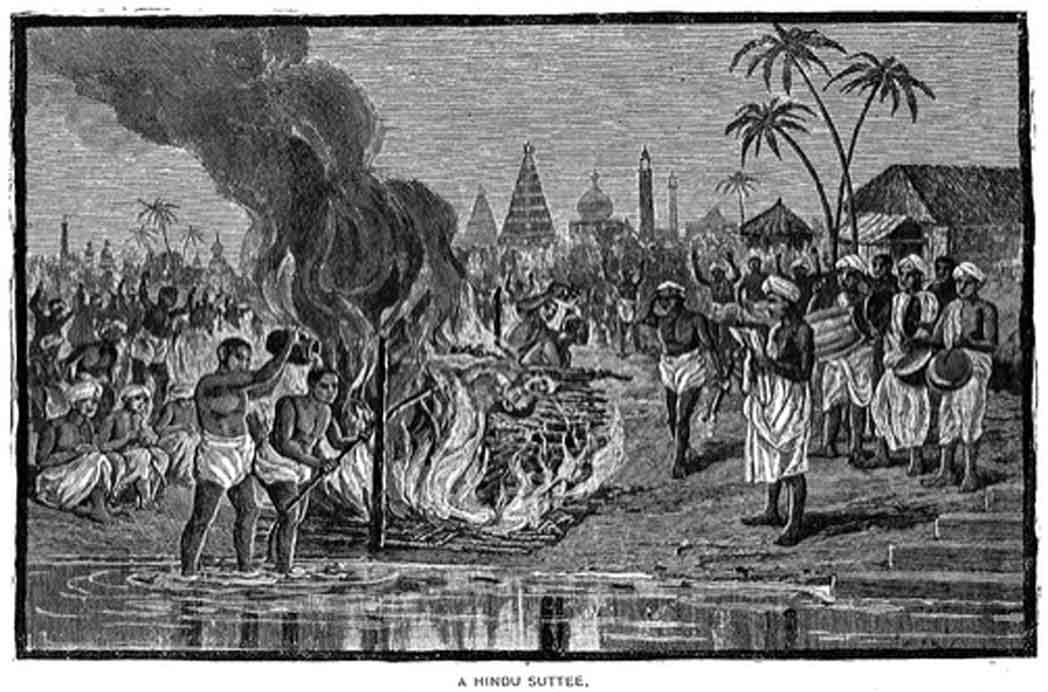
Suttee
What did Roop Kanwar, 18 years, think when she took the dead husband's head in her arms and laid on his funeral pyre? What did she feel when, after three ritual laps around the corpse, her brother in law set fire to the pyre on which she, alive, and her husband, dead, were lying? How did she suffer when the smoke of the pyre surrounded her and the flames have seized up to burn her alive?
It is anugamana (which in Sanskrit means ‘to follow’) or sahamarana (in Sanskrit saha = together, marana = death), universally known as 'sati' o suttee (in Sanskrit 'fidelity') and it’s the name of the first wife of Shiva self-immolated by burning because she was offended for insulting his father Daksha did to the divine spouse.

It’s a practice banned in India since 1839 and now quite rare, but we have news of this ritual from more or less remote villages of the subcontinent (especially in Rajasthan and Bengal) even today. And who knows how many we have no news.
Unbelievably in India – where there are many movements against sati and in favor of women - among the general population and among intellectuals and religious men there is still hesitation in condemning without appeal this ritual (see here and here).

The last case of 'sati' was recognized officially on 2008, when a woman 75 years old has been thrown on the pyre of her dead husband (80 years) in the state of Chattisgarh. Previously ‘sati’ were on 1973, 1978, 1987, 1988, 2002 and, two cases, on 2006.
The practice is/was generally voluntary, but in many cases there was a physical or psychological coercion against the woman to force or 'persuade' her to self-immolation (see here).

The case of Roop Kanvar, for example, created a sensation because according to many it was unthinkable that on 1987 a girl of 18 years with a high level of education voluntarily followed her dead husband in the flames facing a painful death.
In the past, statements were not only cases where the wife was even tied to the funeral pyre, but also cases where she had been drugged with bhang or opium to wear out the strength and will.
The rite of sati is not found in the Vedas - the main sacred texts of Hinduism – where it provides for the widow marriage with her husband's brother or other close relatives. We find, however, a nod, you do not know what period dating, which is reminiscent of that custom in Atharva Veda where we read that "every good woman is burned with the corpse of her husband."
The sati in Ramayana and Mahabharata appear to be added later too.
The scholars mostly believe that the origin of the shameful practice - founded in the seventh century BC and widespread, especially but not only, between the upper caste of Brahmins - is a direct consequence of the division of castes, endogamy and obligations. The sati is in fact closely related to other phenomena as child marriage with older men as prohibition on remarriage and other social restrictions for widows.
The husband for the Indian woman is like a God, the wife must serve and worship him, she must follow him in life and precede him in the death. Consequently, a wife without a husband, without her God, has no reason to exist and she could become a problem for the rigid caste concept. A widow in fact could hardly find another husband in India among people of the same caste and therefore she could be brought to marry men of different caste, violating the primary rule that prohibits caste mobility between castes.
In fact the condition of the widow in indian traditional villages and sometimes even today, is particularly difficult, at best the woman remained to serve in her husband's family, she had to sleep on the floor and could eat only foods that are not seasoned.
Often widows are still sent to convents or shelters where, shaved and dressed in white (the color of mourning in India), to spend their time praying in temples or, if young people into prostitution as we can read in the good book 'Water' of Bapsi Sidhwa and in the eponymous film directed by Deepa Mehta.
As far as reporting the news, the terrible rite is/was celebrated in a solemn manner, the woman wears the clothes of marriage, goes in procession to the cremation ground and, after turning three times around the pyre of husband by chanting sacred mantras, lies on the pile of wood to be burned alive with her deceased hausband. The widow who is self-immolation is then worshiped as a Goddess and temples are built for her.
At present Indian laws provide severe punishment against who organizes, promotes, encourages or takes part in a sati, it is also forbidden to build altars and temples to worship ‘sati-women’.

Sati e l'autoimmolazione delle vedove

Sati, stampa dell' '800
Che cosa avrà pensato Roop Kanwar, 18 anni, quando ha preso tra le proprie braccia il capo del marito morto e adagiato sulla pira funebre? Cosa avrà sentito quando, dopo i rituali tre giri intorno al cadavere, il cognato ha appiccato il fuoco alla catasta di legna su cui giacevano lei, viva, ed il marito, morto? Quanto avrà sofferto quando il fumo della pira l’ha circondata e le fiamme l’hanno ghermita fino a bruciarla viva?
Si tratta dell’anugamana (che in sanscrito significa 'seguire') o del sahamarana (leteralmente saha=insieme, marana=morte), universalmente conosciuto come ‘sati’ (o suttee) che in sanscrito significa ‘fedeltà’ ed è il nome della prima sposa di Shiva che, offesa per lo sgarbo che suo padre Daksha fece al divino sposo, si autoimmolò bruciandosi.
E’ un’usanza vietata in India dal 1839 ed oggi abbastanza rara, ma della cui pratica in più o meno remoti villaggi del subcontinente (soprattutto in Rajasthan e Bengala) ogni tanto si hanno purtroppo ancora notizie. E chissà di quante invece non abbiamo notizia.
Incredibilmente in India – a fronte dei movimenti che si battono contro la sati e a favore della condizione femminile - sia tra la gente comune sia tra gli intellettuali ed i religiosi esistono ancora titubanze a condannare senza appello questo rituale (cfr. qui e qui)
L’ultimo caso di ‘sati’ ufficialmente riconosciuto risale al 2008, quando una donna di 75 anni si è gettata sul rogo del marito morto all’età di 80 anni nello stato del Chattisgarh. Precedentemente si ricordano sati nel 1973, nel 1978, nel 1987, nel 1988, nel 2002 e, due casi, nel 2006.
La pratica è/era in genere volontaria, ma in molti casi c’è stata una coercizione fisica o psicologica nei confronti della donna per costringerla o ‘convincerla’ ad autoimmolarsi (cfr. qui).
Il caso di Roop Kanvar, per esempio, fece molto scalpore perché a detta di molti era impensabile che nel 1987 una ragazza di 18 anni con un alto livello di istruzione seguisse volontariamente il marito defunto tra le fiamme andando incontro ad una morte atroce.
In passato sono stati attestati non solo casi in cui la moglie era addirittura legata sulla pira funebre, ma anche casi in cui era stata drogata con bhang o oppio per fiaccarne la resistenza e la volontà.
Il rito della sati non si ritrova nei Veda – principali testi sacri dell’induismo – che per la vedova prescrivono il matrimonio col fratello del marito o con altro prossimo congiunto. Troviamo però un cenno, non si sa a che periodo risalente, dell’usanza nell’Atharva Veda dove si ricorda che “ogni donna virtuosa si brucia assieme al cadavere del marito”.
Anche gli episodi di sati che sono narrati nei due poemi epici Mahabharata e Ramayana, paiono aggiunte tardive.
Gli studiosi in prevalenza ritengono che l’origine della vergognosa usanza – nata nel VII secolo a.C. e diffusa soprattutto, ma non solo, tra la casta superiore dei brahmani – sia diretta conseguenza della divisione castale e degli obblighi di endogamia conseguenti. La sati infatti è strettamente legata ad altri fenomeni inaccettabili come il matrimonio in giovanissima età con marito anziano e come il divieto di risposarsi e le altre restrizioni sociali per le vedove.
Il marito per la donna indiana è come un dio, la moglie lo deve servire e venerare, lo deve seguire nella vita e precederlo nella morte. Di conseguenza una moglie senza il marito, senza il suo dio, non ha ragione di esistere anzi potrebbe diventare un problema per la rigida concezione castale. Una donna vedova infatti difficilmente potrebbe trovare un altro marito in India tra gli uomini di pari casta e quindi potrebbe essere portata a sposare uomini di casta diversa, violando la principale regola castale che vieta la mobilità tra caste. In effetti la condizione della vedova nell’India tradizionale, e talvolta nei villaggi ancora oggi, è particolarmente difficile, quando va bene la donna restava a servire nella famiglia del marito, doveva dormire per terra e poteva mangiare solo cibi non conditi.
Spesso le vedove ancor oggi vengono inviate in conventi o case di accoglienza dove, rasate e vestite di bianco (colore del lutto in India), passano il loro tempo a pregare nei templi o, se giovani, a prostituirsi come possiamo leggere nel bel libro ‘Acqua’ di Bapsi Sidhwa dal quale è stato tratta l’omonimo film diretto da Deepa Mehta.
A quanto riportano le cronache, il terribile rito è/era celebrato in modo solenne, la moglie che si immola si veste con gli abiti del matrimonio, si reca in processione sul luogo della cremazione e, dopo aver girato per tre volte intorno alla pira del marito salmodiando sacri mantra, sale sulla catasta di legna e si adagia accanto allo sposo per essere arsa viva insieme al defunto. La vedova che si autoimmola viene poi venerata come una dea tanto che sul luogo della cremazione sono stati costruiti santuari e templi.
Attualmente le leggi indiane prevedono pene molto dure per chi organizza, promuove, incentiva o anche assiste ad una sati, è anche vietato costruire altari o templi o recarsi a pregare sui luoghi dove la sati è avvenuta.

domenica 3 aprile 2011

Shiva, Sati e Daksha


Il sacrificio di Sati

Shiva. Dio ambiguo dai 1008 nomi. Solitario, ascetico, frequentatore dei luoghi della cremazione, mendicante coperto di cenere. Molto probabilmente ci sono voluti secoli perché la religione che si basava sui Veda, portata nel subcontinente indiano dagli arii verso il 1.500 a.C. accettasse questa divinità autoctona.
Shiva era considerato qualcosa di estraneo, violento, molesto, sporco.
All’inizio venne chiamato Rudra, l’urlatore, lui fu individuato come il cacciatore che colpì il ventre di Prajapati nell’atto di congiungersi alla figlia Usha. Quella freccia colpì il progenitore ed il suo seme si disperse sulla terra dando origine a tutto ciò che esiste, violando l'unità dell'increato.
Rudra era temuto dagli uomini e dagli dei. Appena nato si scagliò contro il padre. Non era ammesso al sacrificio, poteva solo nutrirsi di ciò che rimaneva del sacrificio officiato per gli altri dei.
Il passaggio dall’esclusione di Shiva al suo prevalere,  l’accettazione cioè degli dei, dei riti e dei principi religiosi dell’India autoctona da parte della cultura vedica, è metaforizzato nel mito di Shiva e la sua prima sposa, Sati che in sanscrito significa ‘Fedeltà’ e che voglio sintetizzare oggi.
Ebbene Sati era la prima delle sessanta figlie di Daksha, il Signore del sacrificio, ed era andata sposa a Shiva su ordine di Brahma. Daksha però non amava il genero e aveva subito l’ordine di Brahma, suo padre.
Un giorno Daksha si recò a celebrare un sacrificio, al suo ingresso tutti si alzarono in piedi in segno di rispetto, ma non Shiva. Daksha si sentì offeso, non consentì al genero di prendere la sua porzione di sacrificio e non lo invitò più ai sacrifici, umiliandolo pubblicamente.
Sati, irata per l’esclusione del marito, si recò dal padre e si uccise bruciando nel fuoco sacrificale.
Shiva fu sconvolto dalla morte della sposa. Si recò nel luogo dove lei era bruciata e si cosparse sul corpo le sue ceneri. Poi realizzò la propria vendetta, una vendetta che doveva essere definitiva, doveva segnare un prima e un dopo.
Il grande dio si strappò un capello e da esso nacquero Virabhadra e Mahakali mostri tremendi che, alla guida di una folla di esseri violenti, attaccarono gli dei e il sacrificio. Distrussero ed uccisero senza sosta finchè Virabhadra non tagliò la testa di Daksha. Gli dei non poterono far altro che rifugiarsi presso Brahma al quale riferirono ciò che era accaduto.
Brahma allora, insieme a tutti gli altri dei, si recò a chiedere perdono a Shiva, lo venerarono e gli promisero che avrebbe avuto parte del sacrificio.
Si recarono quindi sul campo di battaglia. Il corpo di Daksha senza testa giaceva in terra. Su ordine di Shiva misero sul corpo di Daksha la testa di un caprone,  l’animale sacrificale. Poi Shiva guardò Daksha e in questo modo gli ridiede la vita.
Era finita un’epoca. Non era stato semplice, ma Shiva era stato accettato. Shiva era il Mahadeva, il Grande Dio.


Shiva, Sati and Daksha

Shiva. God ambiguous with 1008 names. Solitary, ascetic, frequenter of places of cremation, beggar covered with ashes. Most likely it took centuries for the religion that was based on the Vedas, brought in the Indian subcontinent from 1500 BC by the Aryans accept that indigenous god.
Shiva was regarded as something foreign, threatening, harassing, dirt.
At first he was called Rudra, the screamer, he was identified as the hunter who struck the belly of Prajapati in the act of linking to his daughter Usha. That arrow hit the progenitor and his seed is scattered on the ground giving rise to everything that exists.
Rudra was feared by men and gods. Newborn he flung himself against his father. He was not allowed to sacrifice, could only eat what was left of sacrifice.
The move by the exclusion of Shiva at his prevalence, ie the acceptance of the gods, rituals and religious principles in India by the indigenous Vedic culture, is a metaphor in the myth of Shiva and his first wife, Sati, which in Sanskrit means 'loyalty' I want to summarize now.
Well, Sati was the first of sixty daughters of Daksha, the Lord of sacrifice, and she was married to Shiva on the order of Brahma. Daksha, however, did not like Shiva.
Shiva - Elephanta caves
One day Daksha went to celebrate a sacrifice, everyone stood at his entrance as a sign of respect, but not Shiva. Daksha felt offended, did not allow Shiva to take his share of sacrifice nor invited him over to the sacrifices. Shiva was humiliated.
Sati, angry about the exclusion of her husband, went to his father and killed himself burning in the sacrificial fire.
Shiva was upset by the death of his wife. He went to the place where she was burned and his ashes scattered on the body. Then he realized his revenge, a revenge that had to be final, was to mark a before and after.
The great god tore a hair and from it sprang Virabhadra and Mahakali, terrible monsters who, driving a crowd of violent beings, attacked the gods and sacrifice. They destroyed and killed non-stop until Virabhadra cut off the head of Daksha. The gods could not help but take refuge near Brahma to which they told what had happened.
Brahma then, along with all the other gods, went to Shiva for forgiveness, worship him and promised him he would have had the sacrifice.
He then went on the battlefield. Daksha's body without his own head lying on the ground. At the behest of Shiva they put on the body of Daksha the head of a goat, the sacrificial animal. Then Shiva looked at Daksha and in this way he gave him back to life.
It was over time. Shiva had been accepted. Shiva was Mahadeva, the Great God.