Visualizzazione post con etichetta Shakti. Mostra tutti i post

sabato 17 dicembre 2011

Durga, the inaccessible

Golden Durga
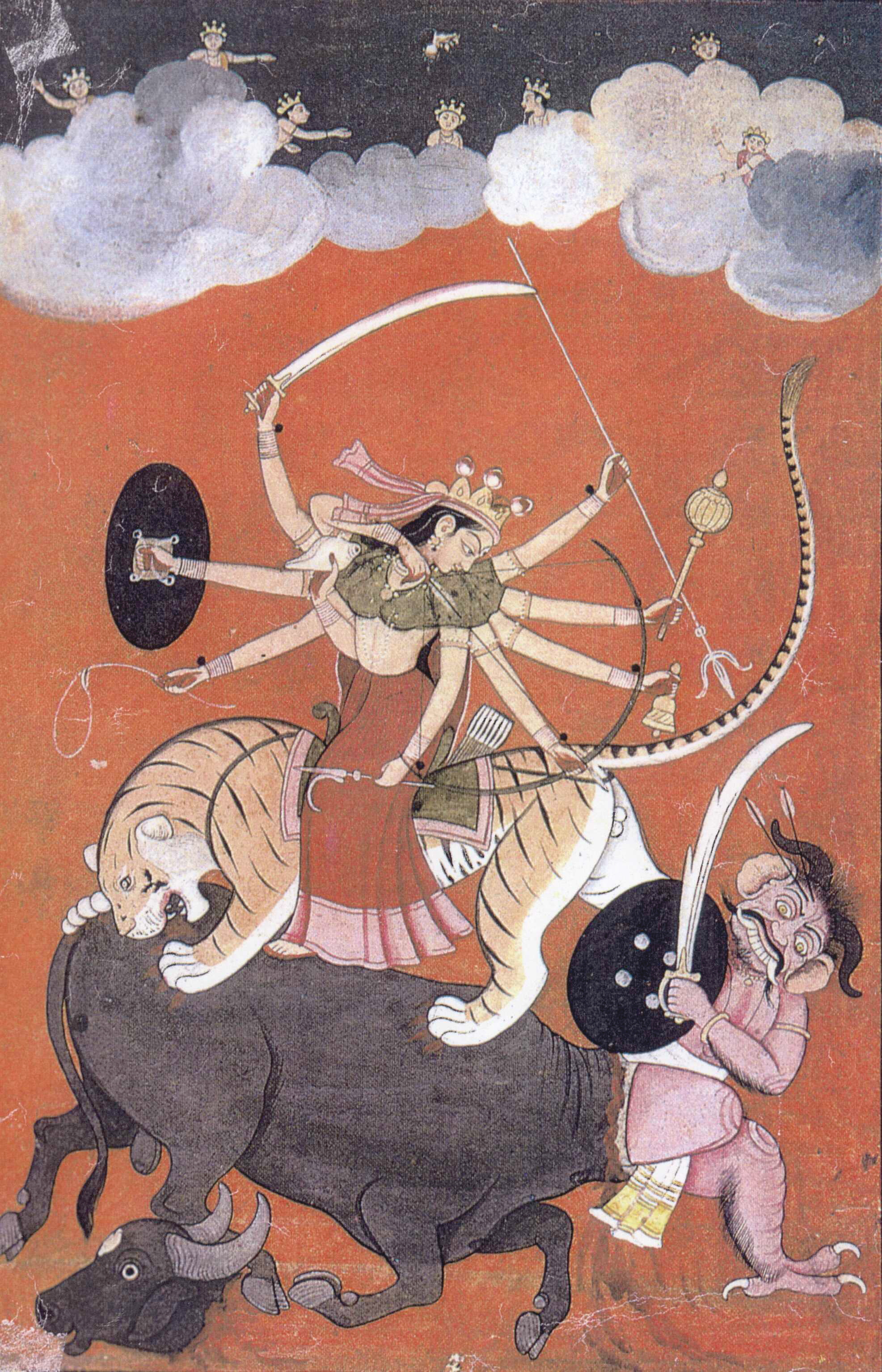
This time the gods in their eternal struggle against the demons asuras cannot win. Powerful weapons, bloody battles, ingenious stratagems cannot eliminate the powerful buffalo Mahisha and its endless hordes of savage warriors.
Only the sum of their energies and their weapons will be concentrated will can prevail against Mahisa. Here comes Durga, the more powerful, ruthless, cruel god of Hinduism along with Kali who - according to some traditions - was born out of an eyebrow of Durga.
Shiva gift  his own trishula, Vishnu chakra, Agni the arrow of fire, Vayu the bow, Indra the thundhier, Kubera the bat, Yama the spear. For this Durga has many arms, up to thirty-two. Hes vahana, the vehicle which she uses  to move, is the tiger and more often lion, for this she is also known as Simhavahini (Simha = Lion).
Durga is beautiful and she isn't - like the other goddesses - the Shakti that is the energy of a particular god, but it is the sum of the energies of all the gods. Durga has no spouse even if the different traditions seek to associate now to a god now to another.
So armed Durga is launched against the buffalo, hits him, but he turns into a lion, and she strikes again turns into an elephant, and catching her with its proboscite. The goddess then with a clean blow knocks his proboscite and Mahisha turns back buffalo, the goddess - enhanced by the intoxicating drink soma - hits the monster to death and at the end from the mouth of the buffalo get out the demon in his human form. A huge and powerful warrior with a sword. Durga does not scare Mahisa and hits his heart with the trident, the Shiva's trishula.
It was the tenth day of battle and Durga had killed Mahisha finally, for this she is also called Mahishasuramardini, the one who killed Mahisha and that day is considered to be dedicated to her, is the Vijaya Dashami.
The goddess is worshiped all over India especially during the festivals of Durga Puja.
For her fighting and winning  nature she was also taken as a symbol of independent and free India.

Durga, l'inaccessibile

Durga uccide Mahisha
Questa volta gli dèi, nella loro eterna lotta contro i demoni asura non ce la fanno. Armi potentissime, battaglie cruente, stratagemmi ingegnosi non riescono ad eliminare il potente bufalo Mahisha e le sue infinite schiere di selvaggi guerrieri.
Soltanto la somma delle loro energie e delle loro armi concentrata in un unico essere potrà avere la meglio contro Mahisha. Ecco che nasce Durga, la più potente, spietata, cruenta divinità dell'induismo insieme a Kali che - secondo certe tradizione - nasce proprio da un sopraciglio di Durga.
Shiva dono' il proprio trishula, Vishnu il chakra, Agni la freccia di fuoco, Vayu l'arco, Indra il tuono, Kubera la mazza, Yama la lancia. Per questo Durga ha molte braccia, fino a trentadue. Il suo vahana, il veicolo che utilizza per muoversi, è la tigre, più spesso il leone e per questo è anche conosciuta come Simhavahini (simha = leone).
Durga è bellissima e non è - come le altre divinità femminili - la shakti cioè l'energia di un particolare dio, ma è la somma delle energie di tutti gli dei. Durga non ha sposo anche se le varie tradizioni cercano di associarla ora a un dio ora ad un altro.
Così armata Durga si lancia contro il bufalo, lo colpisce, ma lui si trasforma in leone, di nuovo la colpisce e lui si trasforma in elefante e la cattura con la sua proboscite. La dea allora con un colpo netto gli stacca la proboscite e Mahisha si trasforma nuovamente in bufalo, la dea - rafforzata dalla bevanda inebriante soma - colpisce a morte il mostro e alla fine dalla bocca del bufalo esce l'asura nella sua forma umana. Un enorme e potente guerriero armato di spada. Durga non si fa intimorire e colpisce Mahisha al cuore con il tridente, il trishula di Shiva. Si era al decimo giorno di combattimento e Durga aveva finalmente ucciso Mahisha, per questo è chiamata anche Mahishasuramardini, Colei che uccise Mahisha e quel giorno è considerato a lei dedicato, è il Vijaya Dashami.
La dea è venerata in tutta l'India soprattutto durante le feste del Durga Puja.
Per il suo carattere combattivo e vincente è stata anche assunta a simbolo dell'India indipendente e libera.

venerdì 22 luglio 2011

Kali

Kali
Black, with red tongue hanging from her mouth, a necklace of 50 (or 52) skulls, a skirt of severed arms, one hand holding a bloody sword, a severed head in the other one, drunk with wine and blood, his body and his face is covered with blood, dancing furiously on the body of a man and living near the funeral pyres. She is Kali, the Black, the power of time, the destructive aspect of the goddess.
Only she was able to kill Raktabija the demon against whom the Gods had signed the final showdown.
But Raktabija - as his name (in Sanskrit 'rakta' means 'blood' and ‘bija’ ‘seed’) - seemed invincible as soon as a drop of his blood touched the ground another demon arose, and so ad infinitum.
Then from the eyebrow of Durga, Kali was born, the night supreme devouring all that exists, the time destroing the worlds, the one who inspires fear, in fact the one who embodies all the fears you, but who ignores the fear.
With his mouth she drank the blood Raktabija avoiding touching the ground and then she cut cleanly through the head of the demon, just the head in her left hand.
But the thirst for blood, violence, death has now made drunk the goddess, she cannot stop herself, she no longer distinguishes the enemies from friends, the good from the bad, and all kills, destroys everything. Only Shiva, her husband, can stop her jumping on her. Kali wants to kill Shiva too, but when she recognizes her husband, she stops. He is on the ground, seems helpless and defenseless, the foot of the goddess is on his chest. Even Shiva, without his own shakti, his energy is inert.
Prearyan divinity, probably dravidian, Kali is worshiped by reciting the mantra Krim and sacrificing live animals.
A big festival in honor of Kali is held in the month of Ashvin (late September), it is Navaratri, the nine nights that remind the nine days of the year in which Shiva allows his wife to travel from his mother.
Kali is regarded as a terrible aspect of the goddess Parvati, but also as an independent deity having a benevolent aspect and terrible in keeping with the ambivalence of deity, which manifests itself, according to Hindu tradition, in continuous cycle of life and death, creation and destruction.

Kali

Kali
Nera, con la lingua rossa che le pende dalla bocca, una collana composta da 50 (o 52) teschi, un gonnellino di braccia mozzate, con una mano tiene una spada insanguinata, con l’altra una testa mozzata, ebbra di vino e di sangue, il suo corpo è sporco di sangue, danza furiosamente sul corpo di un uomo e risiede nei pressi delle pire funerarie. E’ Kali, la nera,  la potenza del tempo, l’aspetto distruttivo della dea.
Solo lei fu in grado di uccidere Raktabija, il demone contro il quale gli dei avevano ingaggiato lo scontro finale.
Ma Raktabija – come dice il suo nome (in sanscrito ‘rakta’ significa ‘sangue’ e ‘bija’ ‘seme’) – sembrava invincibile in quanto appena una goccia del suo sangue toccava terra nasceva un altro demone e così all’infinito.
Dal sopracciglio di Durga allora, nacque Kali, la notte suprema che divora tutto ciò che esiste, il tempo che distrugge i mondi, colei che incute paura, anzi incarna tutte le paure lei, ma che ignora la paura.
Con la sua bocca bevve tutto il sangue di Raktabija evitando che toccasse terra e poi tagliò di netto la testa al demone, proprio quella testa che tiene nella mano sinistra.
Ma la sete di sangue, di violenza, di morte ha ormai reso ebbra la dea che più non si ferma, che non distingue più i nemici dagli amici, i buoni dai cattivi e tutti uccide, tutto distrugge. Solo Shiva, il suo sposo, riesce a fermarla gettandosi su di lei. Kali vorrebbe uccidere anche Shiva, ma quando riconosce il suo sposo, si ferma. Lui è a terra, sembra indifeso ed inerme, il piede della dea è sul suo torace. Anche Shiva, senza la sua shakti, la sua energia è inerte.
Divinità preariana probabilmente di origine dravidica, Kali viene venerata recitando il mantra KRIM e sacrificandole animali vivi.
Una grande festa in onore di Kali si svolge nel mese di Ashvin (fine settembre), si tratta di Navaratri, le nove notti che ricordano i nove giorni dell’anno in cui Shiva consente a suo moglie di recarsi dalla propria madre.
Kali è considerata come aspetto terribile della dea Parvati, ma anche come divinità autonoma a se stante che ha sia un aspetto benevolo sia un aspetto terribile coerentemente con l'ambivalenza della divinità, che si manifesta, secondo la tradizione induista, nell' incessante ciclo di vita e morte, creazione e distruzione.

venerdì 25 marzo 2011

Little Shiva

This picture of the little Shiva is very reassuring, it is in a temple of Shiva in my beloved Cochin in Kerala, wonderful State of south India.
He’s a baby Shiva, but he has all attributes of great god which I’ve described in another post.
The little boy is sleeping serenely on a leopard leather, in his right hand he is grasping trishula of the top of that there is the little dram damaru from which primordial syllable AUM was born and it is made by union of two triangles, female and male aspects, Shakti and Purusha, yoni and lingam. In left hand of little Shiva the is a little cobra.
There are a crescent of moon on his head, another small cobra and Ganga water springing from his hair. In the middle of his forehead there is the third eye and he has a japamala (rosary or prayer beads) around his neck.
I like the context of this picture too. In the background Himalaya rises majestically, that is the abode of Shiva. There is the vahana, the vehicle of Shiva:  the white bull, Nandi.
On lift side there is the mystic symbol of Shiva, the lingam-yoni, the union between male and female principles living  inside the God and from which the universe was born. On the top of lingam, there is padma, the lotus.

Shiva bambino

E’ molto rassicurante questa immagine di Shiva bambino che si può trovare in un tempio shivaita della mia amata Cochin, città del Kerala, meraviglioso stato del sud dell’India.
E’ un piccolo Shiva, ma ha tutti gli attributi della grande divinità che ho descritto in precedente post.
Il bambino dorme serenamente sopra una pelle di leopardo, nella mano destra stringe il trishula alla cui sommità è legato il tamburello damaru dal quale scaturì la sillaba primordiale AUM e che è formato dall’unione di due triangoli, l’aspetto femminile e quello maschile, shakti e purusha, yoni e lingam. Nella mano sinistra il piccolo Shiva tiene un piccolo cobra.
Sulla testa troviamo il crescente di luna, un altro piccolo cobra, la crocchia dalla quale scendono le acque della dea Ganga. Al centro della fronte è situato il terzo occhio e il collo è ornato da un rosario shivaita.
Mi piace anche il contesto. Sullo sfondo si ergono le catene himalayane, residenza di Shiva e si scorge il vahana del dio, il veicolo, il fedele toro Nandin.
Sulla sinistra invece sta l’immagine mistica della divinità, il lingam-yoni, l’unione del maschile e del femminile che abitano all’interno del dio. Sopra il lingam, che è adornato dalle tre strisce orizzontali dello shivaismo, è posto un fiore di loto (padma).

venerdì 18 marzo 2011

Sri Yantra

To watch the Sri Yantra fascinates me always, it’s the most sacred of all yantras I reproduce in this post and I’m using as my avatar.
But what are yantras?  Yantra literally means ‘tool’ and those are an aid to meditation. These geometric diagrams with two or even three dimensions represent god and goddesses or mystical concepts. The bases of the temples and religious buildings are yantras with mystical and religious meanings very precise.
In the yantras are used geometrical figures, each of which has its own meaning, which, combined with other figures, give to the yantra meaning sometimes very articulate.
Points, straight lines and curves, points or arrow, triangles, circles, crescents, hexagons, squares, pentagons, crosses of various types combine to form a yantra. These symbols are usually surrounded by one or two circles of lotus petals, the flower symbol of Hinduism, the flower that is what man should be.  In fact, like the petals of the lotus while being supported on the surface of the pond it is neither wet nor contaminated, so the man should live in the phenomenal reality without being affected by that. To be in the world but not of the world.
The two concentric circles of lotus petals are in turn surrounded by a square called sisira (which means trembling in Sanskrit) with four T-shaped gates placed at the four cardinal points.
Each Hindu god has a yantra that represents, even each god has a yantra for each of his own many aspects and each yantra is also a mantra, a ritual formula that Is repeated mentally or verbally, a further aid to devotional meditation.
The Sri Yantra is called also Sri Chakra or diagram of fortune and Nava Chakra because it allows nine levels of meditation starting from outer frame until you reach the center of the drawing.
The Sri Yantra is a symbol of good luck and is dedicated to the Mother Goddess, more precisely to Rajarajeshvari, the Queen of the queens. It represents the powerful and permanent flow of the creation presided over by that goddess.
The Sri Yantra is composed of the frame (sisira), two concentric circles, respectively 16 and 8 lotus petals that surrounded a figure made of four isosceles triangles with the vertex upwards, intersecting with another five isosceles triangles with the vertex down. The four triangles represent the male aspect and the five triangles the female aspect, Purusha and Prakriti, Lingam and Yoni, Shiva and Parvati, by whose union was created and developed the whole universe whose multiplicity is represented by 43 triangles borning from the intersection of the nine main triangles.
The five triangles are feminine energy that powers the Purusha, the matrix, static property that has the unexpressed universe within itself.
The Sri Yantra is also a metaphor that refers to the oldest vedism and the centrality of sacrifice. The five triangles that intersect with four below are the symbol of the sacrifice of Shakti that is sacrificed in the fire of Agni and gives life to the manifest world.
In the middle of the last small triangle is sometimes visible sometimes not, bindu, which represents the boundary between the manifest and the unmanifest.

Sri Yantra

Mi affascina sempre guardare lo Sri Yantra, il più sacro di tutti gli yantra che riproduco in questo post e che uso anche come mio avatar.
Ma cosa sono gli yantra? Letteralmente yantra significa 'strumento' e sono un ausilio alla meditazione. Si tratta di diagrammi geometrici a due o anche a tre dimensioni che rappresentano divinità o concetti mistici. Anche le basi dei templi e degli edifici sacri sono yantra con precisi significati mistici e religiosi.
Negli yantra vengono utilizzate figure geometriche elementari ciascuna delle quali ha un significato proprio che, unite alle altre figure, danno allo yantra un significato complessivo talvolta molto articolato.
Punti, linee rette e curve, punte a forma di freccia o fiamma, triangoli, cerchi, mezzelune, esagoni, quadrati, pentagoni, croci di vario tipo concorrono a formare uno yantra. Questi simboli sono in genere circondati da uno o due cerchi di petali di loto, il fiore simbolo dell’induismo, il fiore che rappresenta quello che l’uomo dovrebbe essere.
Infatti come i petali del loto pur essendo appoggiati sulla superficie dello stagno da esso non sono né bagnati né sporcati, così anche l’uomo nella realtà fenomenica dovrebbe vivere senza essere da questa condizionato. Insomma essere nel mondo, ma non del mondo.
I due cerchi concentrici di petali di loto sono a loro volta circondati da un quadrato chiamato sisirita (che significa tremante in sanscrito) con quattro porte a forma di T collocate ai quattro punti cardinali.
Ogni dio hindu ha uno yantra che lo rappresenta, anzi ha uno yantra per ciascuno dei suoi molteplici aspetti ed ad ogni yantra corrisponde anche un mantra, una formula rituale che si ripete mentalmente o si pronuncia come forma devozionale ed ulteriore ausilio alla meditazione.
Lo Sri Yantra, è chiamato in molti modi, è detto Sri Chakra o diagramma della fortuna ed anche Nava Chakra, perché consente nove livelli di meditazione partendo dalla cornice esterna fino ad arrivare al centro del disegno.
Lo Sri yantra è un simbolo di buon auspicio ed è dedicato alla Dea Madre, più precisamente a Rajarajeshvari, cioè alla Regina delle regine. Rappresenta il flusso potente e permanente della creazione presieduta da questa dea.
Lo Sri Yantra è composto dalla cornice (sisirita), da due cerchi concentrici rispettivamente di 16 e di 8 petali di loto che racchiudono una figura composta da quattro triangoli isoscele col vertice verso l’alto che si intersecano con altri cinque triangoli isoscele con il vertice verso il basso. I primi rappresentano l’aspetto maschile mentre i secondi quello femminile, purusha e prakriti, lingam e yoni, Shiva e Parvati, dalla cui unione nasce e si sviluppa l’Universo intero la cui molteplicità è rappresentata dai 43 triangoli che si formano dall’intersecarsi dei nove triangoli principali.
I cinque triangoli femminili sono l’energia che alimenta il purusha, la matrice immobile e statica che possiede dentro di sè l’universo inespresso.
Lo Sri Yantra è una metafora che rimanda anche al più antico vedismo e alla centralità del sacrificio. I cinque triangoli che si intersecano con i quattro sottostanti sono il simbolo del sacrificio della shakti che si immola nel fuoco di Agni e dà vita al mondo manifesto.
Al centro dell’ultimo piccolo triangolo c’è, talvolta visibile talvolta no, il bindu che rappresenta il punto limite tra immanifesto e manifesto.