Visualizzazione post con etichetta Avatar. Mostra tutti i post

sabato 2 giugno 2012

Etymologies: karma, atman, brahman and avatar

The Sanskrit word 'karma' means action essentially. Karma is generally understood as the result of the action or thought, positive or negative result of each behavior and focus of the theory of samsara, the cycle of rebirths. We can generally say that  when the soul leaves the body will reincarnate in a lower or higher being depending on the previous karma. When the karmic residue will be depleted, the atman is free (moksha). Karma is often understood as fate.
The word 'sanskrit' in devanagari

More uncertain is the etymology of the word 'atman', another key word of Hinduism. It is often likened to the soul, but really the atman is the Supreme Self, is the essence of every living being, is the Absolute in us that has nothing to do with our personal and individual soul which in Sanskrit is jiva. Perhaps the word from Sanskrit an (to move) and at (breathing), atman being the breath which moves, gives life to every living being. 
The 'brahman' however, not to be confused with  Brahma one of the three gods of the Trimurti, is the universal principle, the essence of supreme, absolute, pure metaphysical reality. The word is derived from the Sanskrit root brh, which stands for growth and development. In fact everything is born from Brahman and everything is a manifestation of it. 
'Avatara' means descent and derives from the Sanskrit root tr / tar 'go' and ava which means 'down'. Then Avatar is going down, down to earth. The avatars are in fact the incarnations of deities with particular reference to the incarnation of Vishnu.

domenica 16 ottobre 2011

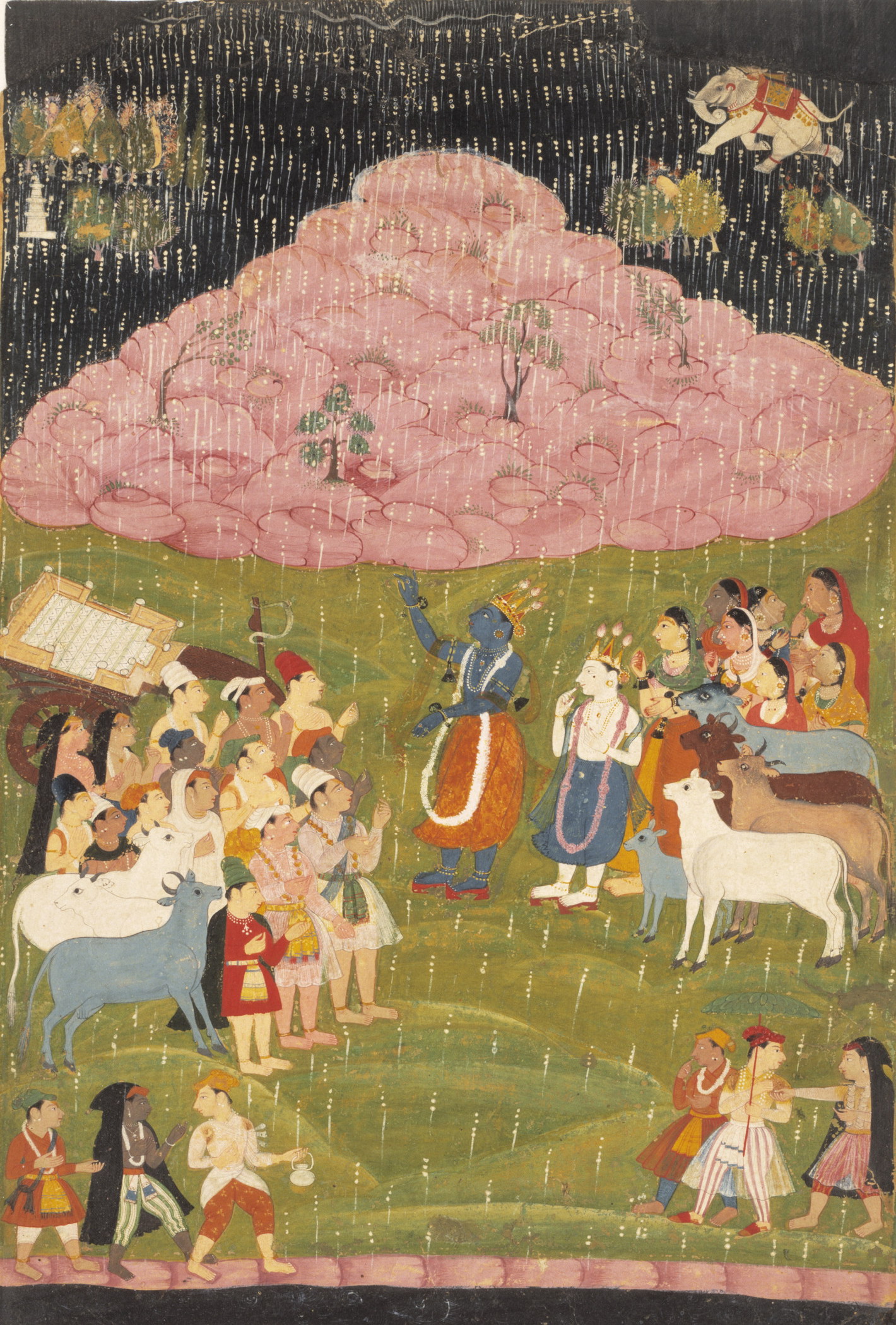
Krishna and Govardhan hill

Krishna raising Govardhan
The villagers of Vrindavana were preparing Indrapuja, the yearly sacrifice dedicated to the King of the Gods, Lord of the rain who, with his benevolence, made possible their lives and the lives of animals bred by them.
But Krishna, the seventh iavatar of Vishnu, who lived with the shepherds of the village, persuaded them there was no need to make that sacrifice.
"There is no need to make a sacrifice to Indra, the rain will fall and the water will not fail for you or for your animals and for your fields. It's better than the sacrifice you are doing in honor of the hill Govardhan, it's makes your life possible, not Indra. "
The shepherds and peasants of Vrindavana were astounded by those words, but after some hesitation, they began to celebrate a grand sacrifice in honor of the hill at the foot of which stood their village.
Krishna wanted to teach a lesson to Indra became too proud and wanted to restore the hierarchy, he was the Supreme Personality of Godhead which bakta, devotees, had veneration and worship.
Indra, however, was furious and called together his most powerful clouds starting samvartaka, the awful cloud that appears every dissolution of the universe.
The village of Vrindavan was struck by most furious storm of all time, for days and days it did rain and hail. The land was no longer able to absorb water, the village was devastated by severe floods, people and animals did not know where to stand and turned to Krishna, pleading for help.
Krishna then lifted by his hand the whole hill of Govardhan and invited all the shepherds and their animals under that huge umbrella.
Indra continued to bring down rain, but friends of Krishna were safe under his protection, and the wrath of the King of the gods nothing could against Krishna.
Indra understood, he did stop raining and bowed humbly at the feet of Krishna.
Govardhan Hill was put back in its place and is still celebrated every year a sacrifice in his honor, Govardhanpuja.

Krishna e la collina Govardhan

Krishna sostiene la collina Govardhan
Gli abitanti del villaggio di Vrindavana stavano preparando l'Indrapuja, il sacrificio annuale dedicato al re degli dei, signore delle piogge che con la sua benevolenza rendeva possibile la loro vita e quella degli animali da loro allevati.
Ma Krishna, settimo avatara di Vishnu che abitava con i pastori del villaggio, riuscì a cionvincerli che non era necessario fare quel sacrificio. "Non c'è bisogno di fare un sacrificio ad Indra, la pioggia cade lo stesso e l'acqua non mancherà nè per voi nè per i vostri animali nè per i vostri campi. E' meglio che il sacrificio lo facciate in onore della collina Govardhan, è lei che rende possibile la vostra vita, non Indra."
I pastori e i contadini di Vrindavana rimasero stupiti da quelle parole, ma dopo qualche esitazione iniziarono a celebrare un sontuoso sacrificio in onore della collina ai cui piedi sorgeva il loro villaggio.
Krishna voleva dare una lezione ad Indra divenuto troppo orgoglioso e voleva ristabilire le gerarchie, lui era la Persona Suprema cui i bakta, devoti, dovevano venerazione e culto.
Indra però non ci stette e chiamò a raccolta le sue più potenti nuvole a cominciare da Samvartaka, la terribile nuvola che appare ad ogni dissoluzione dell'universo. Sul villaggio di Vrindavana si scatenò il più furioso di tutti i temporali, per giorni e giorni piovve e grandinò. Il terreno non riusciva più ad assorbire l'acqua, il villaggio venne devastato da violente inondazioni, gli uomini e gli animali non sapevano più dove stare e si rivolsero a Krishna, supplicandolo di aiutarli.
Krishna allora sollevò con la mano l'intera collina di Govardhan ed invitò tutti i pastori ed i loro animali sotto quell'enorme ombrello.
Indra continuò a far cadere pioggia, ma gli aminci di Krishna erano al sicuro sotto la sua protezione e l'ira del re degli dei niente poteva contro Krishna.
Indra capì, fece smettere di piovere e si prostrò umilmente ai piedi di Krishna.
La collina Govardhan venne rimessa al suo posto e ogni anno ancora oggi viene celebrato un sacrificio in suo onore, il Govardhanpuja.

giovedì 30 giugno 2011

Sita, Rama's wife

She was faithful to her husband, but she, prisoner, had lived with another man. It was not good. And Rama, Lord of Ayodhya, tell to his beloved wife that the war against Ravana, the millions of deaths, the mythical bridge linking India to Sri Lanka, none of all this had been done for her, but to restore the order, the dharma. "I cannot live with you who lived so long with another man."
Rama and Sita, the couple shown as exemple of the perfect wedding even today in India, of what must be the relationship between husband and wife and that speaks volumes about the status of women in the Indian continent.
Sita was stunned, outraged that they doubted her loyalty, "light a fire - she ordered - if I have been faithful to Rama, though I have always respected, if any other man has touched me, Agni, the god of fire, protect me. Otherwise, I burn! " And she threw herself into the flames.
Agni protected her, held her and brought her to Rama, saying, "This woman is pure and have always been faithful."
She was the goddess Lakshmi, who, like Sita, she became the wife of Rama, seventh avatar of Vishnu and hero of the Ramayana epic. Her father found her in a furrow of earth and so called Sita. He married the Prince of Ayodhya, but she was kidnapped by the demon Ravana who took her to Lanka. Rama, with the help of monkeys Sugriva and Hanuman, rescued his wife.
The couple and Rama's army returned to Ayodhya, they lived happily, but the people whispered again. "She lived for more than a year with another man, she cannot live with our King." It was not good that she lived with the example of dharma, righteousness, of what is good, of the rules that make turn the universe.
This time Rama, although his wife was pregnant, forsed Sita to leave the kingdom. She will go in the forest near the hermitage of Valmiki, where the two sons of Rama born: Lava and Kusa.
Rama knew Kusa and Lava when they had children. Once he had kwown them, Rama wanted to return Sita to Ayodhya too.
The queen again declared her loyalty to Rama and her own purity and, before the assembly convened to receive her, said: "If in my mind I had no other man that Rama, if I was always faithful to my husband, you mother, earth, where I was born, give me the grace to get my body."
Having said that the earth opened and revealed a royal throne, where Sita sat before disappearing into the earth closed over her.
In a furrow she was born, in a furrow she returned.

Sita, la moglie di Rama

La prova del fuoco di Sita
Era rimasta fedele a suo marito, ma era vissuta prigioniera presso un altro uomo. Non era bene. E Rama, signore di Ayodhya, dichiara all’amata moglie che la battaglia contro Ravana, i milioni di morti, il mitico ponte che unisce la punta d’India a Sri Lanka,  tutto ciò non era stato compiuto per lei, ma per ristabilire l’ordine, il dharma. “Non posso più vivere con te che hai vissuto così a lungo con un altro uomo.”
Rama e Sita, la coppia modello portata ancora oggi ad esempio in India di matrimonio perfetto, di quello che deve essere il rapporto tra marito e moglie e che la dice lunga sulla condizione femminile nel continente indiano.
Sita rimase attonita, sdegnata che si dubitasse della sua fedeltà, “accendete un rogo – ordinò – se sono stata fedele a Rama, se sempre l’ho rispettato, se mai altro uomo mi ha toccato, Agni, il dio del fuoco, mi proteggerà, altrimenti, che io bruci!” E si gettò nelle fiamme.
Agni la protesse, la sorresse e la condusse da Rama dicendo “Questa donna è pura e ti è sempre stata fedele.”
Era la dea Lakshmi che, come Sita, divenne moglie di Rama, settimo avatar di Vishnu ed eroe dell’epica del Ramayana. Suo padre la trovò in un solco di terra e per questo la chiamò Sita. Si sposò col principe di Ayodhya, ma venne rapita dal demone Ravana che la condusse a Lanka. Rama, con l’aiuto delle scimmie Sugriva e Hanuman, liberò sua moglie.
La coppia e l’esercito di Rama tornarono ad Ayodhya e vissero felicemente, ma la gente mormorava ancora. “Ha vissuto per più di un anno con un altro uomo, non è bene che stia col nostro re.” Non era bene che vivesse con il campione del dharma, della rettitudine, di ciò che è bene, delle regole che fanno girare l’universo.
Questa volta Rama, nonostante la moglie sia incinta, la obbliga ad andarsene dal regno. Andrà nella foresta presso l’eremo di Valmiki dove partorirà i due figli di Rama, Kusa e Lava.
Rama seppe di Kusa e di Lava quando erano già fanciulli e, conosciutili, volle che tornasse ad Ayodhya anche Sita.
La regina dichiarò nuovamente la propria fedeltà a Rama e la propria purezza e, di fronte all’assemblea convocata per riceverla, disse: “Se nella mia mente non ho avuto altro uomo che Rama, se sono stata sempre fedele al mio sposo,  tu madre terra da cui sono nata fammi la grazia di riprendere il mio corpo.”
Detto questo la terra si aprì e ne emerse un trono regale dove Sita si assise prima di scomparire nella terra che si richiuse sopra di lei.
Dal solco della terra era nata, nel solco della terra ritornò.

mercoledì 25 maggio 2011

Vishnu

Vishnu lying on Ananta with Lakshmi
Vishnu represents the cohesive tendency of the Indian Trimurti, is known as the preserver of the Universe, while Brahma is its creator and Shiva the destroyer. He is the supreme deity, the supreme and only Brahman for Vaishnavas.
The etymology of the name Vishnu is traced back to the root vis, to permeate, the god who is all-pervasive.
It is generally known and revered in his major incarnations or avatars that I have already discussed in
a previous post.
Currently in India the most revered deity are Rama and Krishna, respectively the seventh and eighth avatars of Vishnu.
His images represent him lying on snake Sheshanaga or Ananta, the Serpent residue or Infinity  (see photo) or standing with four arms.
The image of Vishnu  in general has the following features.
On the chest to the right is a lock of hair call Shrivatsa and the jewel Kausthubha, Treasure of the ocean that is the universal consciousness that has emerged from the
churning of the cosmic ocean or Samutramanthan.
The four arms represent - as in all the images of Hindu gods - the domain of the four directions of space, but also the four Vedas, the four goals of life, the four stages of human life, the four castes, the four yuga or eras.
In the lower right hand Vishnu holds the conch, symbol of the origin of life and is linked to the primordial ocean and the primordial sound, the syllable AUM.
In the right high hand is placed Sudarshana (Nice to see), it is the chakra, ultimate weapon of Vishnu consisting of six rays that represent the six seasons of the hindu year.
In his left high hand there is the bow and  in the lower left hand Kaumodaki, the mace, the power of knowledge.
The color of the god is blue and usually  there is  a veil on his hips called pitambara, his wife is the goddess of fortune Lakshmi and his Vahan or  vehicle is Garuda the eagle with the human body.
Vishnu is known as the god of a thousand names, each linked to a condition or a manifestation of the god. These names are listed and explained in Vishnusahasranama, which means the thousand names of Vishnu and is a part of Mahabharata.
Among them I remember: Vishva, He who is everything, Bhutakrit, Maker of all beings, Bhutabhrit, The support of all creatures, Bhutabhavana, The essence of all beings, Hari, The thief, Bhakta Vatsala, Lover of  his devotees, Mahamaya, The supreme magician, Bhagavan,  Full of glory, Anandi, Bringer of  joy, Narayana, The Son of man.

Vishnu

Vishnu
Vishnu rappresenta la tendenza coesiva della Trimurti indiana, è noto come il conservatore dell’Universo, mentre Brahma ne è il creatore e Shiva il distruttore. E’ la divinità suprema, il supremo ed unico Brahman per i vishnuiti.
L’etimologia del nome Vishnu è fatta risalire alla radice vis, pervadere, il dio è colui che tutto pervade.
Generalmente è conosciuto e venerato nelle sue incarnazioni principali o avatar di cui ho già parlato in un precedente post. Attualmente in India le divinità maggiormente venerate sono proprio Rama e Krishna, rispettivamente settimo e ottavo avatar di Vishnu.
Le sue immagini più diffuse lo rappresentano disteso sul serpente Sheshanaga o Ananta, il Serpente residuo o Infinito (foto del successivo post) oppure in piedi con quattro braccia .
L’immagine di Vishnu eretto in genere ha le seguenti caratteristiche.
Sul petto a destra c’è una ciocca di peli chiamata Shrivatsa cioè Cara alla fortuna che rappresenta tutto l’esistente e il gioiello Kausthubha,  Tesoro dell’oceano che rappresenta la coscienza universale e che è emersa dal Samutramanthan, il frullamento dell’oceano.
Le quattro braccia rappresentano – come in tutte le immagini di dei hindu - il dominio sulle quattro direzione dello spazio, ma anche i quattro Veda, i quattro scopi della vita, i quattro stadi della vita umana, le quattro caste, le quattro ere o yuga.
Nella mano destra bassa Vishnu tiene la conchiglia simbolo dell’origine dell’esistenza ed è collegata sia all’oceano primordiale sia al suono primordiale, la sillaba AUM.
Nella mano destra alta è posto Sudarshana, (Bello a vedersi), è il disco, la sua arma micidiale composta di sei raggi che rappresentano le sei stagioni in cui è diviso l’anno in India.
Nella mano sinistra alta c’è l’arco e nella mano sinistra bassa il dio tiene la mazza Kaumodaki, Colei che inebria lo spirito, cioè la potenza della conoscenza.
Il colore del dio è l’azzurro e abitualmente ha un velo su i fianchi che si chiama pitambara, la sua sposa è la dea della fortuna Lakshmi e suo veicolo o vahana è Garuda l’aquila dal corpo umano.
Vishnu è conosciuto come il dio dai mille nomi, ognuno collegato ad una caratteristica o ad una manifestazione particolare del dio. Questi nomi sono elencati e spiegati nel Vishnusahasranama, che significa appunto i mille nomi di Vishnu e che è una parte del Mahabharata.
Tra di essi ricordo: Vishva, Colui che è tutto, Bhutakrit, Creatore di tutte le cose, Bhutabhrit, Supporto di tutte le cose, Bhutabhavana, L’essenza di tutti gli esseri, Hari, Colui che porta via, Bhakta Vatsala, Colui che ama i suoi devoti, Mahamaya, Suprema illusione, Bhagavan, Il Glorioso, Anandi, Colui che dà gioia, Narayana, Figlio dell’uomo.

mercoledì 13 aprile 2011

Samutramanthan: The Churning of the cosmic ocean


Gods and asuras churning ocean
One of the most interesting myths of Hinduism is the Churning of the cosmic ocean, in Sanskrit the Samutramanthan.
The gods and asuras, dangerous demons, always fighting each others decided for once to make alliance to churn the infinite cosmic ocean and bring out the amrita, the nectar of immortality (in Sanskrit : "a" privative "mrit" = death).
To achieve their goal, they used as a “mixer” mount Mandara and plunged into the ocean resting on Kurma, the tortoise in which Vishnu had turned in his second avatar.
Once placed on the mountain tortoise, they wrapped around it  like a rope the snake Vasuki Nagaraja, the king of snakes. The demons grabbed the snake from side of the many mouths and the gods from the tail and they began to pull Vasuki from side to side by turning the mount in this way the cosmic ocean from which gigantic waves arose.
But from the ocean arose a terrible poison halahala. According others tradition the poison did not emerge from the water, but it was spewed from the mouths of the snake.
However things went, the terrible poison began to destroy everything that existed until Shiva intervened and swallowed the poison saving the existing. The poison did no harm to the great god, except to paint his neck at the troath blu, which is why the great god is also called Nilakantha, ie the blue troath. A few drops of poison fell upon the earth and for this there are several different plants and animals that are poisonous.
Having escaped the danger, the gods and the asuras went back to churn the ocean and from  waters Chaturdasa Ratnam, i.e. fourteen wonders, came out. The fourteen things desirable are: Amrita, nectar of immortality; Lakshmi, the goddess of fortune, wife of Vishnu, Dhanvantari, the physician of the gods who brought the cup with nectar; Sura the goddess of wine; Chandra, the moon; Rambha apsara or the vessel Pushpak; Uchchihsravas, the white horse; Airvata, the white elephant  vahana or vehicle of Indra; Parijata, tree of heaven; Kaustubha, the jewel of Vishnu; Kamadhenu or Surabhi, the cow of abundance; Sankha, the shell of Vishnu; Dhanu, the arc of Rama; Visha, poison and medicine.
Of course, when the amrita came out the gods and demons fought for possession, the fight lasted twelve days and twelve nights. During the fight from the pot (Kumbha in Sanskrit), fell four drops of nectar, in these places the holy cities of Allahabad, Haridwar, Ujjain and Nasik were born. In these cities every three years the great religious festival of Kumbha Mela is celebrated (in sanskrit festival of pot).
The asuras seized Amrita. The gods then turned to Vishnu who became Mohini, a girl of infinite beauty. She was able to steal from asuras the cup of Amrita and to bring it to the gods.


Samutramanthan: il frullamento dell'oceano

Uno dei miti più interessanti dell’induismo è quello del frullamento dell’oceano cosmico, in sanscrito il Samutramanthan.

Samutramanthan: in cima al monte Mandara siede Vishnu

Gli dei e gli asura, terribili demoni, sempre in lotta fra loro decisero per una volta di allearsi per  frullare le infinite acque dell’oceano cosmico e far emergere l’Amrita, cioè il nettare dell’immortalità (“a” privativo “mrita”=morte).
Per realizzare l’impresa utilizzarono come bastone il monte Mandara e lo immersero nell’oceano appoggiandolo su Kurma, la tartaruga nella quale si era trasformato Vishnu nel suo secondo avatar.
Una volta appoggiato il monte sulla tartaruga, vi avvolsero intorno a mo’ di fune il serpente Vasuki Nagaraja, cioè il Re dei serpenti. I demoni lo afferrarono dalla parte delle molteplici bocche e gli dei dalla parte della coda e cominciarono a tirarlo da una parte e dall’altra facendo ruotare il monte su se stesso e frullando in questo modo l’oceano cosmico dal quale sorsero gigantesche onde.
Ma a forza di frullare, dall’oceano scaturì il terribile veleno halahala. Per altre tradizione il veleno non emerse dalle acque, ma venne vomitato dalla bocca del serpente.
Comunque andarono le cose, il terribile veleno cominciò a distruggere tutto ciò che esisteva finchè non intervenne Shiva che ingoiò il veleno e salvò l’esistente. Il veleno non recò alcun danno al grande dio, salvo colorargli la gola di blu, motivo per cui Shiva è anche chiamato Nilakantha cioè dalla gola blu. Alcune gocce di veleno caddero sulla terra e per questo esistono varie piante e vari animali che sono velenosi.
Scampato il pericolo, gli dei e gli asura ripresero a frullare l’oceano e dopo mille anni dalle acque immense mosse da quell’inusuale strumento emersero quattordici meraviglie, le chaturdasa ratnam, le quattordici cose desiderabili.
Esse sono: l’Amrita, cioè nettare dell’immortalità; Lakshmi, la dea della fortuna sposa di Vishnu; Dhanvantari, il medico degli dei che portava la coppa col nettare; Sura la dea della bevanda inebriante; Chandra, la luna; Rambha l’apsara; Uchchihsravas, il cavallo bianco; Airvata, l’elefante bianco vahana cioè veicolo di Indra; Parijata, l’albero del paradiso; Kaustubha, il gioiello che porta Vishnu; Surabhi o Kamadhenu, la vacca dell’abbondanza; Sankha, la conchiglia che tiene Vishnu; Dhanu, l’arco di Rama; Visha, un veleno ma anche un farmaco miracoloso.
Ovviamente quando emerse l’amrita gli dei e i demoni lottarono per impossessarsene, la lotta durò dodici giorni e dodici notti. Durante lo scontro dal vaso (in sanscrito Kumbha) che conteneva l’amrita caddero a terra quattro gocce del nettare, in questi luoghi sono sorte le città sacre di Allahabad, Haridwar, Ujjain e Nasik dove a turno ogni tre anni si svolge la grandiosa festa religiosa del Kumbha Mela (in sanscrito Festa della coppa o del vaso). 
Gli asura si impossessarono infine dell’amrita. Gli dei allora si rivolsero a Vishnu che si trasformò in Mohini, una ragazza di bellezza infinita che con la sua seduzione riuscì a sottrarre agli asura la coppa dell’amrita riportandola agli dei.