Visualizzazione post con etichetta Maya. Mostra tutti i post

domenica 28 maggio 2017

Conoscenza e azione

L'atman si realizza e non si conosce, non servono azioni meritorie o caritatevoli, non è un premio o un traguarda raggiunto dai buoni, ma dai saggi. Sankara nel suo Vivekacudamani ci ricorda che "le azioni meritorie servono a purificare la mente non a comprendere la realtà. La realizzazione del Sè è sempre frutto  dell'investigazione scriminante e non di azioni meritorie per quanto numerose possano essere".
Non servono neppure le azioni rituali, l'azione infatti si svolge sempre sul piano fenomenico, quello della (falsa) realtà, dell'illusione di Maya. La molteplicità non è reale perchè l'atman è indivisibile e senza parti.
"L'atman è aldilà di ogni immaginazione ed è libero dalla molteplicità fenomenica, solo i saggi possono realizzarlo pienamente, coloro che si sono liberati dal desiderio, dalla paura, dall'ira e che conoscono i Veda" (Gaudapada).


sabato 2 novembre 2013

Hamsa mantra

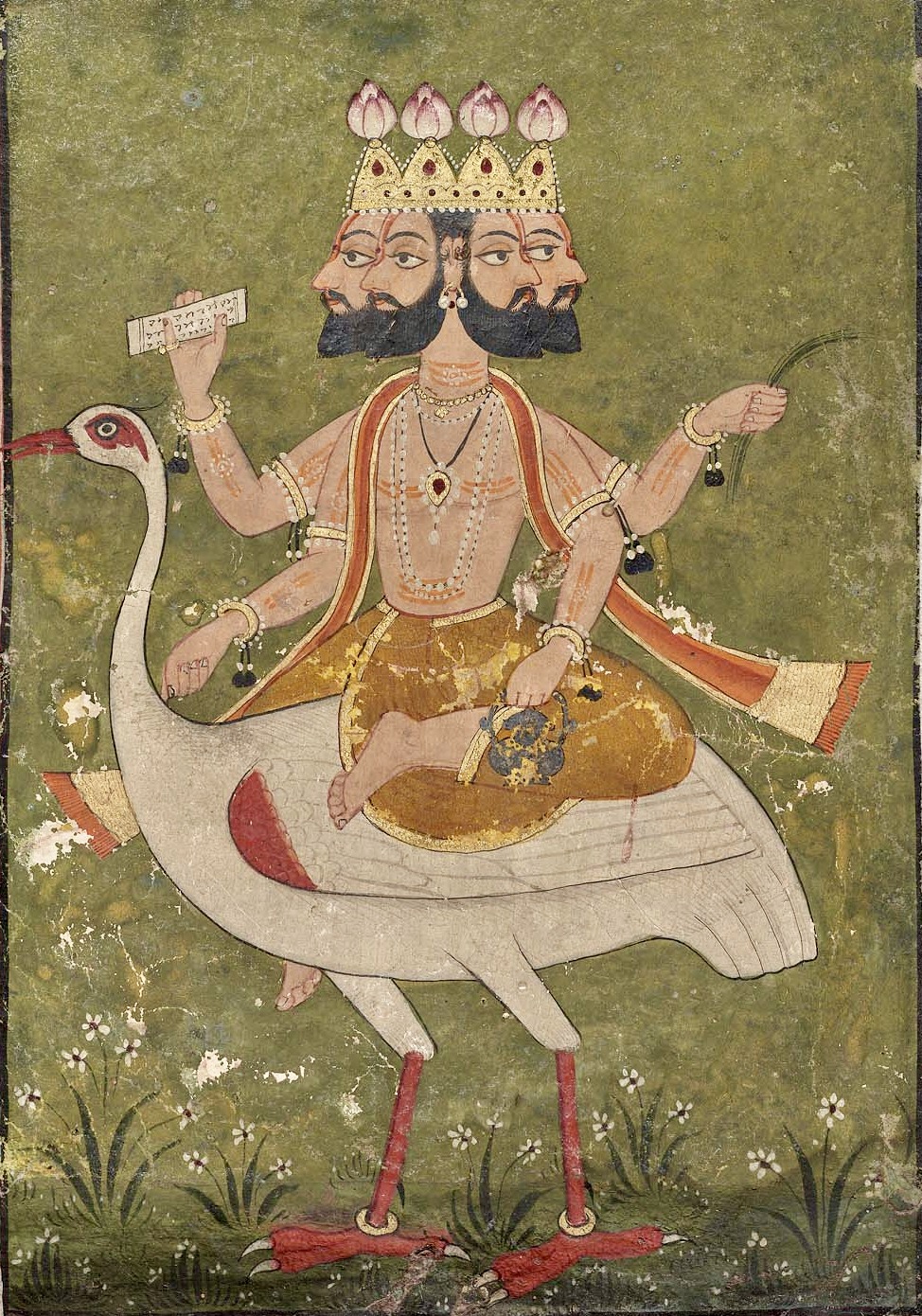
Brahma on his vahana, Hamsa
One of the most powerful and most famous mantra is the Hamsa Mantra, Mantra of the with swan.
The sacred texts, one for all the Shivasutravirmasini, require that the mantra should be repeated 21,600 times.
The syllable ham is pronounced with inspiration and the syllable sa with exhalation. And since the two phases of respiration occupy about four seconds, the repetition of the mantra for 21,600 times covers a period of 24 hours, one day (86,400 seconds that is, in fact, 24 hours).
The word hamsa refers to wild goose or withe swan, among other things it is the vahana of Brahma and his wife Saraswati. 
That animal is the symbol of transcendent knowledge as it can with its flight to break away from the lake as well as the man has to succeed, with the continued repetition of the mantra to break away from the illusory world of maya.
The mantra is very important for the Vedanta philosophy because hamsa refers to the words so ham (I am that) that refers to the identification of individual atman with the supreme Brahman.
The repetition (japa) of this mantra ensures the achievement of the purushatra, the four aims of life dharma, artha, kama and moksha.


Il Mantra Hamsa

Brahma sul suo vahana, l'Hamsa
Uno dei mantra più potenti e più famosi è l’Hamsa Mantra, il Mantra dell’oca o del cigno. 
I testi sacri, uno per tutti lo Shivasutravirmasini, prescrivono che il mantra vada ripetuto 21.600 volte. 
La sillaba ham va pronunciata con l’ispirazione e la sillaba sa con l’espirazione. E poiché le due fasi della respirazione occupano circa quattro secondi, la ripetizione del mantra per 21.600 volte copre l’arco delle 24 ore (86.400 secondi cioè, appunto, 24 ore).
La parola hamsa fa riferimento all’oca selvatica, tra l’altro vahana di Brahma e di sua moglie Saraswati, simbolo della conoscenza trascendente in quanto riesce col suo volo a staccarsi dal lago così come l’uomo deve riuscire, con la protratta ripetizione del mantra a staccarsi dal mondo illusorio di maya.
Il mantra è molto importante per la filosofia vedanta perchè hamsa fa riferimento a ham so che significa io sono e che si riferisce all’identificazione dell’atman individuale con il supremo brahman.
La ripetizione (japa) di questo mantra assicura il raggiungimento dei purushartha dei quattro scopi della vita dharma, artha, kama e moksha.


domenica 24 marzo 2013

Nishkama karma, l'azione distaccata


“Tu devi agire, ma non godere dei frutti delle tue azioni, non essere attaccato ai frutti delle azioni e non provare neppure attaccamento per il non agire. 
Quello che devi fare fallo, però senza attaccamento alcuno. Resta con animo equilibrato e distaccato nel successo come nell’insuccesso.” (Bhagavad Gita II, 47,48) 


Arjuna e Krishna, suo cocchiere
Tra i problemi del pensiero filosofico hindu quello del rifiuto del mondo e della tendenza all’inazione è molto interessante. 
Sappiamo che il mondo in cui viviamo non è altro che maya, illusione. Anzi è la manifestazione del Brahman, l’Essere Supremo, che nasconde il Brahman stesso. 

Le nove porte dell’uomo sono tutte rivolte verso l’esterno, verso questa falsa realtà e i sensi e le passioni allontanano l’uomo dalla vera realtà, che è il Brahman che può essere raggiunta solo ‘guardando’ dentro di noi e non fuori. 

Sembrerebbe quindi coerente con questa visione privilegiare l’inazione rispetto all’azione, l’ascesi rispetto al concreto vivere nel mondo. 

E’ lo stesso dilemma che Arjuna, eroe pandava del Mahabharata, ha quando deve iniziare a combattere, ma vede nello schieramento opposto cugini, zii, amici, maestri ed è tentato di ritirarsi, di non agire appunto. 

Krishna spiega all’eroe perché l’azione è preferibile all’inazione. 
E’ la Bhagavad Gita – testo principe della mediazione e della sintesi tra le varie correnti di pensiero hindu – che teorizza il concetto di nishkama karma o naishkarmykarma, l’azione distaccata, l’azione che non si fonda sul desiderio, il compimento del dovere per il dovere, l’azione compiuta senza sperare in una ricompensa, l’azione libera da ogni impulso individuale. 
Vivi nel mondo, ma non essere del mondo, agisci, ma in uno spirito di interiore rinuncia al mondo.                     

Nishkam karma, desireless action


"You are qualified simply with regard to action, never with regard to its results. You must be neither motivated by the results of action nor attached to inaction."

Bhagavad Gita II, 47


Arjuna and Krishna, his charioteer
Among the problems of Hindu philosophical thought that the rejection of the world and the tendency to inaction is very attractive.
We know that the world we live in is nothing but maya, illusion. Indeed, it is the manifestation of Brahman, the Supreme Being, and that conceals the Brahman.
The nine doors of man are all facing outwards, to this false reality and the senses and the passions of the man turn away from true reality, which is Brahman, which can only be achieved by 'looking' within us and not outside.
It would therefore seem coherent with this view favor inaction over action, asceticism compared to living in the real world.
It is the same dilemma of Arjuna, the Pandava hero of the Mahabharata, when he must begin to fight, but he sees the opposing side cousins, uncles, friends, teachers and tried to retreat, not to act in fact.
Krishna explains to the hero because the action is preferable to inaction.
It is the Bhagavad Gita - text of mediation and synthesis of the various Hindu schools of thought - who theorizes the concept of nishkam karma or naishkarmykarma, detached action, action which is not based on the desire, the fulfillment of duty for duty, the action done without thought of recompense, the action free from any individual impulse.
Live in the world but not be of the world, act, but in a spirit of inner renunciation of the world.

domenica 27 maggio 2012

The snake on the path

Kottayam - Kerala (India)
In a village nestled in the woods at the foot of the Himalayas there were many paths and many roads which led to all parts of India, but there was a path that no one knew where led because no one had ever walk on.
The fact is that at some point of this path, just as the forest grew darker and more impenetrable, in the middle of the lane, there was a cobra which never moved from there. A poisonous snake very powerful, perhaps magic because it diddn't move even if  the stones were pulled or anything.
The villagers did not dare go there nor tried to approach to the snake because they feared for their lives and for this reason did not know where the path led.
One day a  wise man came to the village and  lived in a nearby cave for a time, when he realized that no one walked that path he asked why.
"There is a very dangerous and poisonous cobra - they answered - it watches day and night on that path and does not  let us pass."
The wise man was amazed, and despite the inhabitants advised him against go, he walked down the path, he saw the snake and approached to it, the animal did not move, the man advanced and just when he was a few steps away from the snake, he saw that it was not a snake but a rope which in the darkness of the forest looked like a snake, but it was not a snake. The man did not come back to the village, but he passed the rope and walked up the path to where it led.
The villagers, seeing that he didn't come back, thought that the snake had swallowed him and still now they do not travel that path for fear of the snake.
For Vedanta, the outer world, the one perceived by the senses is like that rope.The men believe that it is real and act accordingly. Actually it is only maya, illusion.

Il serpente sul sentiero

Kottayam - Kerala (India)
In un villaggio immerso nel bosco ai piedi dell’Himalaya esistevano molte strade e molti sentieri che conducevano da tutte le parti dell’India, ma esisteva un sentiero che nessuno sapeva dove conducesse in quanto nessuno lo aveva mai percorso.
Il fatto è che a un certo punto di questo sentiero, proprio quando il bosco si faceva più oscuro e impenetrabile, nel bel mezzo del viottolo, c’era un cobra che non si muoveva mai di lì. Un serpente velenoso molto potente, forse magico in quanto non si spostava neppure se gli venivano tirate pietre o qualsiasi altro oggetto.
Gli abitanti del villaggio non osavano avvicinarsi né tantomeno tentavano di oltrepassare il serpente perché temevano per la propria vita e per questo motivo non sapevano dove il sentiero conducesse. 
Un giorno al villaggio arrivò un saggio che si stabilì per un certo tempo in una grotta vicina, quando si rese conto che nessuno percorreva quel sentiero ne chiese il motivo. 
“C’è un cobra velenosissimo e pericolosissimo – gli risposero - che veglia giorno e notte su quel sentiero e non fa passare nessuno.” 
Il saggio rimase meravigliato e, nonostante gli abitanti lo sconsigliassero, percorse il sentiero, vide il serpente, si avvicinò, l’animale non si muoveva, il saggio avanzò ancora e solo quando fu a pochi passi dal serpente si accorse che non si trattava di un serpente, ma di una corda che, nell’oscurità del bosco, sembrava effettivamente un serpente, ma non lo era. Il saggio non tornò al villaggio, ma superò la corda e percorse il sentiero fin dove quello portava. 
Gli abitanti del villaggio, non vedendolo tornare, pensarono che il serpente lo avesse inghiottito e ancor oggi non percorrono quel sentiero per paura del serpente. 
Per il vedanta, il mondo esteriore, quello percepito dai sensi è come quella corda. Gli uomini credono che sia reale e si comportano di conseguenza. In realtà è solo maya, illusione.

venerdì 11 marzo 2011

This site is a dream. Only those who sleep believe it is real

In the good book “The pleasure seekers”, Tishani Doshi, writer from Cennay (Madras), expresses some Hindu conceps very effectively. One chapter is titled: “This site (the world) is a dream. Only those who sleep believe it is real.” Aphorism that sums up very well vedantic conception according to which the world is not real but merely an expression of maya, the power of illusion.
Another concept is very similar to that expressed by the title of this blog: “God created a truth with many doors to welcome every creature knocking any of those.”

Questo luogo è un sogno. Solo chi dorme pensa che sia reale

Nel bel libro di Tishani Doshi, scrittrice di Chennai (Madras), “Il piacere non può aspettare” sono espressi in maniera molto efficace alcuni concetti molto indù. Un capitolo è intitolato: “Questo luogo (il mondo) è un sogno. Solo chi dorme pensa che sia reale.” Aforisma che sintetizza molto bene la concezione vedantica in base alla quale il mondo non è reale, ma solo espressione di maya, il potere dell’illusione.
Un altro concetto è molto simile a quello espresso dal titolo di questo blog: ”Dio ha creato una verità con molte porte per accogliere ogni creatura che bussa a qualsiasi di esse.”

lunedì 17 gennaio 2011

Brahman and Atman

I think that the crucial element of all philosophical speculation of Hinduism is the identity between Atman and Brahman, between individual self or soul and universal self.
According to Hinduism every human being has within himself, in the more secret part of his heart, this spirit and this is nothing but a small part of the universal spirit, this is him, the same thing.
In Chandogya Upanishad you can read: "The light which shines above us, above all things, above the universe, above every world and above which there is no more, this light is that same light that shines inside us"
(III, 13, 7). And again, "this Self within my heart, smaller than a grain of rice, than a grain of barley, than a grain of mustard seed, than a grain of millet, this Self that is within my heart is greater than the earth, greater than the space, greater than the sky, greater than all the worlds……this Self that is within my heart, this Self is the Brahman” (Ch. Up. 3, XIV 3-4).
Contrarily to the thought of other religions, Hinduism does not believe that the Atman is something inextricably tied to the individual to whom it refers, it is not believed to be born with the birth of each human being, it is the Being, it has always been considered existing. So  the Being cannot be created because otherwise it would mean that before it was not and this is a contradiction in terms. The Atman isn’t the soul as well as christian tradition sees it.
In a beautiful piece of the Bhagavad Gita you can read: "the Atman that is inside every man is not born, it never dies, Being, it will never cease to be. It is innate, necessary, eternal, primordial, it doesn’t die when the body dies " (Bhagavad Gita II, 20).
The Universal Spirit, the Supreme Being, Brahman, is the only real and actually existing thing, because the reality that man knows is usually transitory, passing, changeable and what is changing can not be considered real. This is why according to Hinduism, especially to Vedanta, it is argued that the commonly perceived reality is nothing but Maya, illusion.
Given this background, we understand perfectly well that the goal of each one is to have the knowledge, the experience of Brahman which is inside us. This means being able to understand that "tat tvam asi" or "I'm the that" (Chandogya Upanishad VI, 8, 7). The deepest aspiration of Hinduism is to feel the presence of God or Brahman in themselves.
In this way, as all rivers join the ocean, so Atman will join the Brahman too and Atman will be indistinguishable (Prasna Upanishad VI, 5), putting a stop, by what is called moksha, to samsara that is the cycle of rebirth.
The instruments indicated by the Hindu reflection to achieve this are many and vary with the times, situations, contexts and people, but meditation has a central role. Those who think that rituals, sacrifices, good deeds or the study of texts is the road to liberation will be condemned to be reborn, but who is dedicated to asceticism and remains free of passions and desires reaches the Supreme Brahman (Mundaka Upanishad II, I, 11-12).
The religious experience of Hinduism is essentially an intimate experience of the trascendental reached by meditation and ascetism; dogmas, beliefs, rituals, prayers are only one stage more or less back on spiritual individual path.
Man is the fortress with eleven doors, all facing outwards to the changing and deceptive reality. Man has to close these doors and, free from desires, must open the third eye, the eye of wisdom, the eye that is at the center of our forehead and which sees inside of us and not outside.
"Some wise men, wishing for immortality, turning their gaze towards themselves, they saw within themselves the Atman" and cut all the ties that held them enthralled, those mortals became immortal (Katha Upanishad 1, IV,1).
Once man could perceive, have experience of this identity, the man leaves the world of illusions, the reality of opposites (good/evil, pleasure/pain, good/bad) reaches the source of all joy and is saved from slavery death. "By pondering on the Self, by joing it, by identifyng with it, every illusion shall cease" (Svetasvatara Upanishad I, 10-11).


Italiano

Brahman e Atman

Reti cinesi a Cochin (Kerala - India)
Mi pare che l’elemento cruciale di tutta la speculazione filosofica dell’induismo sia l’identità tra Atman e Brahman, tra Sè individuale e Sè universale.
Secondo l’induismo ciascun essere vivente ha dentro di sé, nella parte più segreta del proprio cuore questo spirito che non è altro che una piccola parte dello spirito universale, è lui, è la stessa cosa.
Si legge nella Chandogya Upanishad, “quella luce nel cielo che splende al di sopra di noi, che brilla al di là di tutto, al di là dell’universo, nei mondi superiori e oltre ai quali non vi è più nulla, questa luce è quella stessa luce che risplende dentro di noi” (III, 13, 7). E ancora, “questo Sé dentro il mio cuore, che è più piccolo di un chicco di riso, di un granello d’orzo, di un seme di senape, di un grano di miglio, questo Sé che è dentro il mio cuore è più grande di tutta la terra, più grande dello spazio, più grande del cielo, più grande di ogni altro mondo….. questo Sé che è dentro il mio cuore è lo stesso Brahman” (Ch. Up. 3, XIV 3-4).
A differenza di quanto pensato da altre religioni, l’induismo non crede che l’Atman presente in ogni individuo sia qualcosa di indissolubilmente legato all’individuo cui si riferisce, non si crede che nasca con la nascita di ciascun essere umano, esso è l’Essere, è da sempre esistente, infatti l’Essere non può essere creato, non può nascere perché altrimenti significherebbe che prima non era e questa è una contraddizione in termini. L’Atman non è l’anima così come intesa dalla tradizione cristina.
In un brano molto bello della Bhagavad Gita si legge, "lo Spirito che è dentro di noi mai nasce nè muore; non è stato, non sarà di nuovo. Esso, che è innato, necessario, eterno, primordiale, non muore quando muore il corpo (Bhagavad Gita II, 20).
Lo Spirito universale, l’Essere Supremo, il Brahman, è l’unica cosa reale ed effettivamente esistente, in quanto la realtà che l’uomo abitualmente conosce è transitoria, provvisoria, mutevole e ciò che è mutevole non può essere considerato reale. Per questo nell’induismo, soprattutto nel vedanta, si sostiene che la realtà abitualmente percepita non è altro che maya, illusione.
Tenuto conto di queste premesse si capisce perfettamente che l’obiettivo di ciascuno è quello di avere la conoscenza, l’esperienza del Brahman che è dentro ciascuno di noi. Ciò significa riuscire a comprendere che “tat tvam asi” ossia “io sono quello” (Chandogya Upanishad VI, 8, 7). La più profonda aspirazione dell’induismo è cioè la realizzazione della presenza di Dio o del Brahman in se stessi.
In questo modo, come tutti i fiumi si uniscono all’oceano, così anche l’Atman si unirà al Brahman e sarà da lui indistinguibile (Prasna Upanishad VI, 5), ponendo fine, con quello che è chiamato moksha, al samsara cioè al ciclo delle rinascite.
Gli strumenti indicati dalla riflessione induista per raggiungere questo obiettivo sono molteplici e variano al variare delle epoche, delle situazioni, dei contesti e della persona, ma la meditazione ha un ruolo centrale. Chi pensa che il rito, il sacrificio, le buone azioni o lo studio dei testi siano la strada per la liberazione saranno condannati a rinascere, colui invece che si dedica all’ascesi e resta privo di passioni e desideri raggiunge il supremo Brahman (Mundaka Upanishad II, I, 11-12).
L’esperienza religiosa nell’induismo è essenzialmente esperienza intima del trascendente, raggiunta attraverso la meditazione, l’ascesi e non i dogmi, le credenze, i riti, le preghiere che rappresentano soltanto uno stadio più o meno arretrato nel cammino spirituale dell’individuo.
L’uomo è la fortezza dalle 11 porte, tutte rivolte verso l’esterno verso la realtà mutevole e ingannevole. Queste porte devono essere tutte chiuse e l’uomo, libero da desideri, deve aprire il terzo occhio, l’occhio della saggezza, l’occhio che sta al centro della nostra fronte e che si rivolge all’interno di noi e non al di fuori.
“Alcuni saggi – si legge nella Katha Upanishad (1, IV, 1) – desiderosi dell’immortalità rivolgendo lo sguardo verso se stessi, videro dentro di sé l’atman” e, tagliati tutti i legami che li tenevano avvinti, quei mortali divennero immortali.
Una volta che riuscito a percepire, ad avere esperienza di questa identità, l’uomo abbandona il mondo delle illusioni, la realtà degli opposti (bene/male, piacere/dolore, bello/brutto) raggiunge la fonte di ogni gioia e si salva dalla schiavitù della morte. “Meditando sul Sé – dice la Svetasvatara Upanishad (I, 10-11) - a questi congiungendosi, identificandosi con lui, cessa ogni illusione.”

English