Visualizzazione post con etichetta Surya. Mostra tutti i post

sabato 25 marzo 2023

Il sole sacrifica i suoi raggi per amore


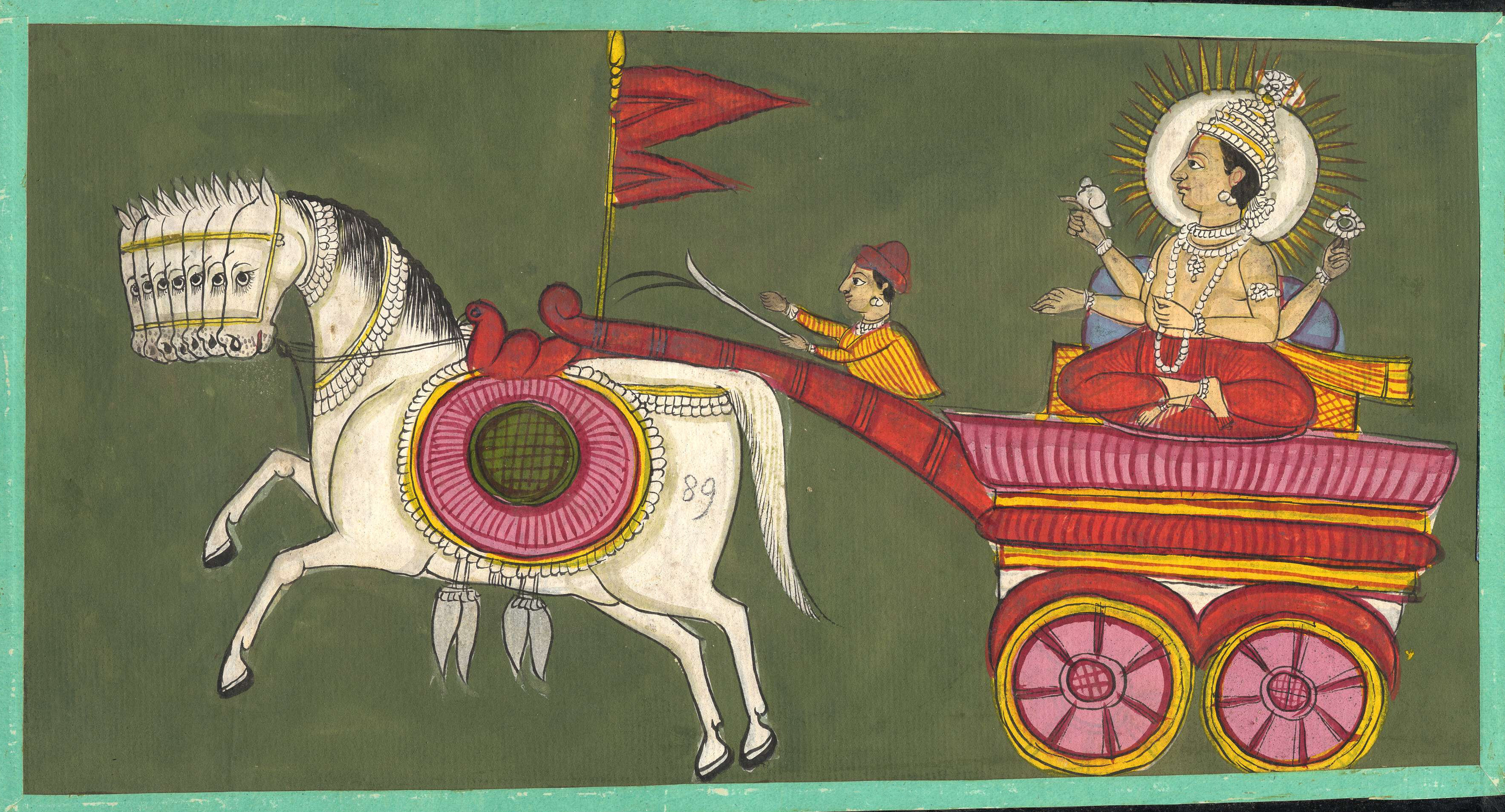
Surya sul suo carro trainato da sette cavalli

Surya, il dio sole, che consuma se stesso nel sacrificio cosmico dell'universo, era un giovane molto bello e  forte. Percorreva le sfere celeste sopra il suo carro di fuoco trainato da sette cavalli e guidato da Aruna, l'uomo-uccello fratello di Garuda il veicolo del dio Vishnu.  Un giorno vide una bellissima ragazza e se ne innamorò. Era Samjna, figlia di Visvakarman, l'architetto degli dei. I due si sposarono.
Ma lo splendore e il calore di Surya, o forse la forza del suo amore, erano intollerabili per Samjna che non poteva neppure avvicinarsi all’amato sposo.
Una notte allora, quando Surya non c’era, fuggì nella foresta e si fece sostituire da Chaya (in sanscrito ‘ombra’) in tutto e per tutto uguale a lei, ma capace di sostenere la luce di Surya.
Surya non si accorse della sostituzione e visse con Chaya finchè un giorno, quando lei brontolò duramente uno dei figli di Samjna, il dio sole scoprì la verità.
Surya andò subito in cerca della moglie e la trovò nella foresta trasformatasi, per non essere scoperta, in una cavalla. Surya si trasformò a sua volta in uno stallone e si unì a lei svelando poi la sua vera identità.
I due tornarono nella sfera celeste, ma il problema del calore e della luce di Surya non era stato risolto.
Visvakarman, l’architetto degli dei e padre di Samjna, propose allora di ridurre i raggi di Surya che accettò. Visvakarman tagliò parte dei raggi solari in modo che Surya e Samina potessero vivere vicini.
Con i raggi tagliati vennero realizzate alcune tra le più potenti armi mai viste nell’universo, il trishula (tridente) di Shiva, il chakra (disco) di Vishnu, la lancia di Karttikeya, il tempio del sole di Konarak.

lunedì 2 aprile 2018

One who feed Krishna feeds the world

Mahabhalipuram, Tamil Nadu (India)
The twelve years of exile in the forest for the Pandavas were very hard and tiring. They no longer had the command of a flourishing kingdom, no longer lived in sumptuous palaces with servants and maids, but they lived in huts made of bushes and were exposed to the harsh climate and the dangers of the forest.
To make their exile less hard and to enable the five heroic brothers and their wife Draupadi to always have food, the Mahabharata tells us that Surya, the sun God, had given them a copper tray prodigious.
Every time that the Pandavas were hungry, the tray was filled with food and remained full of food until Draupadi had eaten. After the tray remained empty until the next day.
This magic tray made possible not only to the Pandavas to eat, but also to welcome the guests and the wise men who came to visit them with worthy honors. If the hospitality was not worthy and generous, the sages could cast a curse against the Pandavas, and in their situation, they could not afford to be cursed by some ascetic.
One of the most angry rishi was Durvasa. He always pretended to be received with full honors, demanded food for himself and for his many disciples who followed him always, if he had not been satisfied by his guests, he hurled painful curses.
One day, Durvasa went to the palace of Hastinapura where Duryodhana, the evil son of Dritharshtra who had exiled by fraud Pandava cousins, received him with the greatest honors. Durvasa was pleased and said to Duryodhana: "Ask what you want, I will give it."
The evil Duryodhana, who feared the return of the cousins ​​at the end of exile, asked the rishi:
"Oh great and venerable sage, please go to the forest to visit my poor cousins, I are sorry for them and I’m sure they would be happy of your visit."
Duryodhana invited the rishi to go to Pandavas in the evening, after dinner, because he knew that in that way the magic tray would have been hopelessly empty until the next morning.
And so it happened. Durvasa went to the Pandavas and said: "I and my followers are going to do the ritual ablutions, we would like to eat when we come back."
Draupadi was desperate, the tray was empty and she was not able to prepare food in a short time for such a large group. She was terrified, the rishi would hurl a curse against the Pandavas once he was realized that there was nothing to eat. The Queen turned to Lord Krishna, she thought him with all his strength and Krishna appeared to her.
"Hello my Queen Draupadi," said Krishna.
"I need your help, my dear Lord!" Draupadi cried in anguish.
"Wait, I'm hungry, can you give me something to eat first."
"But it is precisely the problem, I’ve nothing to eat," said Draupadi.
"Are you sure? - Krishna insisted - Get the tray and look closely."
Draupadi took the tray and looked into it, it was empty.
"Look closer," said Krishna.
"There is nothing - Draupadi said sadly - there was only a grain of rice and a piece of vegetable."
"Give those to me," said Krishna.
Draupadi gave those to him and Krishna ate two small pieces of food.
"I am satiated - said Krishna to Draupadi - have no concern." And he went.
At the same time, Durvasa and his disciples were returning to the hermitage of the Pandavas and felt incredibly full, satiated, they were no longer hungry, they felt as if they had eaten a large meal.
"Excuse us, Queen - Durvasa said to Draupadi - thank you for your hospitality, but we’ll eat with you another day."
Thus Draupadi and the Pandavas were saved from the curse of Durvasa.
One who feed Krishna feeds the world.


Chi sazia Krishna sazia il mondo


Tempio di Sri Meenaski - Madurai
(Tamil Nadu - India)
I dodici anni di esilio nella foresta per i Pandava furono molto duri e faticosi. Non avevano più il comando di un regno florido, non vivevano più in sontuosi palazzi con servi e ancelle, ma abitavano in capanne fatte di arbusti ed erano esposti al clima rigido e ai pericoli della foresta.
Per rendere il loro esilio meno duro e per consentire ai cinque eroici fratelli e alla loro moglie Draupadi di avere sempre cibo, il Mahabharata ci racconta che Surya, il dio del Sole, aveva donato loro un prodigioso vassoio di rame.
Ogni volta che i Pandava avevano fame, il vassoio si riempiva di cibo e restava pieno di cibo fino a che non si serviva Draupadi. Dopo che la regina aveva mangiato, il vassoio rimaneva vuoto fino al giorno successivo.
Questo vassoio magico consentiva ai Pandava non solo di mangiare, ma anche di accogliere con i degni onori gli ospiti ed i rishi, saggi che si recavano da loro in visita. Se l'accoglienza non fosse stata degna e generosa, i saggi avrebbero potuto lanciare una maledizione contro i Pandava e, nella loro situazione, non potevano certo permettersi di venire maledetti da qualche asceta.
Tra i rishi più iracondi c'era Durvasa. Esigeva di essere sempre accolto con tutti gli onori, pretendeva cibo per sè e per i propri numerosi discepoli che lo seguivano sempre e, nel caso in cui non fosse stato soddisfatto dai propri ospiti, lanciava maledizioni dolorosissime.
Un giorno Durvasa si recò alla reggia di Hastinapura dove Duryodhana, il malvagio figlio di Dritharshtra che aveva con l'inganno esiliato i cugini Pandava, lo accolse con i più grandi onori. Durvasa rimase soddisfatto e disse a Duryodhana: "Chiedimi ciò che vuoi, te lo concederò."
Il perfido Duryodhana, che temeva il ritorno dei cugini al termine dell'esilio, chiese al rishi:
"Oh grande e venerabile saggio, ti prego di andare nella foresta a visitare i miei poveri cugini, sono in pena per loro e sono certo che sarebbero felici di una tua visita."
Duryodhana invitò il rishi a recarsi dai Pandava la sera, dopo la cena, perchè sapeva che in quel modo il vassoio magico sarebbe stato irrimediabilmente vuoto fino al mattino successivo.
E così avvenne. Durvasa si recò dai Pandava e disse loro: "Io ed i miei discepoli andiamo a fare le rituali abluzioni, al ritorno vorremmo mangiare."
Draupadi era disperata, il vassoio era vuoto e non era certo in grado di preparare da mangiare in poco tempo per una così numerosa comitiva. Era terrorizzata, il rishi avrebbe lanciato una maledizione contro i Pandava una volta che si fosse reso conto che non c'era niente da mangiare. La regina si rivolse a Krishna, lo pensò con tutta la sua forza e Krishna le apparve davanti.
"Salve mia regina Draupadi," disse Krishna.
"Ho bisogno del tuo aiuto, mio caro Signore!" gridò angosciata Draupadi.
"Aspetta, ho fame, prima dammi qualcosa da mangiare," ribattè lui.
"Ma è proprio questo il problema, non ho niente da mangiare," replicò Draupadi.
"Ne sei sicura? - insistè Krishna - Prendi il vassoio e guarda bene."
Draupadi prese il vassoio e vi guardò dentro, era vuoto.
"Guarda meglio," disse Krishna.
"Non c'è niente - disse sconsolata Draupadi - c'è rimasto un chicco di riso e un pezzetto di verdura."
"Dammeli," disse Krishna.
Draupadi così fece e Krishna mangiò i due piccoli pezzi di cibo.
"Mi sono sfamato - disse Krishna a Draupadi - non avere alcuna preoccupazione." E se ne andò.
Nello stesso momento, Durvasa ed i suoi discepoli stavano tornando all'eremo dei Pandava e si sentirono incredibilmente sazi, non avevano più fame, si sentivano come se avessero mangiato un abbondante pasto.
"Scusaci, regina - disse allora Durvasa a Draupadi - ti ringrazio per la tua ospitalità, ma mangeremo alla tua tavola un altro giorno."
Così Draupadi e i Pandava si salvarono dalla maledizione dell'iracondo Durvasa.
Chi sazia Krishna sazia il mondo.


sabato 23 novembre 2013

Il sole sacrifica i suoi raggi per amore


Surya sul suo carro trainato da sette cavalli


Surya, il dio sole, che consuma se stesso nel sacrificio cosmico dell'universo, era un giovane molto bello e forte.
Percorreva le sfere celeste sopra il suo carro di fuoco trainato da sette cavalli e guidato da Aruna, l'uomo-uccello fratello di Garuda il veicolo del dio Vishnu.
Un giorno vide una bellissima ragazza e se ne innamorò. Era Samjna, figlia di Visvakarman, l'architetto degli dei. I due si sposarono.
Ma lo splendore e il calore di Surya, o forse la forza del suo amore, erano intollerabili per Samjna che non poteva neppure avvicinarsi all’amato sposo.
Una notte allora, quando Surya non c’era, fuggì nella foresta e si fece sostituire da Chaya (in sanscrito ‘ombra’) in tutto e per tutto uguale a lei, ma capace di sostenere la luce di Surya.
Surya non si accorse della sostituzione e visse con Chaya finchè un giorno, quando lei brontolò duramente uno dei figli di Samjna, il dio sole scoprì la verità.
Surya andò subito in cerca della moglie e la trovò nella foresta trasformatasi, per non essere scoperta, in una cavalla. Surya si trasformò a sua volta in uno stallone e si unì a lei svelando poi la sua vera identità.
I due tornarono nella sfera celeste, ma il problema del calore e della luce di Surya non era stato risolto.
Visvakarman, l’architetto degli dei e padre di Samjna, propose allora di ridurre i raggi di Surya che accettò. Visvakarman tagliò parte dei raggi solari in modo che Surya e Samina potessero vivere vicini.
Con i raggi tagliati vennero realizzate alcune tra le più potenti armi mai viste nell’universo, il trishula (tridente) di Shiva, il chakra (disco) di Vishnu, la lancia di Karttikeya, il tempio del sole di Konarak.


The Sun agrees to cut his rays for love


Surya on his chariot with seven horses
Surya, the God Sun, who consumes himself in the sacrifice of the cosmic universe, was a very nice and strong young man.
He walked the celestial spheres above his fiery chariot drawn by seven horses and driven by Aruna, the brother of the man-bird Garuda the vehicle of the God Vishnu.
One day he saw a beautiful girl and fell in love. She was Samjna, the young daughter of Visvakarman, the architect of the Gods. The two were married.
But the splendor and warmth of Surya, or perhaps the power of his love, were intolerable for Samjna since she could not even get close to beloved husband.
One night, then, when Surya was not there, she fled into the forest and had replaced by Chaya (in Sanskrit 'shadow' ), she was in all respects like her, but she was able to hold the light of Surya.
Surya did not notice the substitution and lived with Chaya until one day, when she grumbled hard  a Samjna son, so the God Sun discovered the truth.
Surya immediately went in search of his wife and found her in the forest transformed in a mare not to be discovered. Surya transformed hinself into a stallion and joined her revealing then his true identity.
The two returned to the celestial sphere, but the problem of the heat and light of Surya had not been resolved.
Visvakarman then proposed to reduce the rays of Surya, who accepted. Visvakarman cut off part of the sun's rays so that Surya and Samina could live near.
With cut-rays were built some of the most powerful weapons ever seen in the universe, the trishula (trident) of Shiva , the chakra (disc) of Vishnu, the lance of Karttikeya, the Sun Temple of Konarak.


sabato 25 febbraio 2012

Rahu and the eclipses

Samutramanthan:
the first demons is Rahu
Do you remember the churning of the primordial ocean, the Samutramanthan? Well the Gods and demons were once allies, they had rolled up the serpent Vasuki around Mount Mandara, the Gods had seized it from the head and the demons from its tailor and began to spin around the mountain, which rested on Kurma, the tortoise. 
The first of the demons who grabbed the snake was called Rahu. 
From ocean churning emerged many things, but most important was the amrita, nectar of the Gods, also called soma, the drink that gave power and, above all, eternal live (in fact the Sanskrit amrita is made "a" privative "mrita" "death" like mortis in Latin : "no death"). 
Obtained the drink, the Gods and demons began to fight again. Each of them wanted to drink the soma and, after a hard struggle and many deceptions, the Gods were somehow better. 
But when peace seemed restored, and the Gods, in turn, drank the drink, Surya (the Sun) and Soma or Chandra (the Moon), found that Rahu, the demon, had slipped between the Gods and was drinking the nectar. 
Surya and Chandra gave the alarm and the God Vishnu threw the disc Sudarsana, one of his main weapons against Rahu and he was decapitated. 
The head of Rahu splashed in the sky and the body fell loudly on the ground causing a terrible hearthquake. 
But Rahu had already drank a bit of 'soma' which had come up to his neck. Therefore, the body fell on the earth perished as all mortal things, while the head of Rahu gained eternal life. 
The demon, betrayed by Surya and Chandra, wanted revenge on the two 'spies' and perpetually chasing them in the sky. Periodically Rahu (in Sanskrit "Rahu" meaning "he who grasps") reach es them and swallows them, but having no longer the body, once swallowed Chandra the moon, and Surya, the Sun, they re-emerge from the neck of the demon. 
Here is the explanation of the eclipses of the sun and moon.

Rahu e le eclissi


Samutramanthan:
il primo dei dèimoni è Rahu

Vi ricordate il frullamento dell’oceano primordiale, il Samutramanthan? Ebbene gli dèi ed i demoni una volta tanto si erano alleati, avevano arrotolato il serpente Vasuki        intorno al monte Mandara, poi gli dèi lo avevano afferrato  per la testa e i demoni per la coda e avevano cominciato a girare vorticosamente il monte che poggiava su Kurma, la tartaruga. 
Il primo dei demoni che afferrò il serpente si chiamava Rahu. 
Dal frullamento dell’oceano emersero tantissime cose, ma soprattutto fuoriuscì l’amrita il nettare degli dèi, chiamato anche soma, la bevanda che dava potere e, soprattutto, eternità (infatti il sanscrito amrita è composto da “a” privativa e “mritamorte, cioè “assenza di morte”).
Ottenuta la bevanda, gli dèi e i demoni cominciarono di nuovo la lotta. Ognuno di loro voleva bere il soma e, dopo uno scontro durissimo e molteplici inganni, gli dèi ebbero in qualche modo la meglio. 
Ma quando la calma sembrò ristabilita e gli dèi, a turno, bevevano la bevanda, Surya (il Sole), e Soma o Chandra, (la Luna) si accorsero che Rahu, uno dei demoni, si era intrufolato tra gli dèi e stava bevendo il nettare.
Surya e Chandra diedero l’allarme e il dio Vishnu lanciò il disco Sudarsana, una delle sue armi più micidiali, contro Rahu che venne decapitato. La testa di Rahu schizzò nel cielo ed il corpo cadde fragorosamente sulla terra causando un terribile sommovimento.
Ma ormai Rahu era riuscito a bere un po’ di soma che era arrivato fino al collo. Pertanto il corpo caduto sulla terra perì come tutte le cose mortali, mentre la testa di Rahu ottenne la vita eterna. 
Il demone, tradito da Surya e da Chandra, volle vendicarsi dei due ‘spioni’ e perennemente li rincorre nel cielo. Periodicamente riesce a raggiungerli e li ingoia (infatti in sanscrito Rahu significa "l'afferratore"), ma non avendo più il corpo, una volta ingoiati Chandra la Luna, e Surya, il Sole, fuoriescono nuovamente dal collo del demone. 
Ecco spiegate le eclissi di sole e di luna.

sabato 5 novembre 2011

One who feed Krishna feeds the world

Mahabhalipuram, Tamil Nadu (India)
The twelve years of exile in the forest for the Pandavas were very hard and tiring. They no longer had the command of a flourishing kingdom, no longer lived in sumptuous palaces with servants and maids, but they lived in huts made of bushes and were exposed to the harsh climate and the dangers of the forest.
To make their exile less hard and to enable the five heroic brothers and their wife Draupadi to always have food, the Mahabharata tells us that Surya, the sun God, had given them a copper tray prodigious.
Every time that the Pandavas were hungry, the tray was filled with food and remained full of food until Draupadi had eaten. After the tray remained empty until the next day.
This magic tray made possible not only to the Pandavas to eat, but also to welcome the guests and the wise men who came to visit them with worthy honors. If the hospitality was not worthy and generous, the sages could cast a curse against the Pandavas, and in their situation, they could not afford to be cursed by some ascetic.
One of the most angry rishi was Durvasa. He always pretended to be received with full honors, demanded food for himself and for his many disciples who followed him always, if he had not been satisfied by his guests, he hurled painful curses.
One day, Durvasa went to the palace of Hastinapura where Duryodhana, the evil son of Dritharshtra who had exiled by fraud Pandava cousins, received him with the greatest honors. Durvasa was pleased and said to Duryodhana: "Ask what you want, I will give it."
The evil Duryodhana, who feared the return of the cousins ​​at the end of exile, asked the rishi:
"Oh great and venerable sage, please go to the forest to visit my poor cousins, I are sorry for them and I’m sure they would be happy of your visit."
Duryodhana invited the rishi to go to Pandavas in the evening, after dinner, because he knew that in that way the magic tray would have been hopelessly empty until the next morning.
And so it happened. Durvasa went to the Pandavas and said: "I and my followers are going to do the ritual ablutions, we would like to eat when we come back."
Draupadi was desperate, the tray was empty and she was not able to prepare food in a short time for such a large group. She was terrified, the rishi would hurl a curse against the Pandavas once he was realized that there was nothing to eat. The Queen turned to Lord Krishna, she thought him with all his strength and Krishna appeared to her.
"Hello my Queen Draupadi," said Krishna.
"I need your help, my dear Lord!" Draupadi cried in anguish.
"Wait, I'm hungry, can you give me something to eat first."
"But it is precisely the problem, I’ve nothing to eat," said Draupadi.
"Are you sure? - Krishna insisted - Get the tray and look closely."
Draupadi took the tray and looked into it, it was empty.
"Look closer," said Krishna.
"There is nothing - Draupadi said sadly - there was only a grain of rice and a piece of vegetable."
"Give those to me," said Krishna.
Draupadi gave those to him and Krishna ate two small pieces of food.
"I am satiated - said Krishna to Draupadi - have no concern." And he went.
At the same time, Durvasa and his disciples were returning to the hermitage of the Pandavas and felt incredibly full, satiated, they were no longer hungry, they felt as if they had eaten a large meal.
"Excuse us, Queen - Durvasa said to Draupadi - thank you for your hospitality, but we’ll eat with you another day."
Thus Draupadi and the Pandavas were saved from the curse of Durvasa.
One who feed Krishna feeds the world.

Chi sazia Krishna sazia il mondo

Tempio di Sri Meenaski - Madurai
(Tamil Nadu - India)
I dodici anni di esilio nella foresta per i Pandava furono molto duri e faticosi. Non avevano più il comando di un regno florido, non vivevano più in sontuosi palazzi con servi e ancelle, ma abitavano in capanne fatte di arbusti ed erano esposti al clima rigido e ai pericoli della foresta.
Per rendere il loro esilio meno duro e per consentire ai cinque eroici fratelli e alla loro moglie Draupadi di avere sempre cibo, il Mahabharata ci racconta che Surya, il dio del Sole, aveva donato loro un prodigioso vassoio di rame.
Ogni volta che i Pandava avevano fame, il vassoio si riempiva di cibo e restava pieno di cibo fino a che non si serviva Draupadi. Dopo che la regina aveva mangiato, il vassoio rimaneva vuoto fino al giorno successivo.
Questo vassoio magico consentiva ai Pandava non solo di mangiare, ma anche di accogliere con i degni onori gli ospiti ed i rishi, saggi che si recavano da loro in visita. Se l'accoglienza non fosse stata degna e generosa, i saggi avrebbero potuto lanciare una maledizione contro i Pandava e, nella loro situazione, non potevano certo permettersi di venire maledetti da qualche asceta.
Tra i rishi più iracondi c'era Durvasa. Esigeva di essere sempre accolto con tutti gli onori, pretendeva cibo per sè e per i propri numerosi discepoli che lo seguivano sempre e, nel caso in cui non fosse stato soddisfatto dai propri ospiti, lanciava maledizioni dolorosissime.
Un giorno Durvasa si recò alla reggia di Hastinapura dove Duryodhana, il malvagio figlio di Dritharshtra che aveva con l'inganno esiliato i cugini Pandava, lo accolse con i più grandi onori. Durvasa rimase soddisfatto e disse a Duryodhana: "Chiedimi ciò che vuoi, te lo concederò."
Il perfido Duryodhana, che temeva il ritorno dei cugini al termine dell'esilio, chiese al rishi:
"Oh grande e venerabile saggio, ti prego di andare nella foresta a visitare i miei poveri cugini, sono in pena per loro e sono certo che sarebbero felici di una tua visita."
Duryodhana invitò il rishi a recarsi dai Pandava la sera, dopo la cena, perchè sapeva che in quel modo il vassoio magico sarebbe stato irrimediabilmente vuoto fino al mattino successivo.
E così avvenne. Durvasa si recò dai Pandava e disse loro: "Io ed i miei discepoli andiamo a fare le rituali abluzioni, al ritorno vorremmo mangiare."
Draupadi era disperata, il vassoio era vuoto e non era certo in grado di preparare da mangiare in poco tempo per una così numerosa comitiva. Era terrorizzata, il rishi avrebbe lanciato una maledizione contro i Pandava una volta che si fosse reso conto che non c'era niente da mangiare. La regina si rivolse a Krishna, lo pensò con tutta la sua forza e Krishna le apparve davanti.
"Salve mia regina Draupadi," disse Krishna.
"Ho bisogno del tuo aiuto, mio caro Signore!" gridò angosciata Draupadi.
"Aspetta, ho fame, prima dammi qualcosa da mangiare," ribattè lui.
"Ma è proprio questo il problema, non ho niente da mangiare," replicò Draupadi.
"Ne sei sicura? - insistè Krishna - Prendi il vassoio e guarda bene."
Draupadi prese il vassoio e vi guardò dentro, era vuoto.
"Guarda meglio," disse Krishna.
"Non c'è niente - disse sconsolata Draupadi - c'è rimasto un chicco di riso e un pezzetto di verdura."
"Dammeli," disse Krishna.
Draupadi così fece e Krishna mangiò i due piccoli pezzi di cibo.
"Mi sono sfamato - disse Krishna a Draupadi - non avere alcuna preoccupazione." E se ne andò.
Nello stesso momento, Durvasa ed i suoi discepoli stavano tornando all'eremo dei Pandava e si sentirono incredibilmente sazi, non avevano più fame, si sentivano come se avessero mangiato un abbondante pasto.
"Scusaci, regina - disse allora Durvasa a Draupadi - ti ringrazio per la tua ospitalità, ma mangeremo alla tua tavola un altro giorno."
Così Draupadi e i Pandava si salvarono dalla maledizione dell'iracondo Durvasa.
Chi sazia Krishna sazia il mondo.

domenica 18 settembre 2011

Gayatri, il più sacro di tutti i mantra

Surya, il dio Sole
OM
Bhur bhuvah svah
Tat Savitur varenyam
Bhargo devasya dhimahi
Dhiyo yo nah prachodayat
OM

E’ il mantra più sacro dei Veda, la preghiera più potente della tradizione induista. E’ la Gayatri, l’inno rivolto a colui che dona la vita, cioè Savitri, il Sole, altre volte chiamato Surya.
La pronuncia sanscrita corretta dovrebbe essere la seguente:

OM
Bur buva suaà,
Tat Savitur variniam
Bargo devasiadi-maì
Diò ionà praciodayàt
Om

Alain Danielou traduce il mantra in questo modo:

Sfera terrestre, sfera dello spazio, sfera celeste!
Contempliamo lo splendore dello spirito solare,
il creatore divino.
Possa egli guidare i nostri spiriti.


Altra libera traduzione che mi piace:

Meditiamo sulla gloria del creatore, che ha creato l'universo,
che è degno di adorazione, che è l'incarnazione della conoscenza e della luce,
che rimuove il peccato e l'ignoranza.
Possa egli illuminare il nostro intelletto.

Lo troviamo nel Rig Veda, il più antico di tutti i Veda (Rig Veda III, 62-10), e potremmo dire che la Gayatri è il Padre Nostro dell’Induismo, i dvija, i nati due volte, cioè gli adulti delle tre caste superiori lo devono recitare almeno due volte al giorno, meglio tre.
La Gayatri infatti – come insegna anche la Manusmirti, il Trattato di Manu sulle norme etiche - viene insegnato e assegnato al ragazzo al momento dell’iniziazione durante il sacramento dell’Upanayana per coloro che così diventano i dvija (brahmana, kshatriya e vaishta) e viene recitato ai ‘due crepuscoli e cioè all’aurora rivolti ad est finchè non si vede sorgere il sole e al tramonto, rivolti ad ovest finchè non si scorgono le costellazioni, all’aurora stando in piedi, al tramonto stando seduti.
“Chiunque reciti questo verso per tre anni ogni giorno – continua Manu - raggiunge la realtà ultima” e comunque, ogni sua recitazione lava i peccati passati.
Questa preghiera prende il nome dal classico verso vedico di ventiquattro sillabe (tre volte otto).
Questo mantra è chiamato Gayatri quando viene recitata all’aurora, Savitri, quando è recitato a mezzogiorno e Saraswati quando è recitato al tramonto.
La Gayatri è anche detta Vedmata perché madre dei quattro Veda di cui contiene l’essenza e Krishna, nella Baghavad Gita dice “io tra i mantra sono la Gayatri”.
Da un punto di vista mitologico Gayatri e Saraswati sono anche dee, spose di Brahma.


Gayatri, the most sacred of all mantras


OM
Bhur bhuvah svah
Tat Savitur varenyam
Bhargo devasya dhimahi
Dhiyo yo nah prachodayat
OM

File:Om.svg
OM


It's the most sacred mantra of the Vedas, the most powerful prayer of the Hindu tradition. That is the Gayatri, the hymn addressed to Savitri, the Sun (sometimes called Surya), the gifter of life.

The correct Sanskrit pronunciation should be as follows:
OM
Bur buva suaà,
Tat Savitur variniam
Barga-ever devasiadi
God Iona praciodayàt
Om
This is one translation:

Glory to Savitri, the excellent, the effulgent of the divine,
let us meditate upon it.
May it inspire us with understanding, who is Gayatri

Other free translation:

Terrestrial sphere, the sphere of space, the celestial sphere!
Contemplate the splendor of the spirit solar
the divine creator.
May he guide our spirits.
We could find this mantra in the Rig Veda, the oldest of all Vedas (Rig Veda III, 62-10), and we could say that the Gayatri is the Lord's Prayer in Hinduism, the dvija, the twice-born, i.e. the adults of the three the upper castes must play at least twice a day, preferably three.
The Gayatri - as also taught the Manusmriti, the Treaty of Manu on ethical standards - are taught and assigned to the boy at the time of initiation during the sacrament of Upanayana for those who become so dvija (brahmana, kshatriya and vaishta) and it is recited in two twilights: at aurora, standing and facing east until you see the sunrise and sunset, sitting and facing west until you can see the constellations.
"Whoever recites this verse every day for three years - continues Manu - reach the ultimate reality" and in any case, repeating this mantra takes away past sins.
This prayer takes its name from the classic to the Vedic twenty-four syllables (three times eight).
This is called Gayatri mantra  when it is recited at aurora, and Savitri, when it is recited at noon and Saraswati at sunset.
The Gayatri is also known as Vedmata, mother of the four Vedas because it contains the essence of Vedas and Krishna in the Bhagavad Gita says "Amongst mantras, I am the Gayatri".
From a mythological point of view Saraswati and Gayatri are goddesses, wives of Brahma.


domenica 6 febbraio 2011

Swastika


Lingam

Do not hide the fact that in India I’m still bewildered when I run, and this happens very often, in the swastila as this is a symbol that is indelibly linked to the disastrous and insane Nazi ideology.
Yet this symbol, which in present in many ancient civilizations, is highly significant in Hinduism, Buddhism and Jainism.
In the Vedic period, the swastika is the graphic symbol of Surya, the Sun god, and then the swastika is coupled mainly to the god Ganesh.
Swastika is a symbol connoting general auspiciousness, present on the doors of homes, lingam, vehicles or even on camels as you can see in this picture I took near Delhi.
The symbolic meanings of the swastika are many and they change with changing traditions.
The tradition most fascinating to me is that explains the swastika is a graphical representation of the development of multiplicity from a single point and develops the universe. The point is the intersection of the cross and is called bindu, the limit of the manifest. The manifest was created by multiplicity from a unmanifest and it devoleps in a non-linear way, so the arms of the cross are bent to symbolize that outward forms of the universe don’t ever take us to their fundamental unity, the center, the Truth. The journey from manifested reality to unmanifested and unchanging reality is not linear, but twisted, tortuous, complex, outside of human logic.
The swastika reminds us of the ultimate reality that is not accessible to the human spirit and does not fall undel human control.


La svastica


Non nascondo che in India resto ancora perplesso quando mi imbatto, e ciò capita molto spesso, nella svastica in quanto tale simbolo è indelebilmente collegato alla sciagurata e folle ideologia nazista. Eppure questo simbolo, che è antichissimo e presente in molte civiltà, è altamente significativo per l’induismo, il buddismo e il jainismo.
Nel periodo vedico la svastica è il simbolo grafico di Surya, il dio Sole, mentre successivamente la svastica è abbinata prevalentemente al dio Ganesh.
La svastica è un simbolo beneaugurate, presente sulle porte delle case, sui veicoli, sui lingam o, addirittura, sugli animali, come potete vedere in questa foto di un cammello che ho fatto vicino a Delhi.


Decorazione in marmo - Jaipur


I significati simbolici dati alla svastica sono molteplici e cambiano col cambiare delle tradizioni.
La tradizione per me più suggestiva è quella che spiega come la svastica sia la rappresentazione grafica dello sviluppo della molteplicità che parte da un unico punto e si sviluppa nell’universo. Il punto è l’intersezione della croce ed è chiamato bindu, il limite del manifesto. Il manifesto nasce dal non manifesto e si sviluppa in modo non lineare, per questo le braccia della croce sono piegate a simboleggiare che le forme esteriori dell’universo non ci portano mai verso la loro unità fondamentale, il centro, la verità. Il percorso dalla realtà manifesta alla realtà vera e immutabile non è lineare, ma contorto, tortuoso, complesso, al di fuori della logica umana. La svastica ci ricorda la realtà Suprema che non è accessibile allo spirito umano e non rientra nel controllo dell’uomo.