Visualizzazione post con etichetta Philosophy. Mostra tutti i post

domenica 15 luglio 2012

Mahavakyas

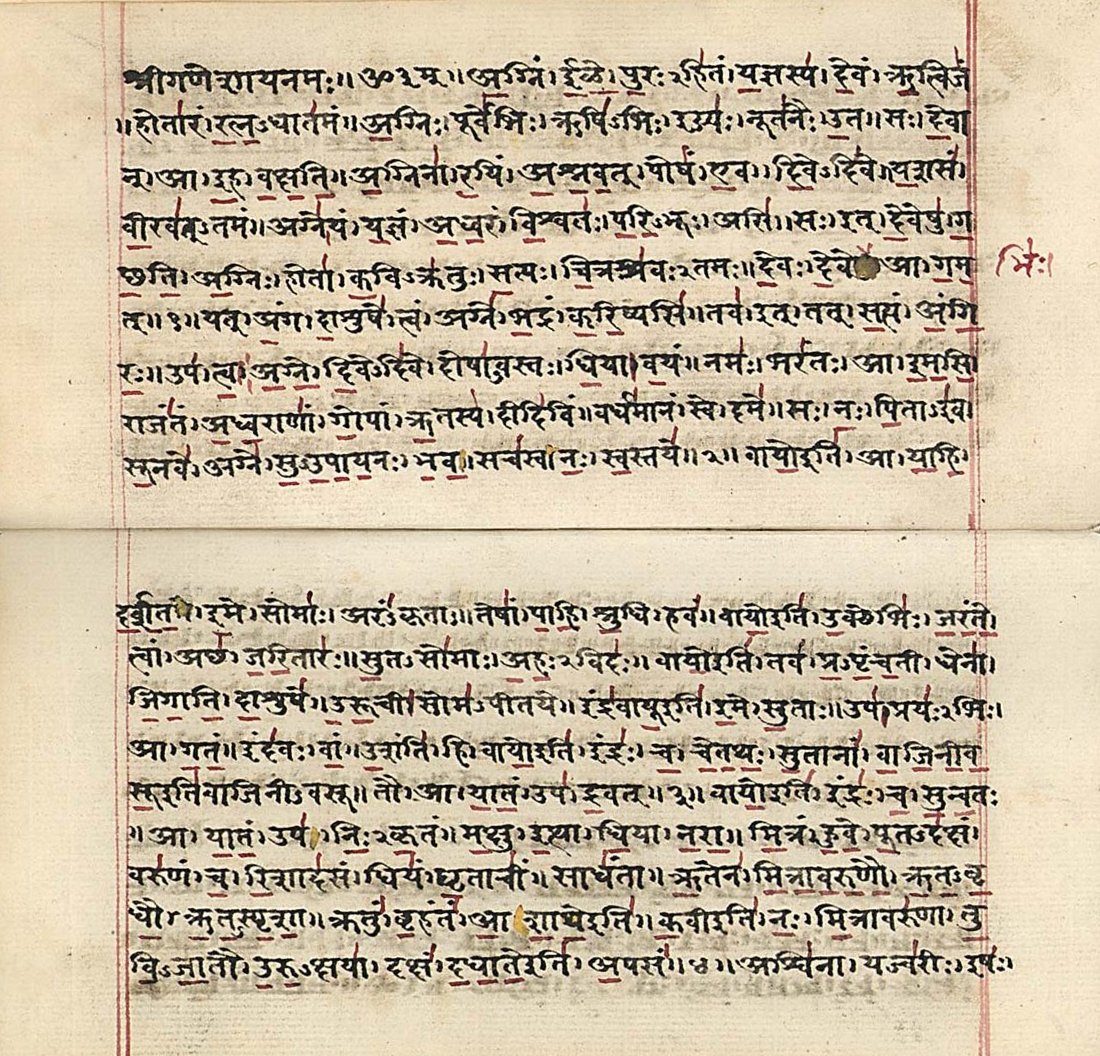
Rig Veda
They are the Mahavakyas, the Great sayings, the four Vedic aphorisms, four Sanskrit sentences which sum up the doctrine of Advaita Vedanta, Vedanta non-dualist, which believes that reality is one and only one, that reality is Brahman with whom also the individual soul identifies.

Tat tvam asi means You are that (Chandogya Upanishad VI, 8, 7)
Aham Brahmasmi means I am Brahman (Brhadaranyaka Upanishad I, 4, 10)
Ayam atma brahman, This Self is Brahman (Mandukya Upanishad II)
Prajnanam Brahma ie Brahman is pure Consciousness (Aitareya Upanishad V, 4)

While the first three sayings express the concept of identity between the individual spirit (Atman) and the Universal Spirit (Brahman), the forth one indicates the nature of Brahman as pure consciousness, devoid of purpose, modification, and duality.
The knowledge of this non-duality, this identity is the means to achieve moksha, or liberation from samsara, the cycle of rebirths.
The Mahavakyas are used as mantras too.


venerdì 2 marzo 2012

The finite is the infinite price

The universe that we consider reality is only appearance. All that is perceived by our senses and our mind is maya, illusion. The unchanging Reality is what's behind this appearance. It is Brahman. The Being, that has always been, is innate, and it is the uncreated essence of every living being.
The Brahman that is inside us is the Atman and purpose of human life is precisely the realization of the Atman, that is the experience that Atman and Brahman are the same reality, after which there is nothing that worth knowing. This, in brief, is the essence of Advaita Vedanta, the Vedanta non dual, ie the Vedanta considers that the existing one Reality, the Self and that nothing exists that is other-than-self. This is one of the six darshana or philosophical doctrines of Hinduism that is grounded in the Upanishads, in Brahmasutra and thinking of some philosophers, including Shancaracarya, and which forms the theological basis of Hinduism today too. 
To reach the knowledge that Brahman and Atman are the same, we must abandon the '"I" and "mine" that are the biggest obstacles to our realization. "We are what we are - Nisargadatta Maharaj says - but we only know what we are not." We must therefore close the "nine gates" and go beyond perception, beyond concepts, beyond the categories of time and space, name and form. 
The universe, what we call reality, is just a personal experience and when a person dies, the body dies and the consciousness of self, but Self doesn't die. "If you want the infinite, abandon the finite - says Maharaj - the finite is the infinite price." That means we must give up everything to get everything. "As long as we think we need things to be happy, we also believe to be unhappy when we lack. In fact we will be free only when we realize that we ourselves are the authors of our slavery, and we stop making things that bind us.
"The Brahman is the end of every desire, every thought and all knowledge. The Brahman is sat-cit-ananda, Being-Consciousness-Bliss Absolute. According to Vedanta this realization cannot be achieved in one lifetime, but it takes many lives, thousands, millions of lives. Atman must rid it of karma, ie the consequences of its actions in previous lives, until you exhaust all residual karma, reincarnation for the last time a human being and attain moksha or mukti, that is the liberation and the interruption of samsar, the cycle of rebirth, to merge the Atman which is inside us with Brahman.
And God, ishvara? God or gods as perceived by men, as every thing that exists in time, in space or in the mind, are destined to die. Religion is generally understood as a step towards self-knowledge. The man has progressed spiritually need something real, a God, an image to turn to, which is devoted. For those who believe in the existence of God, this is Brahman, for those who do not believe, Brahman is an impersonal metaphysical concept, essence and origin of all things and God is just one of many things that live only in the transient our perception.
In reality certain currents of Vedanta - based on selected passages from the Bhagavad Gita too - argue that the way to liberation may also pass through devotion (bakti) or detached action (karmayoga), but the more stringent Vedantists believe that devotion and action are still primitive levels in the path to moksha. Someone, when asked, about the rites and prayers, ceremonies and religion, answers provocatively: "Religion? And what has the religion got to do with God?"


To read: 

Chandogya Upanishad
Mundaka Upanishad 
Svetasvatara Upanishad 
Sankaracharya: Atmabodha, Self- Knowledge 
C. Isherwood, The wishing tree 
Sri Nisargadatta Maharaj, I am that 
Sri Nisargadatta Maharaj,The experience of nothingness

sabato 8 ottobre 2011

About doing nothing

One of the big differences between life in the modern West and India (not urbanized) in this: in India you can stand without doing anything.
Let me explain. If here in Italy or in another Western country you see a person sitting doing nothing, not talking, not reading, not working, not listining the music, not watching TV ... not plaing at pc, you are amazed, surprised. You ask "what are you doing?", in short, you think that person for an idle, for a weird or even crazy. Because here you have to do something, we must act, our senses must perceive visions / sounds / colors etc.. It is unthinkable that a person is standing doing nothing, just thinking, or even (if successful), not even thinking.
In India it is different. Or, at least, it is different in true India and not in that substitute for the West is becoming the 'shining India', the India of the economic boom.
In India you can be doing nothing, it's normal, it may be advisable, to have moments in the day in which nothing is done, you stop, close all openings to the outside.
Sri Nisargadatta Maharaj, a master of Vedanta, in one of his enlightening conversations collected in the book "I am that" about that is saying: "This seemingly pointless to spend time in India was held in high regard. It means that in that time you are free from the obsession with 'after'. If not in a hurry, the mind becomes quiet and free from anxiety and silence begin to feel something that is usually too thin and rarefied to be perceived. The mind, to recognize it, must be open and quiet. Here we try to put the mind in perfect condition in order to understand the reality. " And the reality is not the real world (including our bodies) that we perceive with our senses and that fills us, but that is transient and therefore not real. The reality, according to Hindu thought, is not outside us but within us.
Nisargadatta still reminds us that "all our problems stem from the wrong belief to be our body: food, clothing, shelter, safety, survival. None of this makes more sense when you realize that you may not be just a body. " He who believes to be the body appears at birth and disappears with death. However, if one is freed from this erroneous belief and he is free from "I' and 'mine ', he get closer to the only thing worth knowing is the Self.
In short, "the silence and immobility are not idle, the flower fills the air with its fragrance, the candle with its light . They do nothing but change everything with their mere presence."

sabato 3 settembre 2011

Death, body and Atman


Gange, Varanasi: Cremation

In the Hindu tradition, the body is nothing but the casing, the dress used by the Atman to incarnate itself and take the long journey that will lead this 'spirit', this 'soul' to join the 'universal spirit', the Brahman after many reincarnations until the complete exhaustion of the 'karmic residue.'
The body, especially the human body, is important, it is the instrument, the only one that could allow the achievement of the moksha, final liberation and interruption of samsara, the cycle of rebirth. It is not given to any other living being, only humans can attain liberation.
Gandhi said that the body is like the charka, so it must be kept, maintained, repaired, oiled, used properly, but it is just a tool, nothing more.
Consequently, the death affects only the body, the soul or, more correctly, the Atman does not die, cannot die because is ‘being’ and being cannot 'not to be.' The soul is innate, that is not born as always existed and - like everything that is born dies - what is not born cannot die.
In the Bhagavad Gita (II, 20) reads: "The soul that is inside every man ever born nor dies, it was not, will not be back. It is innate, necessary, eternal, primal, and it doesn’t die when the body dies.
For this reason, despite the pain that death causes among men, in India it is seen with a view different from the West, is considered as a new birth.
This is not something that ends up, but something that continues. So much so that death in India is not opposed to the life but to the birth and, like birth, it is just one of many passages from one state to another.
Significantly, the mother's womb is considered a grave where a certain state of being dies and born back and, on the contrary, the tomb is regarded as a uterus where it is consumed the destruction of the body and from which Atman will be to a new state through a new birth.
The belief that "you are not your body" has the consequence that the funeral rites and ancestor worship are different from those in the West.
The destruction of the body by cremation (completely majoritarian method used in India to get rid of the body) and consequent rituals are all designed to enable Atman to pursue properly the path that has yet to accomplish.
Does not exist, that there is no reason, a body to worship and a tomb on which to pray, there not a name to remember, the deceased lost name and form (namarupam), there is only the Atman and the rites are used to commit the path that Atman has to do.
The deceased lost the connotations of individuality so that takes a name common to all the other dead. Typically, if he was Brahmin is called Sarma, if Kshatriya Varma, if Vaisya Gupta, if Sudra Dasa and are dedicated to him the rituals only until the third generation. In practice the rites are celebrated for their father, grandfather and great-grandfather dead. When the son dies, the great-grandfather will not be the most celebrated rituals and so forth.

domenica 17 luglio 2011

To worship God, became God

Devam buthva, devam yajet: to worhip God, became God.
Religion and philosophy of India is the Adhyatmanvidya, the Science of Self that Ananda K. Coomaraswamy in one of the essays collected by Adelphi in the recent "The Dance of Shiva", sums up:
"And the science that recognizes the unity of all life forms - just one is the source, just one the essence and just one the goal - and considers the realization of this unit the highest good, happiness, salvation , freedom and the ultimate goal of life. "
This thought reminds me the Chandogya Upanishad you can read: "The light which shines above us, above all things, above the universe, above every world and above which there is no more, this light is that same light that shines inside us" (III, 13, 7). And again, "this Self within my heart, smaller than a grain of rice, than a grain of barley, than a grain of mustard seed, than a grain of millet, this Self that is within my heart is greater than the earth, greater than the space, greater than the sky, greater than all the worlds……this Self that is within my heart, this Self is the Brahman” (Ch. Up. 3, XIV 3-4).

Per venerare Dio, diventa Dio

Devam bhutva, devam yajet: per venerare dio, diventa dio.
La religione e la filosofia dell’India è l’Adhyatmanvidya, la Scienza del Sé che Ananda K. Coomaraswamy in uno dei saggi raccolti da Adelphi nel recente “La danza di Shiva”, così sintetizza:
“E’ la scienza che riconosce l’unità di tutte le forme di vita – una sola è la fonte, una sola l’essenza e una sola la meta – e considera la realizzazione di questa unità il bene supremo, la beatitudine, la salvezza, la libertà e lo scopo ultimo della vita.”
Questa riflessione mi ricorda la Chandogya Upanishad dove possiamo leggere che “quella luce nel cielo che splende al di sopra di noi, che brilla al di là di tutto, al di là dell’universo, nei mondi superiori e oltre ai quali non vi è più nulla, questa luce è quella stessa luce che risplende dentro di noi” (III, 13, 7). E ancora, “questo Sé dentro il mio cuore, che è più piccolo di un chicco di riso, di un granello d’orzo, di un seme di senape, di un grano di miglio, questo Sé che è dentro il mio cuore è più grande di tutta la terra, più grande dello spazio, più grande del cielo, più grande di ogni altro mondo….. questo Sé che è dentro il mio cuore è lo stesso Brahman” (Ch. Up. 3, XIV 3-4).

venerdì 10 giugno 2011

Pradakshina and Prasavya

Ganges - Varanasi
Turning around a center. The circular walking around something, the circumambulating something is a ritual very common in India and it has a very significant symbolism.
There is the rite of circumambulating an image of deity, lingam, Nandin, or fire Agni, relic, rivers, hills, sacred trees or a corpse in the hindus funeral rites.
Each of these walkings around has a meaning and precise rules.
First, the circumambulation is clockwise or counterclockwise.
In the first case it is pradakshina, which means 'right' and is a walking reserved for the auspicious rites, or propitiatory rites in honor of the gods.The 'auspicious' walking is in the clockwise direction because this is the path and the direction of the sun and other stars and thus that is considered a positive movement, benevolent, propitiatory.
Among the most important pradakshinas I like to remember the Giripradakshina (‘giri’ in Sanskrit means 'mountain' or 'hill') which consists of walking around the hill of Arunachala ('pillar of fire') at Tiruvannamalai in Tamil Nadu regarded as a representation of the God Shiva. The pilgrimage is done barefoot for 14 km of the route.
There is also a pilgrimage around the Ganges from its sources to its delta and back in the other side, a distance of thousands of kilometers and long years, while the path around the holy city of Varanasi is about sixty kilometers.
The spouses too, during the wedding ceremony of Vivaha, made seven laps in a clockwise direction around the fire reciting the Gayatri mantra.
From a symbolic point of view this walking is a metaphor for what should be the life of the devotee. As in this rite in the middle of walking is a God or an his image, so in the life of each the center should be occupied by God before whom all are equal. In fact, as every point on the circumference is equidistant from the center so every devotee is equal before God.
When the gait is counterclockwise, that is Prasavya (in Sanskrit means 'left'). It 's a movement reserved for funerals and other not auspicious rites - even – for the rituals of black magic.
Even in traditional funeral rites called Antyesti, the male heir sets fire to the pyre where lies the body of the deceased after doing three (or seven) turns counterclockwise around the funeral pyre.

venerdì 20 maggio 2011

Shivalingam


Shiva is the only Hindu deity who is revered as a non-iconic, non-anthropomorphic.
I refer to the lingam (or linga) and in its isolated form as it is combined with the yoni that you can see in this post and the following one.
Obviously there are several anthropomorphic images of Siva and of course the Mahadeva is also revered in his image 'explicit', the fact remains that he is the only Hindu god whose image is very often replaced by an abstract symbol, the lingam, also called just Shivalingam. And that is the lingam is placed and worshiped in Garbhagrha, the most sacred place of the Hindu temples, the place where is stored the image of the god is worshiped mainly in that temple, the sanctum sanctorum in fact.
The worship of the lingam, the main worship for the Lingayat sect of Shaivism, is very old as it is already present in the prevedic period.
This is a totally indigenous cultic element that - after an initial attempt to oust by the Vedism and Brahmanism - came in its own right to be part of Hinduism. Consider that in the Rig Veda despises those who worship the lingam.
As said the lingam can be alone or combined with the yoni.
Lingam in Sanskrit means 'sign ', 'track', mark and even 'phallus'. While yoni means origin, source, womb and indicates the female genitalia.
The lingam is a column, pillar, usually of stone, but can be any other material, in many texts it is described as a pillar of fire. It is built according absolutely predetermined shapes and sizes.
Its base is square and oriented in the four directions and usually is not visible being buried. The second part is octagonal and supported on the yoni.
The three parts of the lingam to be proportional to size based on many parameters including the caste of those who venerate it.
Typically, the surface of the lingam is smooth, but there are also lingam on which are carved images of God or one or more faces of Shiva. In the latter case we speak of Mukhalingam.
When the faces are five - as in the case of the lingam published in this post – the name is Panchamukhalinga. Five is a number of Shiva, as the syllables of his mantra Namah Shivaya.
The lingam is the symbol of Purusha, the cosmic man, the informal, the unchanging, all unspoken. Instead the symbol of the energy  of nature, prakriti, of all that is in the world is the yoni.
One is the immanent cause and the other the efficient cause.
The lingam is in the yoni, it is the power that manifests the unmanifested, is the womb where the lingam deposits its seed to generate all that exists in the universe.

mercoledì 18 maggio 2011

Hinduism and Christianity

Puja
A friend asked me what is the difference in practice between Christianity and Hinduism. Beyond the rites, celebrations, beliefs, specifically what differentiates a Christian from a Hindu.
It is obviously a huge demand which I cannot give an answer, there are many aspects that make the two religions distant from each other and many even those that make them similar.
However I could not help but go back to read the wonderful "Pilgrimage to the sources " of Lanza del Vasto.
This is the diary of an ‘epic’ journey that Lanza del Vasto made ​​in India in 1936 to drink from the wellspring of all religions and all spirituality.
The Italian pilgrim meets an Hindu ascetic and stops a few days in his ashram at the foot of the Himalayas. By the time to go away he was invited to stay to meditate with shadu too, but he refuses.
"In me is Christian restlessness - he says - that, however imperfect, I prefer to perfect peace proposed by this wise man.
The good that I seek is not peace of the deep sleep but the ravings of the soul in love. I don’t think I have the right to seek salvation by myself and for myself. I must go thraough the good of others to get to my good and I believe that charity is worth more than wisdom.
For this I am going to Gandhi, to learn how to become a better Christian."

venerdì 18 marzo 2011

Sri Yantra

To watch the Sri Yantra fascinates me always, it’s the most sacred of all yantras I reproduce in this post and I’m using as my avatar.
But what are yantras?  Yantra literally means ‘tool’ and those are an aid to meditation. These geometric diagrams with two or even three dimensions represent god and goddesses or mystical concepts. The bases of the temples and religious buildings are yantras with mystical and religious meanings very precise.
In the yantras are used geometrical figures, each of which has its own meaning, which, combined with other figures, give to the yantra meaning sometimes very articulate.
Points, straight lines and curves, points or arrow, triangles, circles, crescents, hexagons, squares, pentagons, crosses of various types combine to form a yantra. These symbols are usually surrounded by one or two circles of lotus petals, the flower symbol of Hinduism, the flower that is what man should be.  In fact, like the petals of the lotus while being supported on the surface of the pond it is neither wet nor contaminated, so the man should live in the phenomenal reality without being affected by that. To be in the world but not of the world.
The two concentric circles of lotus petals are in turn surrounded by a square called sisira (which means trembling in Sanskrit) with four T-shaped gates placed at the four cardinal points.
Each Hindu god has a yantra that represents, even each god has a yantra for each of his own many aspects and each yantra is also a mantra, a ritual formula that Is repeated mentally or verbally, a further aid to devotional meditation.
The Sri Yantra is called also Sri Chakra or diagram of fortune and Nava Chakra because it allows nine levels of meditation starting from outer frame until you reach the center of the drawing.
The Sri Yantra is a symbol of good luck and is dedicated to the Mother Goddess, more precisely to Rajarajeshvari, the Queen of the queens. It represents the powerful and permanent flow of the creation presided over by that goddess.
The Sri Yantra is composed of the frame (sisira), two concentric circles, respectively 16 and 8 lotus petals that surrounded a figure made of four isosceles triangles with the vertex upwards, intersecting with another five isosceles triangles with the vertex down. The four triangles represent the male aspect and the five triangles the female aspect, Purusha and Prakriti, Lingam and Yoni, Shiva and Parvati, by whose union was created and developed the whole universe whose multiplicity is represented by 43 triangles borning from the intersection of the nine main triangles.
The five triangles are feminine energy that powers the Purusha, the matrix, static property that has the unexpressed universe within itself.
The Sri Yantra is also a metaphor that refers to the oldest vedism and the centrality of sacrifice. The five triangles that intersect with four below are the symbol of the sacrifice of Shakti that is sacrificed in the fire of Agni and gives life to the manifest world.
In the middle of the last small triangle is sometimes visible sometimes not, bindu, which represents the boundary between the manifest and the unmanifest.

venerdì 11 marzo 2011

This site is a dream. Only those who sleep believe it is real

In the good book “The pleasure seekers”, Tishani Doshi, writer from Cennay (Madras), expresses some Hindu conceps very effectively. One chapter is titled: “This site (the world) is a dream. Only those who sleep believe it is real.” Aphorism that sums up very well vedantic conception according to which the world is not real but merely an expression of maya, the power of illusion.
Another concept is very similar to that expressed by the title of this blog: “God created a truth with many doors to welcome every creature knocking any of those.”

domenica 27 febbraio 2011

The town with nine gates


Jaipur

The town with nine gates. In the Hindu tradition, man is often referred to as navadvare pure, the town of nine gates, or in other texts, ekadasavara pure, a town with eleven gates. This metaphor refers to the openings, the holes in the human body which is seen as a fortress inhabited by the Atman.
The nine doors are the two eyes, two nostrils, two ears, mouth, anus and genital organ. In addition – assumption of eleven gates - the navel and the sagittal suture in the skull join together and from which the Atman comes during the cremation of the corpse.
We find this metaphor in many sacred texts.
Already Atharva Veda (X, 2, 31) refers to this city in a hymn which reads: "The fort of God, impregnable, with eight circles and nine portals contains a golden treasure-chest, celestial, with begirt
Light. "
Another reference to the city (or fortress) this time of eleven gates is located in the Katha Upanishad (II 5, 1) which refers to it as "city belonging to the unborn Atman.”
Even in the Bhagavad Gita (5, 13) says, "having renunced all actions with the mind, the embodied Self sits easily, ruler In Its nine-gated city, acting neither cause nor action."
In the Bhagavad Purana there is even a long story that is based on the allegory of the nine gates of the city inhabited by King Puranjana.

With this metaphor we want to underline that the Self, the Atman, resides in this castle whose doors are all facing outwards, facing the stimuli that come from outside or outside are intended. This moves away from the truth and the true knowledge that Atman and its identity with Brahman.
Therefore it is said that "the Self-existent pierced the openings of the senses so that they turn forward: therefore man looks forward, not backward into himself. Some wise man, however, with his eyes closed and wishing for immortality, saw the Self behind. "And he didn’t born and died anymore.

domenica 6 febbraio 2011

Swastika


Lingam

Do not hide the fact that in India I’m still bewildered when I run, and this happens very often, in the swastila as this is a symbol that is indelibly linked to the disastrous and insane Nazi ideology.
Yet this symbol, which in present in many ancient civilizations, is highly significant in Hinduism, Buddhism and Jainism.
In the Vedic period, the swastika is the graphic symbol of Surya, the Sun god, and then the swastika is coupled mainly to the god Ganesh.
Swastika is a symbol connoting general auspiciousness, present on the doors of homes, lingam, vehicles or even on camels as you can see in this picture I took near Delhi.
The symbolic meanings of the swastika are many and they change with changing traditions.
The tradition most fascinating to me is that explains the swastika is a graphical representation of the development of multiplicity from a single point and develops the universe. The point is the intersection of the cross and is called bindu, the limit of the manifest. The manifest was created by multiplicity from a unmanifest and it devoleps in a non-linear way, so the arms of the cross are bent to symbolize that outward forms of the universe don’t ever take us to their fundamental unity, the center, the Truth. The journey from manifested reality to unmanifested and unchanging reality is not linear, but twisted, tortuous, complex, outside of human logic.
The swastika reminds us of the ultimate reality that is not accessible to the human spirit and does not fall undel human control.


lunedì 17 gennaio 2011

Brahman and Atman

I think that the crucial element of all philosophical speculation of Hinduism is the identity between Atman and Brahman, between individual self or soul and universal self.
According to Hinduism every human being has within himself, in the more secret part of his heart, this spirit and this is nothing but a small part of the universal spirit, this is him, the same thing.
In Chandogya Upanishad you can read: "The light which shines above us, above all things, above the universe, above every world and above which there is no more, this light is that same light that shines inside us"
(III, 13, 7). And again, "this Self within my heart, smaller than a grain of rice, than a grain of barley, than a grain of mustard seed, than a grain of millet, this Self that is within my heart is greater than the earth, greater than the space, greater than the sky, greater than all the worlds……this Self that is within my heart, this Self is the Brahman” (Ch. Up. 3, XIV 3-4).
Contrarily to the thought of other religions, Hinduism does not believe that the Atman is something inextricably tied to the individual to whom it refers, it is not believed to be born with the birth of each human being, it is the Being, it has always been considered existing. So  the Being cannot be created because otherwise it would mean that before it was not and this is a contradiction in terms. The Atman isn’t the soul as well as christian tradition sees it.
In a beautiful piece of the Bhagavad Gita you can read: "the Atman that is inside every man is not born, it never dies, Being, it will never cease to be. It is innate, necessary, eternal, primordial, it doesn’t die when the body dies " (Bhagavad Gita II, 20).
The Universal Spirit, the Supreme Being, Brahman, is the only real and actually existing thing, because the reality that man knows is usually transitory, passing, changeable and what is changing can not be considered real. This is why according to Hinduism, especially to Vedanta, it is argued that the commonly perceived reality is nothing but Maya, illusion.
Given this background, we understand perfectly well that the goal of each one is to have the knowledge, the experience of Brahman which is inside us. This means being able to understand that "tat tvam asi" or "I'm the that" (Chandogya Upanishad VI, 8, 7). The deepest aspiration of Hinduism is to feel the presence of God or Brahman in themselves.
In this way, as all rivers join the ocean, so Atman will join the Brahman too and Atman will be indistinguishable (Prasna Upanishad VI, 5), putting a stop, by what is called moksha, to samsara that is the cycle of rebirth.
The instruments indicated by the Hindu reflection to achieve this are many and vary with the times, situations, contexts and people, but meditation has a central role. Those who think that rituals, sacrifices, good deeds or the study of texts is the road to liberation will be condemned to be reborn, but who is dedicated to asceticism and remains free of passions and desires reaches the Supreme Brahman (Mundaka Upanishad II, I, 11-12).
The religious experience of Hinduism is essentially an intimate experience of the trascendental reached by meditation and ascetism; dogmas, beliefs, rituals, prayers are only one stage more or less back on spiritual individual path.
Man is the fortress with eleven doors, all facing outwards to the changing and deceptive reality. Man has to close these doors and, free from desires, must open the third eye, the eye of wisdom, the eye that is at the center of our forehead and which sees inside of us and not outside.
"Some wise men, wishing for immortality, turning their gaze towards themselves, they saw within themselves the Atman" and cut all the ties that held them enthralled, those mortals became immortal (Katha Upanishad 1, IV,1).
Once man could perceive, have experience of this identity, the man leaves the world of illusions, the reality of opposites (good/evil, pleasure/pain, good/bad) reaches the source of all joy and is saved from slavery death. "By pondering on the Self, by joing it, by identifyng with it, every illusion shall cease" (Svetasvatara Upanishad I, 10-11).


Italiano