Visualizzazione post con etichetta Kali. Mostra tutti i post

domenica 8 marzo 2015

Ten Mahavidyas

Chinnamasta
The Mahavidyas are the ten goddesses representing the transcendent knowledge (maha = great, vidya = knowledge), the ten aspects of the great goddess, the ten types of shakti, of Shiva's energy, and the energy of the whole universe, of microcosm and macrocosm which govern the whole existence.
These deities - venerated especially in Tantrism - represent everything that can be known. The one is from the other and represent all the phenomenal world, from its creation to its dissolution.
It is Kali, the black, the absolute night, the passage of time, the destruction.
Tara, the embryo from which the universe is born, the one who creates the space, the emptiness and the need to fill it, the hunger and the need to feed that is characteristic of all that is created: to exist you have to devour another existence and so on.
Sodashi, the sixteen year old girl, (Sodashi in Sanskrit means 'sixteen') the age of perfection, a full cycle of the moon from new moon to full moon.
Chinnamasta yantra color.jpg
Chinnamasta Yantra
Bhuvaneshvari, the queen of the world, the one who rules the world.
Chinnamasta, the decapitated, she who presides over the ritual sacrifice. The terrible goddess holding a bloody knife in one hand and in the other her own head drinking the blood gushing from the severed neck.
Bhairavi, the terrible, the goddess of terror, the one who presides over the death and dissolution. The goddess of desire that leads to the dissolution of the body.
Dhumavati, the goddess steaming, what remains of the universe destroyed by the fire of dissolution. Nothing remains, only smoke. And 'the goddess of poverty, misfortune, illness. His vahana is an ass.
Bagala, the goddess with the head of the crane, the goddess of hatred, jealousy, cruelty, black magic and poisons.
Matangi, the dominatrix, the power of the elephant symbol of royalty. Restore peace, tranquility.
Kamala, the maiden lotus, the one who gives joy. Pure self-consciousness, found unity.

Le dieci Mahavidya

Chinnamasta devi.jpg
Chinnamasta
Le Mahavidya sono le dieci dee che rappresentano la conoscenza trascendente (maha = grande, vidya = conoscenza), i dieci aspetti della grande dea, le dieci tipologie della sakti di Shiva, l’energia del grande dio e l’energia di tutto l’universo, microcosmo e macrocosmo di cui regolano l’intera esistenza.
Queste divinità - venerate soprattutto nel tantrismo -  rappresentano tutto ciò che può essere conosciuto. L’una sorge dall’altra e rappresentano tutto il mondo fenomenico dalla sua creazione alla sua dissoluzione.
Si tratta di Kali, la nera, la notte assoluta, lo scorrere del tempo, la distruzione.
Chinnamasta yantra color.jpg
Lo yantra di Chinnamasta
Tara, l’embrione dal quale nascerà l’universo, colei che crea lo spazio, il vuoto e la necessità di riempirlo, la fame e la necessità di nutrirsi che è caratteristica di tutto ciò che è creato: per esistere devi divorare un’altra esistenza e così via.
Sodashi, la ragazza sedicenne, (sodashi in sanscrito significa 'sedici') l’età della perfezione, un ciclo completo della luna dal novilunio al plenilunio.
Bhuvaneshvari, la regina del mondo, colei che regge il mondo.
Chinnamasta, la decapitata, colei che presiede il sacrificio rituale. La terribile dea che tiene in una mano un coltello insanguinato e nell’altra la propria testa che beve il sangue che zampilla dal collo reciso.
Bhairavi, la terribile, la dea del terrore, colei che presiede alla morte e alla dissoluzione. La dea del desiderio che porta alla dissoluzione del corpo.
Dhumavati, la dea fumante, ciò che resta dell’universo distrutto dal fuoco della dissoluzione. Non resta niente, solo fumo. E’ la dea della povertà, della sfortuna, della malattia. Suo vahana è un asino.
Bagala, la dea dalla testa di gru, la dea dell’odio, della gelosia, della crudeltà, della magia nera e dei veleni.
Matangi, la dominatrice, potenza dell’elefante simbolo di regalità. Riporta la pace, la tranquillità.
Kamala, la fanciulla del loto, colei che dona gioia. Pura coscienza di sé, unità ritrovata.

sabato 17 dicembre 2011

Durga, the inaccessible

Golden Durga
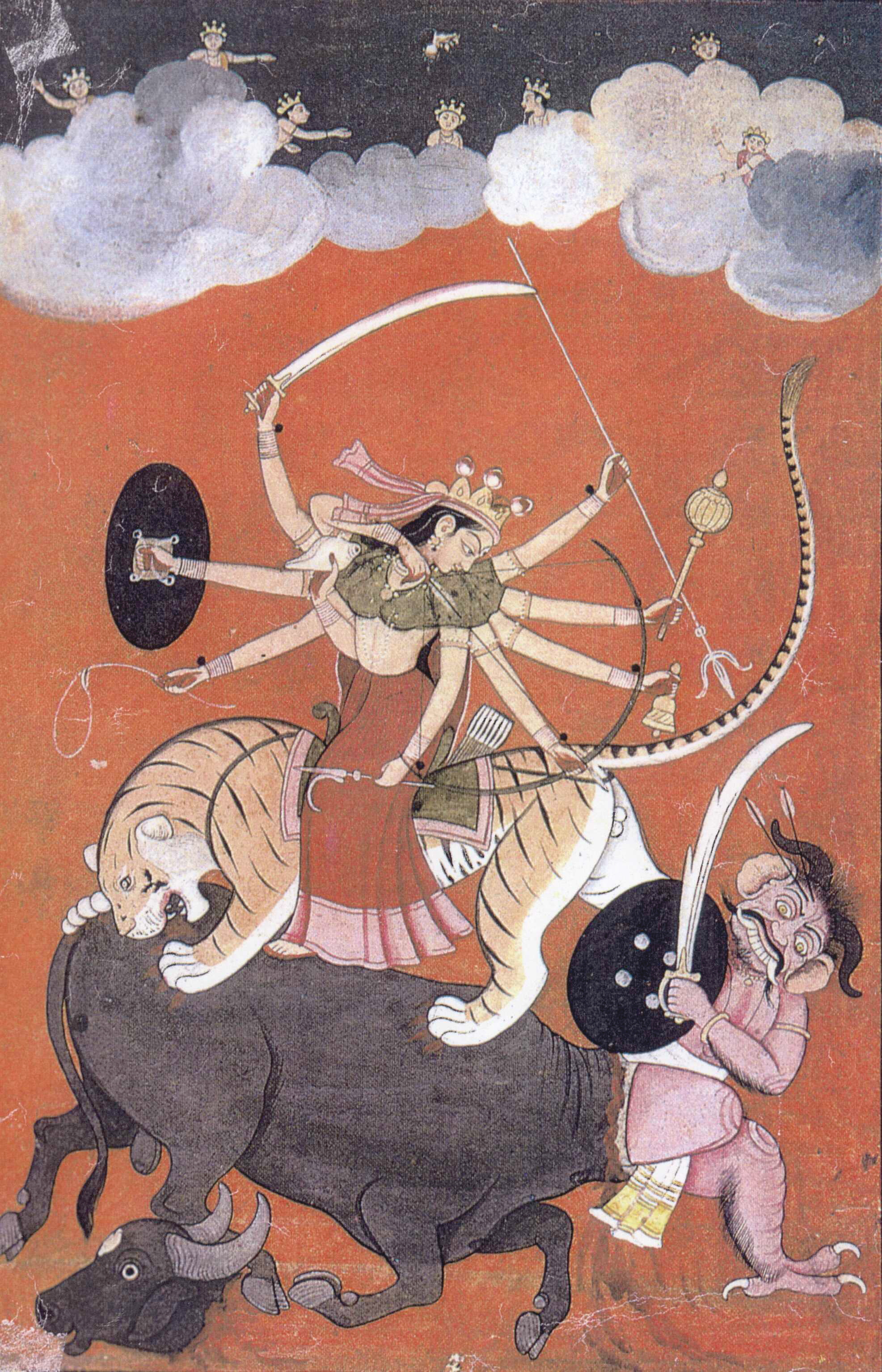
This time the gods in their eternal struggle against the demons asuras cannot win. Powerful weapons, bloody battles, ingenious stratagems cannot eliminate the powerful buffalo Mahisha and its endless hordes of savage warriors.
Only the sum of their energies and their weapons will be concentrated will can prevail against Mahisa. Here comes Durga, the more powerful, ruthless, cruel god of Hinduism along with Kali who - according to some traditions - was born out of an eyebrow of Durga.
Shiva gift  his own trishula, Vishnu chakra, Agni the arrow of fire, Vayu the bow, Indra the thundhier, Kubera the bat, Yama the spear. For this Durga has many arms, up to thirty-two. Hes vahana, the vehicle which she uses  to move, is the tiger and more often lion, for this she is also known as Simhavahini (Simha = Lion).
Durga is beautiful and she isn't - like the other goddesses - the Shakti that is the energy of a particular god, but it is the sum of the energies of all the gods. Durga has no spouse even if the different traditions seek to associate now to a god now to another.
So armed Durga is launched against the buffalo, hits him, but he turns into a lion, and she strikes again turns into an elephant, and catching her with its proboscite. The goddess then with a clean blow knocks his proboscite and Mahisha turns back buffalo, the goddess - enhanced by the intoxicating drink soma - hits the monster to death and at the end from the mouth of the buffalo get out the demon in his human form. A huge and powerful warrior with a sword. Durga does not scare Mahisa and hits his heart with the trident, the Shiva's trishula.
It was the tenth day of battle and Durga had killed Mahisha finally, for this she is also called Mahishasuramardini, the one who killed Mahisha and that day is considered to be dedicated to her, is the Vijaya Dashami.
The goddess is worshiped all over India especially during the festivals of Durga Puja.
For her fighting and winning  nature she was also taken as a symbol of independent and free India.

Durga, l'inaccessibile

Durga uccide Mahisha
Questa volta gli dèi, nella loro eterna lotta contro i demoni asura non ce la fanno. Armi potentissime, battaglie cruente, stratagemmi ingegnosi non riescono ad eliminare il potente bufalo Mahisha e le sue infinite schiere di selvaggi guerrieri.
Soltanto la somma delle loro energie e delle loro armi concentrata in un unico essere potrà avere la meglio contro Mahisha. Ecco che nasce Durga, la più potente, spietata, cruenta divinità dell'induismo insieme a Kali che - secondo certe tradizione - nasce proprio da un sopraciglio di Durga.
Shiva dono' il proprio trishula, Vishnu il chakra, Agni la freccia di fuoco, Vayu l'arco, Indra il tuono, Kubera la mazza, Yama la lancia. Per questo Durga ha molte braccia, fino a trentadue. Il suo vahana, il veicolo che utilizza per muoversi, è la tigre, più spesso il leone e per questo è anche conosciuta come Simhavahini (simha = leone).
Durga è bellissima e non è - come le altre divinità femminili - la shakti cioè l'energia di un particolare dio, ma è la somma delle energie di tutti gli dei. Durga non ha sposo anche se le varie tradizioni cercano di associarla ora a un dio ora ad un altro.
Così armata Durga si lancia contro il bufalo, lo colpisce, ma lui si trasforma in leone, di nuovo la colpisce e lui si trasforma in elefante e la cattura con la sua proboscite. La dea allora con un colpo netto gli stacca la proboscite e Mahisha si trasforma nuovamente in bufalo, la dea - rafforzata dalla bevanda inebriante soma - colpisce a morte il mostro e alla fine dalla bocca del bufalo esce l'asura nella sua forma umana. Un enorme e potente guerriero armato di spada. Durga non si fa intimorire e colpisce Mahisha al cuore con il tridente, il trishula di Shiva. Si era al decimo giorno di combattimento e Durga aveva finalmente ucciso Mahisha, per questo è chiamata anche Mahishasuramardini, Colei che uccise Mahisha e quel giorno è considerato a lei dedicato, è il Vijaya Dashami.
La dea è venerata in tutta l'India soprattutto durante le feste del Durga Puja.
Per il suo carattere combattivo e vincente è stata anche assunta a simbolo dell'India indipendente e libera.

venerdì 22 luglio 2011

Kali

Kali
Black, with red tongue hanging from her mouth, a necklace of 50 (or 52) skulls, a skirt of severed arms, one hand holding a bloody sword, a severed head in the other one, drunk with wine and blood, his body and his face is covered with blood, dancing furiously on the body of a man and living near the funeral pyres. She is Kali, the Black, the power of time, the destructive aspect of the goddess.
Only she was able to kill Raktabija the demon against whom the Gods had signed the final showdown.
But Raktabija - as his name (in Sanskrit 'rakta' means 'blood' and ‘bija’ ‘seed’) - seemed invincible as soon as a drop of his blood touched the ground another demon arose, and so ad infinitum.
Then from the eyebrow of Durga, Kali was born, the night supreme devouring all that exists, the time destroing the worlds, the one who inspires fear, in fact the one who embodies all the fears you, but who ignores the fear.
With his mouth she drank the blood Raktabija avoiding touching the ground and then she cut cleanly through the head of the demon, just the head in her left hand.
But the thirst for blood, violence, death has now made drunk the goddess, she cannot stop herself, she no longer distinguishes the enemies from friends, the good from the bad, and all kills, destroys everything. Only Shiva, her husband, can stop her jumping on her. Kali wants to kill Shiva too, but when she recognizes her husband, she stops. He is on the ground, seems helpless and defenseless, the foot of the goddess is on his chest. Even Shiva, without his own shakti, his energy is inert.
Prearyan divinity, probably dravidian, Kali is worshiped by reciting the mantra Krim and sacrificing live animals.
A big festival in honor of Kali is held in the month of Ashvin (late September), it is Navaratri, the nine nights that remind the nine days of the year in which Shiva allows his wife to travel from his mother.
Kali is regarded as a terrible aspect of the goddess Parvati, but also as an independent deity having a benevolent aspect and terrible in keeping with the ambivalence of deity, which manifests itself, according to Hindu tradition, in continuous cycle of life and death, creation and destruction.

Kali

Kali
Nera, con la lingua rossa che le pende dalla bocca, una collana composta da 50 (o 52) teschi, un gonnellino di braccia mozzate, con una mano tiene una spada insanguinata, con l’altra una testa mozzata, ebbra di vino e di sangue, il suo corpo è sporco di sangue, danza furiosamente sul corpo di un uomo e risiede nei pressi delle pire funerarie. E’ Kali, la nera,  la potenza del tempo, l’aspetto distruttivo della dea.
Solo lei fu in grado di uccidere Raktabija, il demone contro il quale gli dei avevano ingaggiato lo scontro finale.
Ma Raktabija – come dice il suo nome (in sanscrito ‘rakta’ significa ‘sangue’ e ‘bija’ ‘seme’) – sembrava invincibile in quanto appena una goccia del suo sangue toccava terra nasceva un altro demone e così all’infinito.
Dal sopracciglio di Durga allora, nacque Kali, la notte suprema che divora tutto ciò che esiste, il tempo che distrugge i mondi, colei che incute paura, anzi incarna tutte le paure lei, ma che ignora la paura.
Con la sua bocca bevve tutto il sangue di Raktabija evitando che toccasse terra e poi tagliò di netto la testa al demone, proprio quella testa che tiene nella mano sinistra.
Ma la sete di sangue, di violenza, di morte ha ormai reso ebbra la dea che più non si ferma, che non distingue più i nemici dagli amici, i buoni dai cattivi e tutti uccide, tutto distrugge. Solo Shiva, il suo sposo, riesce a fermarla gettandosi su di lei. Kali vorrebbe uccidere anche Shiva, ma quando riconosce il suo sposo, si ferma. Lui è a terra, sembra indifeso ed inerme, il piede della dea è sul suo torace. Anche Shiva, senza la sua shakti, la sua energia è inerte.
Divinità preariana probabilmente di origine dravidica, Kali viene venerata recitando il mantra KRIM e sacrificandole animali vivi.
Una grande festa in onore di Kali si svolge nel mese di Ashvin (fine settembre), si tratta di Navaratri, le nove notti che ricordano i nove giorni dell’anno in cui Shiva consente a suo moglie di recarsi dalla propria madre.
Kali è considerata come aspetto terribile della dea Parvati, ma anche come divinità autonoma a se stante che ha sia un aspetto benevolo sia un aspetto terribile coerentemente con l'ambivalenza della divinità, che si manifesta, secondo la tradizione induista, nell' incessante ciclo di vita e morte, creazione e distruzione.