venerdì 5 giugno 2015

Il Panchamakara e il tantrismo

Nell’induismo è centrale il dilemma che riguarda la realtà fenomenica: luogo immaginario creato dall’illusione di maya dal quale fuggire per raggiungere la liberazione o strumento attraverso il quale necessariamente passare per interrompere il ciclo delle rinascite, il samsara?
Questo dilemma, che pare una contraddizione incolmabile, è risolto in modo forse inusuale nel tantrismo. Non si tratta di una religione a sè stante, ma di un approccio, di un metodo prevalentemente rituale col quale si vive e si pratica l’induismo.
Non eliminare il reale, ma sublimarlo. Non eliminare i desideri astenendosi da essi, ma soddisfacendoli in modo rituale fino al parossismo.  
Il Panchamakara è il rituale delle "5 M", i cinque elementi che iniziano appunto con la lettera M. Si tratta di:
madya, il vino o altra bevanda inebriante
mamsa, la carne
matsya, il pesce
mudra, chicchi di grano
maithuna, l’unione sessuale
E così, mentre per l’induismo più classico il raggiungimento della liberazione passa attraverso l’astensione da questi cinque elementi, il tantrismo prevede un’esaltazione di tutte queste energie. Le funzioni del bere, del mangiare, del procreare che in genere legano l’uomo all’illusione di maya e quindi lo allontanano dalla liberazione, vengono elevate a un piano superiore, sublimate compiendole in maniera rituale talvolta anche solo simbolica.

lunedì 4 maggio 2015

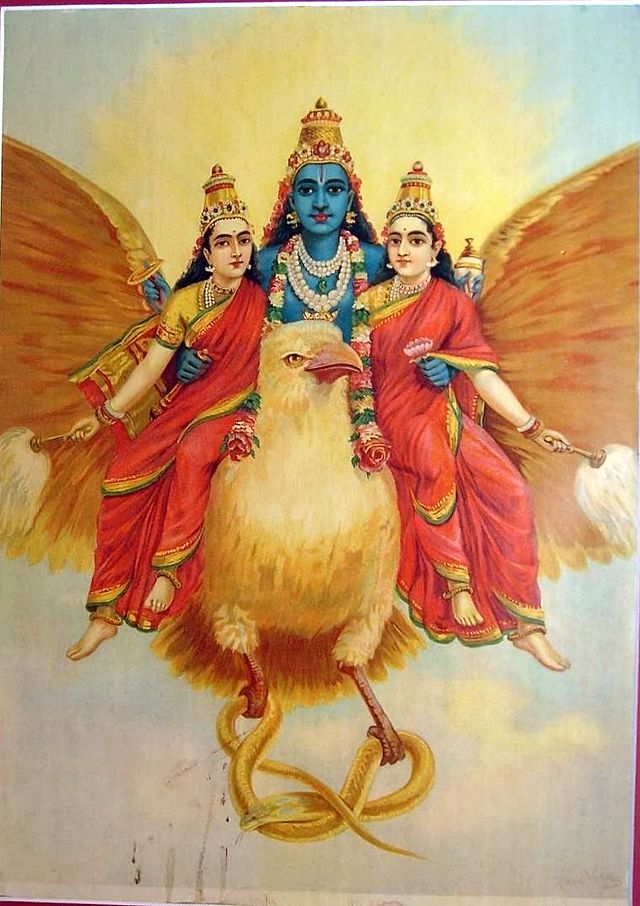
Jaya, Vijaya and four Kumaras

"Garuda Vahan Vishnu," from the Ravi Varma studio, c.1910's Source- ebay, Oct. 2009.jpg
Vishnu with Garuda
Sanaka, Sanandana, Sanatana, and Sanatkumara were the Kumaras, the four beings born from the mind of Brahma at the origin of the creation.

One day the Kumara decided to go to pay homage to Vishnu and presented themselves to the gate of Vaikuntha, the kingdom of God.
The Kumaras, thanks to their meditation and a gift given to them by Brahma, they always look like children, kumara in Sanskrit means in fact child.
When Jaya and Vijaya, who were guarding the gates of Vaikuntha, saw these four children, they blocked their passage, saying that Vishnu was resting and could not be bothered.
The Kumaras replied that Vishnu always had time for his own devotees and that no one could stop them. But Jaya and Vijay were adamant.
The Kumaras then decided to teach a lesson to those two guards and threw them a curse would be reborn on earth as mortal beings.
The two realized their mistake too late, then they went to Vishnu to be loose from the curse.
"You know that no one can be dissolved by a curse when it was launched - said Vishnu - so you have to be born as mortals. I give you, however, two alternatives: you can be born seven times as my devotees or you can be born as my enemies, but only three times."
Jaya and Vijaya much thought to the two alternatives. Finally, they decided to be born just three times as enemies of Vishnu, because they could not think of being separated from God for seven long earthly lives.
The first time Jaya and Vijaya were born as Hiraneyaksha and Hiraneyakashyipu in Satya Yuga. Hiranyaksha was a asura, a demon who was killed by Vishnu came to earth as Varaha, the boar lifted the earth from the cosmic ocean floor. While Hiranyakasipuvenne killed by Narasimha, also avatar of Vishnu.
Jaya and Vijaya were born then as Ravana and Kumbhakarna in Treta yuga and were killed by Vishnu in his avatar of Rama and Lakshmana.
Jaya and Vijaya finally finally born in Dwapara Yuga as Sisupala and Dantavakra and were killed by Balarama and Krishna, avatar of the god Vishnu.
Jaya and Vijaya then had three times as enemies of Vishnu and three times they were killed by avatars of the great God. 

At the end of their third life, they obtained the liberation and came back to the doors of Vaikhunta.


Jaya, Vijaya e i quattro Kumara

"Garuda Vahan Vishnu," from the Ravi Varma studio, c.1910's Source- ebay, Oct. 2009.jpg
Vishnu su Garuda
Sanaka, Sanandana, Sanatana e Sanatkumara erano i Kumara, i quattro esseri nati dalla mente di Brahma all’origine della creazione.
Un giorno i Kumara decisero di andare a rendere omaggio a Vishnu e si presentarono alle porta del Vaikuntha, il regno del Dio.
I Kumara, grazie alla loro meditazione ed ad un dono concesso loro da Brahma, avevano sempre l’aspetto di bambini, kumara in sanscrito significa infatti bambino.
Quando Jaya e Vijaya, che facevano la guardia alle porte del Vaikuntha, videro questi quattro bambini, bloccarono loro il passaggio, dicendo che Vishnu stava riposando e non poteva essere disturbato.
I Kumara replicarono che Vishnu aveva sempre tempo per i suoi devoti e che nessuno poteva fermarli. Ma Jaya e Vijay furono irremovibili.
I Kumara allora decisero di dare una lezione a quei due guardiani e lanciarono loro una maledizione: sarebbero rinati sulla terra come esseri mortali.
I due si resero conto del loro errore troppo tardi, si recarono quindi da Vishnu per essere sciolti dalla maledizione.
“Sapete che nessuno può essere sciolto da una maledizione quando questa è stata lanciata – rispose Vishnu – quindi dovrete nascere come mortali. Vi dó però due alternative:  potete nascere per sette volte come miei devoti oppure potete nascere come miei nemici, ma solo per tre volte.”
Jaya e Vijaya pensarono molto alle due alternative. Alla fine decisero di nascere tre volte come nemici di Vishnu, perché non potevano pensare di essere separati dal dio per sette lunghe vite terrene.
La prima volta Jaya e Vijaya nacquero come Hiraneyaksha e Hiraneyakashyipu nel Satya Yuga. Hiranyaksha era un demone, un asura che fu ucciso da  Vishnu dopo sceso in terra sotto forma di Varaha, il cinghiale che sollevò la terra dal fondo dell’oceano cosmico. Mentre Hiranyakasipuvenne ucciso da Narasimha, anch’esso avatar di Vishnu.
Jaya e Vijaya nacquero poi come Ravana e Kumbhakarna ne Treta-yuga e vennero uccisi da Vishnu nei suoi avatar di Rama e Lakshmana.
Jaya e Vija infine alla fine nacquero nel Dwapara Yuga come Shishupala e Dantavakra e vennero uccisi da Krishna e Balarama, avatar del dio Vishnu.
Jaya e Vijaya quindi nacquero tre volte come nemici di Vishnu e per tre volte vennero uccisi da avatar del grande dio. Al termine della loro terza vita, ottennero la liberazione e tornarono alle porte del  Vaikhunta.


domenica 8 marzo 2015

Ten Mahavidyas

Chinnamasta
The Mahavidyas are the ten goddesses representing the transcendent knowledge (maha = great, vidya = knowledge), the ten aspects of the great goddess, the ten types of shakti, of Shiva's energy, and the energy of the whole universe, of microcosm and macrocosm which govern the whole existence.
These deities - venerated especially in Tantrism - represent everything that can be known. The one is from the other and represent all the phenomenal world, from its creation to its dissolution.
It is Kali, the black, the absolute night, the passage of time, the destruction.
Tara, the embryo from which the universe is born, the one who creates the space, the emptiness and the need to fill it, the hunger and the need to feed that is characteristic of all that is created: to exist you have to devour another existence and so on.
Sodashi, the sixteen year old girl, (Sodashi in Sanskrit means 'sixteen') the age of perfection, a full cycle of the moon from new moon to full moon.
Chinnamasta yantra color.jpg
Chinnamasta Yantra
Bhuvaneshvari, the queen of the world, the one who rules the world.
Chinnamasta, the decapitated, she who presides over the ritual sacrifice. The terrible goddess holding a bloody knife in one hand and in the other her own head drinking the blood gushing from the severed neck.
Bhairavi, the terrible, the goddess of terror, the one who presides over the death and dissolution. The goddess of desire that leads to the dissolution of the body.
Dhumavati, the goddess steaming, what remains of the universe destroyed by the fire of dissolution. Nothing remains, only smoke. And 'the goddess of poverty, misfortune, illness. His vahana is an ass.
Bagala, the goddess with the head of the crane, the goddess of hatred, jealousy, cruelty, black magic and poisons.
Matangi, the dominatrix, the power of the elephant symbol of royalty. Restore peace, tranquility.
Kamala, the maiden lotus, the one who gives joy. Pure self-consciousness, found unity.

Le dieci Mahavidya

Chinnamasta devi.jpg
Chinnamasta
Le Mahavidya sono le dieci dee che rappresentano la conoscenza trascendente (maha = grande, vidya = conoscenza), i dieci aspetti della grande dea, le dieci tipologie della sakti di Shiva, l’energia del grande dio e l’energia di tutto l’universo, microcosmo e macrocosmo di cui regolano l’intera esistenza.
Queste divinità - venerate soprattutto nel tantrismo -  rappresentano tutto ciò che può essere conosciuto. L’una sorge dall’altra e rappresentano tutto il mondo fenomenico dalla sua creazione alla sua dissoluzione.
Si tratta di Kali, la nera, la notte assoluta, lo scorrere del tempo, la distruzione.
Chinnamasta yantra color.jpg
Lo yantra di Chinnamasta
Tara, l’embrione dal quale nascerà l’universo, colei che crea lo spazio, il vuoto e la necessità di riempirlo, la fame e la necessità di nutrirsi che è caratteristica di tutto ciò che è creato: per esistere devi divorare un’altra esistenza e così via.
Sodashi, la ragazza sedicenne, (sodashi in sanscrito significa 'sedici') l’età della perfezione, un ciclo completo della luna dal novilunio al plenilunio.
Bhuvaneshvari, la regina del mondo, colei che regge il mondo.
Chinnamasta, la decapitata, colei che presiede il sacrificio rituale. La terribile dea che tiene in una mano un coltello insanguinato e nell’altra la propria testa che beve il sangue che zampilla dal collo reciso.
Bhairavi, la terribile, la dea del terrore, colei che presiede alla morte e alla dissoluzione. La dea del desiderio che porta alla dissoluzione del corpo.
Dhumavati, la dea fumante, ciò che resta dell’universo distrutto dal fuoco della dissoluzione. Non resta niente, solo fumo. E’ la dea della povertà, della sfortuna, della malattia. Suo vahana è un asino.
Bagala, la dea dalla testa di gru, la dea dell’odio, della gelosia, della crudeltà, della magia nera e dei veleni.
Matangi, la dominatrice, potenza dell’elefante simbolo di regalità. Riporta la pace, la tranquillità.
Kamala, la fanciulla del loto, colei che dona gioia. Pura coscienza di sé, unità ritrovata.

sabato 7 febbraio 2015

Rangoli

Kolam for Lingam
Rangoli for Onam

They are called rangoli or kolam or in many other ways depending on the area of India (Kolam in Tamil Nadu; Mandana in Rajasthan; Alpana in West Bengal; Aripana in Bihar; Chowk Pujan in Uttar Pradhesh; Muggu in Andhra Pradhesh; Golam kolam or Kalam in Kerala; Chaookpurna in Chhattisgarh).
They are auspicious drawings used mainly in the south of India.
Rangoli for Nandin
There are motifs of various sizes, some very simple other particularly elaborate, which are made on the sidewalk in front of the entrances of the houses, on the threshold, in homes and temples or before the image (murti) of the deities.
They are generally made every morning by the women as if that activity was a kind of prayer or even a form of meditation, especially in the case of more elaborate rangoli which require more time to be realized.
There  generic rangoli, others driving away bad luck, others purely ornamental, and then there are rangoli specific for a particular deity or a special feast.
Colorful rangoli
As with everything in India, there are specific rules and textbooks that provide examples, sizes, colors, times and meanings of these interesting designs.
They can be made with rice flour, but also chalk, sand or even flower petals as the one I photographed in Kerala during Onam Festival (photo top right).
In India sell pieces of bamboo canes properly drilled, within which is poured flour or sand. Rolling on the floor bamboo, flour coming out from the holes consists of beautiful rangoli.


Rangoli

Rangoli per Onam - Kerala
Kolam innanzi al Lingam
Si chiamano rangoli o kolam o in tanti altri modi a secondo della zona dell'India (Kolam in Tamil Nadu; Mandana in Rajasthan; Alpana in West Bengal; Aripana in Bihar; Chowk Pujan in Uttar Pradhesh; Muggu in Andhra Pradhesh; Golam kolam o Kalam in Kerala; Chaookpurna in Chhattisgarh).
Sono disegni beneauguranti utilizzati soprattutto nel sud dell'India.
Un rangoli per Nandin
Si tratta di motivi ornamentali di varie dimensioni, alcuni molto semplici altri particolarmente elaborati, che vengono realizzati sul marciapiede davanti agli ingressi delle abitazioni, sulle soglie, all'interno delle case e dei templi o davanti all'immagine (murti) delle divinità.
In genere vengono realizzati ogni mattina dalle donne come se quell'attività fosse una specie di preghiera o anche una forma di meditazione soprattutto nel caso di rangoli più elaborati che richiedono più tempo per essere realizzati.
Un altro kolam per il Lingam
Esistono rangoli generici, altri che scacciano la sfortuna, altri puramente ornamentali, e poi esistono rangoli specifici per una determinata divinità o una festa particolare.
Rangoli colorato
Come per tutto in India, esistono precise regole e libri di testo che forniscono esempi, misure, colori, tempi e significati di questi interessanti disegni.
Possono essere realizzati con farina di riso, ma anche gesso, sabbia o anche petali di fiori come quello che ho fotografato in Kerala durante la Festa di Onam (foto in alto a destra).
In India vendono anche pezzi di canne di bambù opportunamente forate, all'interno delle quali viene versata la farina o la sabbia. Rotolando in terra il bambù, la farina che esce dai fori compone dei bellissimi rangoli