sabato 14 novembre 2015

What I'm doing

I'm planning my next trip to India. I just finished the powerful and controversial book "Hindu" of Wendy Doniger and now I'm reading "Delhi" of Rana Dasgupta (Ed. Feltrinelli) and the Bhagavad Gita with commentary by Sri Sankara (Ed. Luni).

The trip: Mumbai, Aurangabad, Ellora and Ajanta, Nasik, Cochin. Starting on December 27, returning on January 11. Plane, train and car.

"Hindu" is a book that gives a lot of information, but that is simplistic purporting to tell the India story (alternative) from sources, 50 million years ago, to the Indian diaspora in the United States. The pages are so many (776), but not enough to avoid the sin of superficiality. However, it is a very interesting read and informative although some theories seem a little weird.

The book "Delhi" are just beginning (pages 140 to 443), it is therefore too early to make a judgment, however, it reads very well.
The commentary of Sankara the Gita is more challenging, in some places almost incomprehensible, but very nice. You have to read slowly and meditate.

Cosa sto facendo

Sto programmando o, meglio, organizzando il mio prossimo viaggio in India. Ho appena terminato il poderoso e controverso libro "Hindu"
di Wendy Doniger e ora sto leggendo "Delhi" di Rana Dasgupta (Ed. Feltrinelli) e la Bagavad Gita col commento di Sri Sankara (Ed. Luni).
Il viaggio: Mumbai, Aurangabad, Ellora e Ajanta, Nasik, Cochin. Partenza il 27 dicembre, rientro l'11 gennaio. Mezzi di trasporto, aereo, treno e auto.
"Hindu" è un libro che fornisce molte informazioni, ma che pecca di superficialità pretendendo di narrare la storia (alternativa) dell'India dalle origini, 50 milioni di anni fa, alla diaspora indiana negli Stati Uniti. Le pagine sono tante (776), ma non sufficienti ad evitare il peccato di superficialità. Comunque è una lettura molto interessante e istruttiva anche se certi terorie mi sembrano un po' campate per aria.
Del libro "Delhi" sono appena all'inizio (140 pagine su 443), è quindi presto per dare un giudizio, comunque si legge molto bene. 
Il commento di Sankara alla Gita è più impegnativo, in certi punti quasi incomprensibile, ma molto bello. Bisogna leggere lentamente e meditare.

domenica 4 ottobre 2015

Chinnamasta, the self-decapiting Goddess


Goddess Parvati was bathing in the cool waters of the river Mandakini, when her two attendends Dakini and Varnini, also known as Jaya and Vijaya, told her that they were hungry and wanted to eat.
The Goddess asked them to wait, but they  insisted the same lot.
Parvati then with the nail of his thumb (or with a sword) cut cleanly through her own head and it fell on her hand.
Severed neck began to flow three spurts of blood that fell directly into the mouth of Dakini and Varnini, while the third went to the mouth of Parvati same.
Was born Chinnamasta or Chinnamundi, the "goddess headless" (in Sanskrit 'chinna' means 'separate' and 'masta' means 'head').
Chinnamasta is one of the ten Mahavidyas I mentioned in this post.
The iconography (see photo) generally rapresents her as a woman holding her head on a hand and neck severed three springs gush of blood that are consumed by the two maids and her own head.
The  Goddess is represented above a man and a woman in the sexual act, they are the God of love, Kama, and his wife Rati, the Goddess of sexual desire.
The neck of the goddess is adorned with skulls and human heads.
The meaning of this deity is controversial.
For more traditional Hinduism, the goddess refers to Vedic sacrifice after which the sacrificial victim was decapitated and to the idea according to which life is born from death in a circular path powered.
The separation of the head from the body and overpower the two deities of desire, also  symbolize detachment from material things, the phenomenal reality and, above all, the ability to control sexual desire, emblematic symbol of all that hinders the attainment of liberation.
In Tantrism instead the meaning of the Goddess is different.
The blood gushing represent the kundalini, the energy that resides in the last chakra of our body and that goes back to the head. In tantric ritual it is in fact central consumption of body fluids. Energy is awakened from its wish-fulfillment represented by the sexual Kama and Rati that then they would not be submissive position, but would be the basis of energy Chinnamasta.


Chinnamasta, la Dea senza testa

La Dea Parvati stava facendo il bagno nelle fresche acque del fiume Mandakini, quando le sue due ancelle, Dakini e Varnini, conosciute anche come Jaya e Vijaya, le dissero che avevano fame e che volevano mangiare. 
La Dea chiese loro di attendere, ma le stesse insistettero molto. 
Parvati allora con l'unghia del suo dito pollice (o con una spada) si tagliò di netto la testa che le cadde sulla mano destra. 
Dal collo mozzato cominciarono a sgorgare tre zampilli di sangue che caddero direttamente nella bocca di Dakini e Varnini, mentre il terzo andò nella bocca di Parvati stessa. 
Era nata Chinnamasta o Chinnamundi, la "dea senza testa" (in sanscrito 'chinna' significa 'separato' e 'masta' significa 'testa').
Chinnamasta è una delle dieci Mahavidya di cui ho parlato in questo post.
L'iconografia (vedi foto sopra) generalmente la rappresenta come una donna che tiene su una mano la propria testa mentre dal collo mozzato sgorgano tre zampilli di sangue che vengono bevuti dalle due ancelle e dalla sua stessa testa.. 
La Dea è rappresentata sopra un uomo e una donna nell'atto sessuale, sono il Dio dell'Amore, Kama, e sua moglie Rati, la Dea del desiderio sessuale. 
Il collo della dea è ornato di crani o teste umani.
Il significato di questa divinità è controverso.
Per l'induismo più tradizionale, la Dea rimanda al sacrificio vedico al termine del quale la vittima sacrificale veniva decapitata e alla concezione in base alla quale la vita nasce dalla morte in un percorso circolare autoalimentato.
La separazione della testa dal corpo ed il sovrastare le due divinità del desiderio, simboleggerebbero inoltre il distacco dalle cose materiali, dalla realtà fenomenica e, soprattutto, la capacità di controllare il desiderio sessuale, simbolo emblematico di tutto ciò che ostacola il raggiungimento della liberazione.
Nel tantrismo invece il significato della Dea è di tuttaltro tenore. 
Il sangue zampillante rappresenterebbe la kundalini, l'energia che risiede nell'ultimo chakra del nostro corpo e che risale fino alla testa. Nel rituale tantrico è infatti centrale il consumo dei fluidi corporali. L'energia è risvegliata proprio dal soddisfacimento del desiderio rappresentato dall'atto sessuale di Kama e Rati che quindi non sarebbero in posizione sottomessa, ma sarebbero la base energetica di Chinnamasta.


venerdì 5 giugno 2015

Il Panchamakara e il tantrismo

Nell’induismo è centrale il dilemma che riguarda la realtà fenomenica: luogo immaginario creato dall’illusione di maya dal quale fuggire per raggiungere la liberazione o strumento attraverso il quale necessariamente passare per interrompere il ciclo delle rinascite, il samsara?
Questo dilemma, che pare una contraddizione incolmabile, è risolto in modo forse inusuale nel tantrismo. Non si tratta di una religione a sè stante, ma di un approccio, di un metodo prevalentemente rituale col quale si vive e si pratica l’induismo.
Non eliminare il reale, ma sublimarlo. Non eliminare i desideri astenendosi da essi, ma soddisfacendoli in modo rituale fino al parossismo.  
Il Panchamakara è il rituale delle "5 M", i cinque elementi che iniziano appunto con la lettera M. Si tratta di:
madya, il vino o altra bevanda inebriante
mamsa, la carne
matsya, il pesce
mudra, chicchi di grano
maithuna, l’unione sessuale
E così, mentre per l’induismo più classico il raggiungimento della liberazione passa attraverso l’astensione da questi cinque elementi, il tantrismo prevede un’esaltazione di tutte queste energie. Le funzioni del bere, del mangiare, del procreare che in genere legano l’uomo all’illusione di maya e quindi lo allontanano dalla liberazione, vengono elevate a un piano superiore, sublimate compiendole in maniera rituale talvolta anche solo simbolica.

lunedì 4 maggio 2015

Jaya, Vijaya and four Kumaras

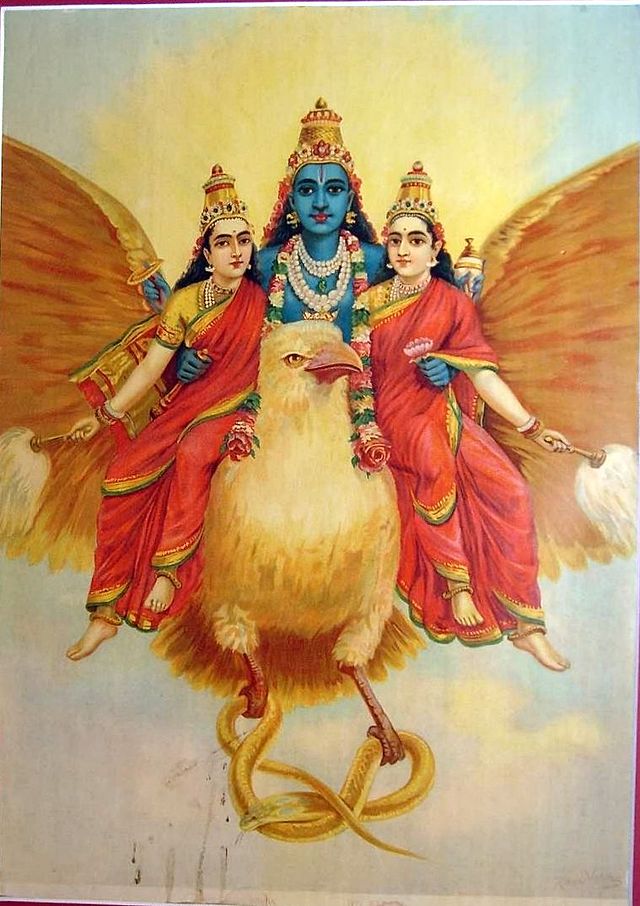
"Garuda Vahan Vishnu," from the Ravi Varma studio, c.1910's Source- ebay, Oct. 2009.jpg
Vishnu with Garuda
Sanaka, Sanandana, Sanatana, and Sanatkumara were the Kumaras, the four beings born from the mind of Brahma at the origin of the creation.

One day the Kumara decided to go to pay homage to Vishnu and presented themselves to the gate of Vaikuntha, the kingdom of God.
The Kumaras, thanks to their meditation and a gift given to them by Brahma, they always look like children, kumara in Sanskrit means in fact child.
When Jaya and Vijaya, who were guarding the gates of Vaikuntha, saw these four children, they blocked their passage, saying that Vishnu was resting and could not be bothered.
The Kumaras replied that Vishnu always had time for his own devotees and that no one could stop them. But Jaya and Vijay were adamant.
The Kumaras then decided to teach a lesson to those two guards and threw them a curse would be reborn on earth as mortal beings.
The two realized their mistake too late, then they went to Vishnu to be loose from the curse.
"You know that no one can be dissolved by a curse when it was launched - said Vishnu - so you have to be born as mortals. I give you, however, two alternatives: you can be born seven times as my devotees or you can be born as my enemies, but only three times."
Jaya and Vijaya much thought to the two alternatives. Finally, they decided to be born just three times as enemies of Vishnu, because they could not think of being separated from God for seven long earthly lives.
The first time Jaya and Vijaya were born as Hiraneyaksha and Hiraneyakashyipu in Satya Yuga. Hiranyaksha was a asura, a demon who was killed by Vishnu came to earth as Varaha, the boar lifted the earth from the cosmic ocean floor. While Hiranyakasipuvenne killed by Narasimha, also avatar of Vishnu.
Jaya and Vijaya were born then as Ravana and Kumbhakarna in Treta yuga and were killed by Vishnu in his avatar of Rama and Lakshmana.
Jaya and Vijaya finally finally born in Dwapara Yuga as Sisupala and Dantavakra and were killed by Balarama and Krishna, avatar of the god Vishnu.
Jaya and Vijaya then had three times as enemies of Vishnu and three times they were killed by avatars of the great God. 

At the end of their third life, they obtained the liberation and came back to the doors of Vaikhunta.


Jaya, Vijaya e i quattro Kumara

"Garuda Vahan Vishnu," from the Ravi Varma studio, c.1910's Source- ebay, Oct. 2009.jpg
Vishnu su Garuda
Sanaka, Sanandana, Sanatana e Sanatkumara erano i Kumara, i quattro esseri nati dalla mente di Brahma all’origine della creazione.
Un giorno i Kumara decisero di andare a rendere omaggio a Vishnu e si presentarono alle porta del Vaikuntha, il regno del Dio.
I Kumara, grazie alla loro meditazione ed ad un dono concesso loro da Brahma, avevano sempre l’aspetto di bambini, kumara in sanscrito significa infatti bambino.
Quando Jaya e Vijaya, che facevano la guardia alle porte del Vaikuntha, videro questi quattro bambini, bloccarono loro il passaggio, dicendo che Vishnu stava riposando e non poteva essere disturbato.
I Kumara replicarono che Vishnu aveva sempre tempo per i suoi devoti e che nessuno poteva fermarli. Ma Jaya e Vijay furono irremovibili.
I Kumara allora decisero di dare una lezione a quei due guardiani e lanciarono loro una maledizione: sarebbero rinati sulla terra come esseri mortali.
I due si resero conto del loro errore troppo tardi, si recarono quindi da Vishnu per essere sciolti dalla maledizione.
“Sapete che nessuno può essere sciolto da una maledizione quando questa è stata lanciata – rispose Vishnu – quindi dovrete nascere come mortali. Vi dó però due alternative:  potete nascere per sette volte come miei devoti oppure potete nascere come miei nemici, ma solo per tre volte.”
Jaya e Vijaya pensarono molto alle due alternative. Alla fine decisero di nascere tre volte come nemici di Vishnu, perché non potevano pensare di essere separati dal dio per sette lunghe vite terrene.
La prima volta Jaya e Vijaya nacquero come Hiraneyaksha e Hiraneyakashyipu nel Satya Yuga. Hiranyaksha era un demone, un asura che fu ucciso da  Vishnu dopo sceso in terra sotto forma di Varaha, il cinghiale che sollevò la terra dal fondo dell’oceano cosmico. Mentre Hiranyakasipuvenne ucciso da Narasimha, anch’esso avatar di Vishnu.
Jaya e Vijaya nacquero poi come Ravana e Kumbhakarna ne Treta-yuga e vennero uccisi da Vishnu nei suoi avatar di Rama e Lakshmana.
Jaya e Vija infine alla fine nacquero nel Dwapara Yuga come Shishupala e Dantavakra e vennero uccisi da Krishna e Balarama, avatar del dio Vishnu.
Jaya e Vijaya quindi nacquero tre volte come nemici di Vishnu e per tre volte vennero uccisi da avatar del grande dio. Al termine della loro terza vita, ottennero la liberazione e tornarono alle porte del  Vaikhunta.